

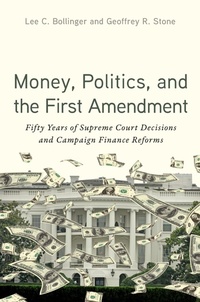
Money, Politics, and the First Amendment
Fifty Years of Supreme Court Decisions and Campaign Finance Reforms
Will be published approx. on 20. March 2026
Book
Paperback/Softback
440 pages
978-0-19-782191-6 (ISBN)
Description
Money in political campaigns is a subject of endless current interest and enormous consequence for American democracy. Beginning in 1976, in Buckley v. Valeo, the Supreme Court established a framework for public campaign regulation that declared that money constitutes "speech" and that the only constitutional basis upon which the government can regulate money was to prohibit corruption or the appearance of corruption. The Court then defined corruption narrowly and held that direct "contributions" to candidates could be limited on that basis but that "expenditures," by political candidates and others, could not. Over time as the role of money became more and more serious in politics the Court in a number of decisions seemed to be turning more willing to accept regulation. But in Citizens United v. Federal Election Commission, the new conservative Supreme Court sharply turned against permitting regulation, including of corporations.
Today that regime of nearly full protection for anyone spending virtually any amount of money for or against candidates and issues remains securely in place. The question, after a half century of this system, is whether this interpretation of the First Amendment is sound or not. If yes, then what are the justifications and what will be the consequences? If not, then what are alternative interpretations and what would the world be like under each one? The contributors, all scholars and experts in this area, give their interpretations and proposals.
Today that regime of nearly full protection for anyone spending virtually any amount of money for or against candidates and issues remains securely in place. The question, after a half century of this system, is whether this interpretation of the First Amendment is sound or not. If yes, then what are the justifications and what will be the consequences? If not, then what are alternative interpretations and what would the world be like under each one? The contributors, all scholars and experts in this area, give their interpretations and proposals.
More details
Language
English
Place of publication
New York
United States
Target group
Professional and scholarly
Product notice
Paperback (trade)
Unsewn / adhesive bound
Dimensions
Height: 234 mm
Width: 156 mm
Thickness: 25 mm
Weight
608 gr
ISBN-13
978-0-19-782191-6 (9780197821916)
Copyright in bibliographic data and cover images is held by Nielsen Book Services Limited or by the publishers or by their respective licensors: all rights reserved.
Schweitzer Classification
Other editions
Additional editions
Lee C. Bollinger | Geoffrey R. Stone
Money, Politics, and the First Amendment
Fifty Years of Supreme Court Decisions and Campaign Finance Reforms
Book
approx. 06/2026
Oxford University Press Inc
€133.50
Not yet published
Persons
Lee C. Bollinger served as Columbia University's 19th president from 2002 to 2023. He is Seth Low Professor of the University, a member of the Columbia Law School faculty, and one of the nation's foremost First Amendment scholars.
Geoffrey R. Stone is the Edward H. Levi Distinguished Service Professor at the University of Chicago. Mr. Stone joined the faculty in 1973, after serving as a law clerk to Supreme Court Justice William J. Brennan, Jr. He is a preeminent constitutional law scholar.
Geoffrey R. Stone is the Edward H. Levi Distinguished Service Professor at the University of Chicago. Mr. Stone joined the faculty in 1973, after serving as a law clerk to Supreme Court Justice William J. Brennan, Jr. He is a preeminent constitutional law scholar.
Content
- Opening Dialogue
- Part I. Introduction to the Supreme Court: Decisions on Campaign Finance Regulation
- 1: Richard Briffault: Buckley v. Valeo's Dubious yet Durable Contribution-Expenditure Distinction
- 2: Paul M. Smith: How Buckley v. Valeo Led Us Astray
- Part II. Critiques and a Defense of the Major Decisions
- 3: Erwin Chemerinsky and Alex Chemerinsky: Getting It Wrong: The Supreme Court and Campaign Finance
- 4: Diane P. Wood: Citizens United: Cracks in the Façade
- 5: Floyd Abrams: A Defense of Buckley v. Valeoand Citizens United v. FEC
- Part III. Campaign Finance and Race
- 6: Abby K. Wood: Race and Campaign Finance Deregulation
- Part IV. Recommendations for Legislation on Campaign Finance Reform
- 7: Sheldon Whitehouse: Money Talks, Dark Money Whispers: How Anonymous, Unlimited Political Spending Is Corrupting American Democracy
- 8: Amy Klobuchar;Stephen Spaulding: Elections in the Age of A.I.
- Part V. Arguments Interpreting The "Corruption" Rationale
- 9: Deborah Hellman: Corruption, Campaign Finance, and Criminal Law: Buckley's Legacy
- 10: Nicholas O. Stephanopoulos: Campaign Finance and "Real" Corruption
- 11: Lawrence Lessig: Buckley at 50: By What Right?
- Part VI. The Effect of Campaign Finance: On Political Institutions
- 12: Samuel Issacharoff: Buckley v. Valeo: Doctrinal Difficulties and Institutional Failure
- 13: Richard H. Pildes: Campaign Finance and Political Polarization
- 14: Michael S. Kang: Party Campaign Finance: From FECA To Modern Hyperpartisanship
- 15: Farris Peale;Guy-Uriel E. Charles: Plutocratic Democracy, Elon Musk, and the Limits of Campaign Finance Reform
- Part VII. The Relationship Between Campaign Finance and the State of American Democracy
- 16: David A. Strauss: A Political Question?: Partisan Gerrymandering, Campaign Finance Regulation, and the Supreme Court
- 17: Pamela S. Karlan: Without Buckley, Would American Democracy Really Be All That Different?
- 18: Nathaniel Persily: Campaign Finance and Contemporary Political Dysfunction
- Part VIII. A Comparative Approach to Campaign Finance
- 19: Mark Tushnet: Leveling The Playing Field: Insights from Comparative Constitutional Law
- Closing Statement
- Other Books by Bollinger and Stone