

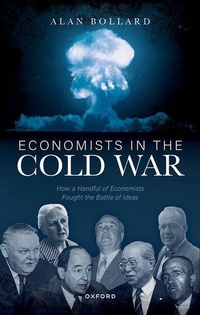
Economists in the Cold War
How a Handful of Economists Fought the Battle of Ideas
Published on 30. June 2023
Book
Hardback
384 pages
978-0-19-288739-9 (ISBN)
Description
Economists in the Cold War is an account of the economic drivers and outcomes of the Cold War, told through the stories of seven international economists, who were all closely involved in theory and policy in the period 1945-73. For them, the Cold War was a battle of economic ideas, a fight between central planning and market allocation, exploring economic thinking derived from the battle between Marxist and Capitalist ideologies, a fundamental difference but with many intricacies.
The book recounts how economic theory advanced, how new economic tools were developed, and how policies were tested. Each chapter is based on the involvement of one of the selected economists. It was a challenging but dangerous time in economics: a time of economic recovery post-war, with industrial rebuilding, economic growth, and rising incomes. But it was also a time of ideological warfare, nuclear rivalry, military expansion, and personal conflict.
The narrative is approximately chronological, ranging from the Potsdam Conference in Germany to the Pinochet Coup in Chile. The selected economists include an American, a Pole, a Hungarian, a German, a British, a Japanese, and an Argentinian, all very different economists, but with interconnections among them. Each chapter also features a dissenting economist who held a contrasting view, and recounts the subsequent economic arguments that played out.
The book recounts how economic theory advanced, how new economic tools were developed, and how policies were tested. Each chapter is based on the involvement of one of the selected economists. It was a challenging but dangerous time in economics: a time of economic recovery post-war, with industrial rebuilding, economic growth, and rising incomes. But it was also a time of ideological warfare, nuclear rivalry, military expansion, and personal conflict.
The narrative is approximately chronological, ranging from the Potsdam Conference in Germany to the Pinochet Coup in Chile. The selected economists include an American, a Pole, a Hungarian, a German, a British, a Japanese, and an Argentinian, all very different economists, but with interconnections among them. Each chapter also features a dissenting economist who held a contrasting view, and recounts the subsequent economic arguments that played out.
Reviews / Votes
This is a very interesting, well-written and informative book by an eminent New Zealand economist. * John King, The History of Economics Review * Alan Bollard, formerly Treasury Secretary, Reserve Bank Governor and Chairman of APEC, has written an insightful book exploring command vs demand approaches to the economy. * The Pundit * This volume is an interesting history of how the conflict between free market-oriented thinkers and central planning-oriented thinkers played out in the policies pursued by different countries during the Cold War. * Choice *More details
Language
English
Place of publication
Oxford
United Kingdom
Target group
Professional and scholarly
Illustrations
7 B&W illustrations
Dimensions
Height: 146 mm
Width: 224 mm
Thickness: 28 mm
Weight
666 gr
ISBN-13
978-0-19-288739-9 (9780192887399)
Copyright in bibliographic data and cover images is held by Nielsen Book Services Limited or by the publishers or by their respective licensors: all rights reserved.
Schweitzer Classification
Other editions
Additional editions
E-Book
06/2023
1st Edition
OUP eBook
€24.99
Available for download
E-Book
05/2023
1st Edition
OUP eBook
€24.99
Available for download
Person
Alan Bollard is a Professor of Economics at Victoria University of Wellington, New Zealand. He formerly managed APEC, the largest regional economic integration organization in the world, and was previously the New Zealand Reserve Bank Governor, Secretary of the New Zealand Treasury, and Chairman of the New Zealand Commerce Commission. Professor Bollard is the author of Economists at War (Oxford University Press, 2019) and A Few Hares to Chase: The Life and Economics of Bill Philips (Oxford University Press, 2016).
Content
1: Rebuilding the World: Harry Dexter White and the New Dealers
2: Making Central Planning Work: Oskar Lange and the Marxist-Leninists
3: The Cold War Hardens: John von Neumann and the Cold War Warriors
4: A Continental Middle Way: Ludwig Erhard and the Social Market Economists
5: Seeking Growth and Stability: Joan Robinson and the Post-Keynesians
6: East Asian Growth: Saburo Okita and the Flying Geese Economists
7: North-South Divide: Raul Prebisch and the Development Economists
8: Epilogue: El Encuentro en Santiago (Encounter in Santiago)
2: Making Central Planning Work: Oskar Lange and the Marxist-Leninists
3: The Cold War Hardens: John von Neumann and the Cold War Warriors
4: A Continental Middle Way: Ludwig Erhard and the Social Market Economists
5: Seeking Growth and Stability: Joan Robinson and the Post-Keynesians
6: East Asian Growth: Saburo Okita and the Flying Geese Economists
7: North-South Divide: Raul Prebisch and the Development Economists
8: Epilogue: El Encuentro en Santiago (Encounter in Santiago)