


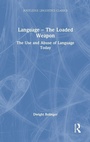
Language - The Loaded Weapon
The Use and Abuse of Language Today
1st Edition
Published on 28. September 2021
Book
Paperback/Softback
264 pages
978-1-032-04894-9 (ISBN)
Description
First published in 1980 and now reissued for the first time as a Routledge Linguistics Classic, Language - The Loaded Weapon is at once an introduction to and a critique of everything we know, or think we know, about language.
This classic text explains in simple terms the essentials of linguistic form and meaning, and applies them to illuminate questions touching on issues related to: correctness; truth; class and dialect; manipulation through advertising and propaganda; sexual and other discrimination; and official obfuscation and the maintenance of power. Bolinger notes that our deepest societal problems are entangled with language, raising questions such as: What kind of English should be taught, or should there be no standard at all? What are the verbal persuasions of technology doing to our children? Which way does information flow, what are its biases, when does it inform and when conceal, and who benefits? Are the people who consider themselves experts in these matters as expert as they pretend to be? In this seminal work, Bolinger addresses all of these concerns in a way which remains as relevant to us today as it was when it was first written.
With a new foreword by James Paul Gee, situating and contextualising the text in the present day, this book is essential reading for anyone with an interest in understanding how language has shaped the world we live in.
This classic text explains in simple terms the essentials of linguistic form and meaning, and applies them to illuminate questions touching on issues related to: correctness; truth; class and dialect; manipulation through advertising and propaganda; sexual and other discrimination; and official obfuscation and the maintenance of power. Bolinger notes that our deepest societal problems are entangled with language, raising questions such as: What kind of English should be taught, or should there be no standard at all? What are the verbal persuasions of technology doing to our children? Which way does information flow, what are its biases, when does it inform and when conceal, and who benefits? Are the people who consider themselves experts in these matters as expert as they pretend to be? In this seminal work, Bolinger addresses all of these concerns in a way which remains as relevant to us today as it was when it was first written.
With a new foreword by James Paul Gee, situating and contextualising the text in the present day, this book is essential reading for anyone with an interest in understanding how language has shaped the world we live in.
More details
Series
Language
English
Place of publication
London
United Kingdom
Publishing group
Taylor & Francis Ltd
Target group
College/higher education
Dimensions
Height: 234 mm
Width: 156 mm
Thickness: 14 mm
Weight
409 gr
ISBN-13
978-1-032-04894-9 (9781032048949)
Copyright in bibliographic data and cover images is held by Nielsen Book Services Limited or by the publishers or by their respective licensors: all rights reserved.
Schweitzer Classification
Other editions
Additional editions
Book
09/2021
1st Edition
Routledge
€207.80
Shipment within 10-20 days
E-Book
09/2021
1st Edition
Routledge
€52.49
Available for download
E-Book
09/2021
1st Edition
Routledge
€52.49
Available for download
Person
Dwight Bolinger (1907-1992) was Emeritus Professor of Romance Languages and Literature at Harvard University (1973-1992) and Visiting Emeritus Professor of Linguistics, Stanford University (1978-1992).
Content
Acknowledgements; Preface; Foreword to the Classic Edition; 1. Lo the shaman 2. The nonverbal womb 3. Signs and symbols 4. Above the word 5. Appointment in Babylon 6. Stigma, status, and standard 7. We reduced the size because we didn't want to increase the price 8. Guns don't kill people, people kill people 9. A case in point: sexism 10. Power and deception 11. Another case in point: the jargonauts and the not-so-golden fleece 12. Rival metaphors and the confection of reality 13. A last case in point: bluenoses and coffin nails 14. School for shamans 15. An ecology of language; Notes to chapters; Further reading; Index