

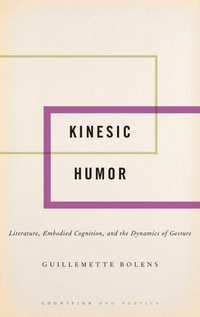
Kinesic Humor
Literature, Embodied Cognition, and the Dynamics of Gesture
Published on 24. September 2021
Book
Hardback
216 pages
978-0-19-093006-6 (ISBN)
Description
This is an open access title available under the terms of a CC BY-NC-ND 4.0 International license. It is free to read at Oxford Scholarship Online and offered as a free PDF download from OUP and selected open access locations.
The triggers of laughter in spoken language or conversation can often be very simple, such as a change in gesture, or in vocal tone or tempo. Speakers and listeners understand these dynamics of gesture through motor cognition and use them to great effect. The causes of laughter and the experience of humor in written texts, however, are less well understood. In Kinesic Humor, Guillemette Bolens offers a cognitive poetics-based study of triggers of laughter in texts, focusing in particular on tonic shifts and gesture in plot and narrative.
Bolens shows how literary texts from a variety of periods provide remarkably precise information concerning kinesthesia, the role of tonicity in communication, and the impact of momentum, timing, and tempo on the way in which gestures are processed in human exchanges. She investigates the narrative use of such parameters and how they prompt laughter in a wide-ranging corpus of major authors that includes Chretien de Troyes, Cervantes, Milton, Saint-Simon, Rousseau, Sterne, and Stendhal. Using the theory of embodied cognition, Bolens shows how thwarted perceptions and expectations of movements and sensations produce the cognitive shifts typical of humor. Bringing together narratology, cognitive studies, gesture studies, humor studies, and historical context, this book offers original perspectives on important artworks and represents a major contribution to cognitive poetics.
Originally published in French as L'Humour et le savoir des corps in 2016, this volume not only brings the work to an English-speaking audience for the first time but expands significantly on the original by analyzing a new corpus of texts and engaging with recent advances in the field to develop a cutting-edge theory of kinesic humor.
The triggers of laughter in spoken language or conversation can often be very simple, such as a change in gesture, or in vocal tone or tempo. Speakers and listeners understand these dynamics of gesture through motor cognition and use them to great effect. The causes of laughter and the experience of humor in written texts, however, are less well understood. In Kinesic Humor, Guillemette Bolens offers a cognitive poetics-based study of triggers of laughter in texts, focusing in particular on tonic shifts and gesture in plot and narrative.
Bolens shows how literary texts from a variety of periods provide remarkably precise information concerning kinesthesia, the role of tonicity in communication, and the impact of momentum, timing, and tempo on the way in which gestures are processed in human exchanges. She investigates the narrative use of such parameters and how they prompt laughter in a wide-ranging corpus of major authors that includes Chretien de Troyes, Cervantes, Milton, Saint-Simon, Rousseau, Sterne, and Stendhal. Using the theory of embodied cognition, Bolens shows how thwarted perceptions and expectations of movements and sensations produce the cognitive shifts typical of humor. Bringing together narratology, cognitive studies, gesture studies, humor studies, and historical context, this book offers original perspectives on important artworks and represents a major contribution to cognitive poetics.
Originally published in French as L'Humour et le savoir des corps in 2016, this volume not only brings the work to an English-speaking audience for the first time but expands significantly on the original by analyzing a new corpus of texts and engaging with recent advances in the field to develop a cutting-edge theory of kinesic humor.
Reviews / Votes
the tonicity and tempo of Bolens's writing make for a startling and rewarding exercise. * T. Lindvall, CHOICE Connect, Vol. 59 No. 8 * Guillemette Bolens's new book takes her powerful theory of kinesic analysis into the rich and complex territory of humor, showing that the sensory and motor resources of human cognition permeate every level of literary culture, including gestural and linguistic play. What she proposes is nothing less than a comprehensive new model of the way humor works, and she demonstrates it through a broad spectrum of brilliantly precise textual analyses. This is comparative cognitive criticism at its very best. * Terence Cave, Emeritus Professor of French Literature, Oxford University * Kinesic humor-triggered by surprising shifts in the rhythm of gestures-is an important aspect of human sociality; but it takes a scholar of Bolens's brilliance and interdisciplinary expertise to demonstrate that literature can create textual contexts for such humor in the most unexpected places. Embodied cognition is at the heart of the game that literature plays with the reader, and that game, Bolens shows us, is both poignant and funny. * Lisa Zunshine, author of Getting Inside Your Head: What Cognitive Science Tell Us about Popular Culture *More details
Series
Language
English
Place of publication
New York
United States
Target group
Professional and scholarly
Dimensions
Height: 240 mm
Width: 161 mm
Thickness: 16 mm
Weight
496 gr
ISBN-13
978-0-19-093006-6 (9780190930066)
Copyright in bibliographic data and cover images is held by Nielsen Book Services Limited or by the publishers or by their respective licensors: all rights reserved.
Schweitzer Classification
Other editions
Additional editions
E-Book
04/2021
OUP eBook
€53.49
Available for download
E-Book
04/2021
OUP eBook
€74.99
Available for download
Person
Guillemette Bolens is Professor of Medieval and Comparative Literature at the University of Geneva, Switzerland. Her research interests are in the history of the body, kinesic intelligence, gestures, and embodied cognition in visual and verbal arts. She is the author of La Logique du corps articulaire: les articulations du corps humain dans la litterature occidentale (2000/2007), for which she was awarded the Latsis Prize and the Helene and Victor Barbour Prize for Literary Criticism; The Style of Gestures: Embodiment and Cognition in Literary Narrative (2012; first published in French in 2008), and L'Humour et le savoir des corps: Don Quichotte, Tristram Shandy et le rire du lecteur (2016).
Content
Introduction: Kinesic Humor and the Dynamics of Gesture
Chapter One: Milton: Surprised By Humor
Chapter Two: Sterne: The Naturalness of a Toe Movement
Chapter Three: Saint-Simon: Speed and Touch, or How to Push a Duke
Chapter Four: Rousseau: Fast Breathing and Trembling Hands
Chapter Five: Stendhal: Walking Styles and Emotional Practice
Chapter Six: Ovid and Chretien de Troyes: Pyramus, Thisbe, and Yvain's Hypersensitive Lion
Chapter Seven: Cervantes: Laughing at a Metaphor
Conclusion: Jacques Tati and Eddie Izzard
Bibliography
Index
Chapter One: Milton: Surprised By Humor
Chapter Two: Sterne: The Naturalness of a Toe Movement
Chapter Three: Saint-Simon: Speed and Touch, or How to Push a Duke
Chapter Four: Rousseau: Fast Breathing and Trembling Hands
Chapter Five: Stendhal: Walking Styles and Emotional Practice
Chapter Six: Ovid and Chretien de Troyes: Pyramus, Thisbe, and Yvain's Hypersensitive Lion
Chapter Seven: Cervantes: Laughing at a Metaphor
Conclusion: Jacques Tati and Eddie Izzard
Bibliography
Index