

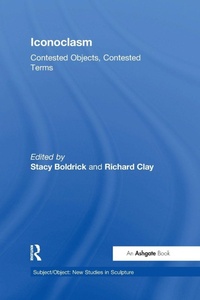
Iconoclasm
Contested Objects, Contested Terms
1st Edition
Published on 6. March 2017
Book
Paperback/Softback
316 pages
978-1-138-25602-6 (ISBN)
Description
The word 'iconoclasm' is most often used in relation to sculpture, because it is sculptures that most visibly bear witness to physical damage. But damage can also be invisible, and the actions of iconoclasm can be subtle and varying. Iconoclastic acts include the addition of objects and accessories, as well as their removal, or may be represented in text or imagery that never materially affects the original object. This book brings together a collection of essays each of which fundamentally questions the meaning of the word iconoclasm as a descriptive category. Each contribution examines the impact of iconoclastic acts on different representational forms, and assesses the development and historical implications of these various destructive and transformative behaviours.
More details
Series
Language
English
Place of publication
London
United Kingdom
Publishing group
Taylor & Francis Ltd
Target group
College/higher education
Dimensions
Height: 234 mm
Width: 156 mm
Thickness: 17 mm
Weight
483 gr
ISBN-13
978-1-138-25602-6 (9781138256026)
Copyright in bibliographic data and cover images is held by Nielsen Book Services Limited or by the publishers or by their respective licensors: all rights reserved.
Schweitzer Classification
Other editions
Additional editions
Book
06/2007
1st Edition
Routledge
€232.20
Shipment within 10-20 days
Persons
Dr Stacy Boldrick is VARIE Administrator at the Department of Fine Art, University of Edinburgh, UK.
Dr Richard Clay is Research Fellow at the Barber Institute of Fine Arts, University of Birmingham, UK.
Dr Richard Clay is Research Fellow at the Barber Institute of Fine Arts, University of Birmingham, UK.
Content
Contents: Introduction, Stacy Boldrick and Richard Clay; What does iconoclasm create? what does preservation destroy? reflections on iconoclasm in East Asia, Fabio Rambelli and Eric Reinders; Attacks on automata and eviscerated sculptures, Aura Satz; Iconoclasm and consumption: or, household management according to Thomas Cromwell, Matthew Hunter; Iconoclasm, the commodity, and the art of painting, Charles Ford; Bouchardon's statue of Louis XV: iconoclasm and the transformation of signs, Richard Clay; 'Wyatt the destroyer': a vandal at Salisbury Cathedral?, Alexandrina Buchanan; Clastic icons: prints taken from broken or reassembled blocks in some 'popular prints' of the Western tradition, Tom Gretton; Making sense of iconoclasm: popular responses to the destruction of religious images in revolutionary Mexico, Adrian Bantjes; Surrealism in the Bronze Age: statuephobia and the efficacy of metaphorical iconoclasm, Simon Baker; Sturm auf das stadtbild: on the treatment of Wilhelminian architectural decoration in the 20th century, Hans Georg Hiller von Gaertringen; 'Idols in stone' or empty pedestals? debating revolutionary iconoclasm in the post-Soviet transition, Polly Jones; Hermetic huts and modern state: the politics of iconoclasm in West Africa, Ramon SarrA (3); Select bibliography; Index.