

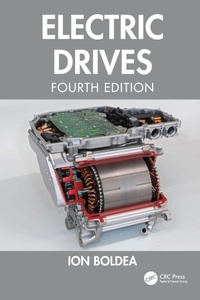
Electric Drives
4th Edition
Published on 10. September 2025
Book
Hardback
742 pages
978-1-032-78286-7 (ISBN)
Description
Electric Drives, now in its fourth edition, provides a practical guide in understanding the fundamental principles and recent new knowledge of electric motion (in motoring) and electric energy flow (in generating) digital control via power electronics for energy savings and increased productivity in practically all industries, from intelligent watches and phones to robots, electric transport, industrial processes, and modern distributed electric power systems with ever more renewable energy penetration.
Every proposition, number, figure, and reference has been revisited to bring necessary changes, with new references to key recent knowledge trends, to reflect the present state of the art.
The book has been restructured, with a few chapters combined and one chapter (on rectifier d.c. brush motor drives) removed, new introductory paragraphs in most chapters (many as inspiring case studies), and brand-new chapters on flux-modulation machine drives (Chapter 8) and predictive control of a.c. drives (Chapter 15), reflecting this updating effort. The large number of new case studies complements the large number of worked numerical examples and the 10 user-friendly MATLAB (R) and Simulink (R) programs that remain available online.
Although, inevitably, the math is intensive and intended to be directly usable, the book, mainly intended for senior undergraduate and graduate students and engineers in research and development in industry, is a practical, easy-to-assimilate, and up-to-date synthesis of basic and advanced power electronics (variable speed) electric motor-generator drives needed in all industries in which electric energy flow-wise, mainly digitally intelligent, control is paramount.
Every proposition, number, figure, and reference has been revisited to bring necessary changes, with new references to key recent knowledge trends, to reflect the present state of the art.
The book has been restructured, with a few chapters combined and one chapter (on rectifier d.c. brush motor drives) removed, new introductory paragraphs in most chapters (many as inspiring case studies), and brand-new chapters on flux-modulation machine drives (Chapter 8) and predictive control of a.c. drives (Chapter 15), reflecting this updating effort. The large number of new case studies complements the large number of worked numerical examples and the 10 user-friendly MATLAB (R) and Simulink (R) programs that remain available online.
Although, inevitably, the math is intensive and intended to be directly usable, the book, mainly intended for senior undergraduate and graduate students and engineers in research and development in industry, is a practical, easy-to-assimilate, and up-to-date synthesis of basic and advanced power electronics (variable speed) electric motor-generator drives needed in all industries in which electric energy flow-wise, mainly digitally intelligent, control is paramount.
More details
Edition
4th edition
Language
English
Place of publication
London
United Kingdom
Publishing group
Taylor & Francis Ltd
Target group
College/higher education
General and Postgraduate
Illustrations
662 s/w Abbildungen, 159 farbige Abbildungen, 1 s/w Photographie bzw. Rasterbild, 12 Farbfotos bzw. farbige Rasterbilder, 661 s/w Zeichnungen, 147 farbige Zeichnungen, 32 s/w Tabellen
32 Tables, black and white; 147 Line drawings, color; 661 Line drawings, black and white; 12 Halftones, color; 1 Halftones, black and white; 159 Illustrations, color; 662 Illustrations, black and white
Dimensions
Height: 260 mm
Width: 183 mm
Thickness: 46 mm
Weight
1620 gr
ISBN-13
978-1-032-78286-7 (9781032782867)
Copyright in bibliographic data and cover images is held by Nielsen Book Services Limited or by the publishers or by their respective licensors: all rights reserved.
Schweitzer Classification
Other editions
Additional editions
Previous edition
Ion Boldea | Syed A. Nasar
Electric Drives
Book
06/2016
3rd Edition
CRC Press
€215.41
Shipment within 15-20 days
Person
Prof. Ion Boldea (IEEE Life Fellow) studied at and obtained a PhD in electrical engineering (on linear induction motors design and control) in 1973 at University Politehnica Timisoara, Romania. He has been an active professor since 1968, having completed a Fulbright postdoctoral scholarship in the United States (1973-1974). Over the years, he has spent more than five years as a visiting professor at institutions across the United States, the United Kingdom, Denmark, and South Korea.
He investigated and published extensively on linear and rotary electric machine drives and magnetically levitated vehicles (MAGLEVs), focusing on their design and control for industrial applications, with his work appearing primarily in IEEE papers and books. In recognition of his professional contributions, he received the 2015 Nikola Tesla IEEE Award and the 2021 EPE Outstanding Achievement Award. He is a full member of both the Romanian Technical Sciences Academy and the Romanian Academy, and holds a Doctor Honoris Causa from Aalborg University, Denmark.
Prof. Boldea has given numerous keynote addresses at IEEE-sponsored international conferences and has delivered (as an IEEE-IAS Distinguished Lecturer since 2008) numerous intensive courses and lectures in the United States, Denmark, South Korea, Brazil, and Italy, among other countries. He chaired and co-chaired the biannual IEEE-sponsored international conference, OPTIM-ACEMP, for over 30 years. He has also held tech consulting contracts with international companies for decades and co-founded the company Bee-Speed (www.Bee-Speed.ro) in 1994, which is still continually active today, specializing in industrial digital electric automation in water integrated technologies.
He enjoys a rich family life and studies seminal books in philosophy, literature, economics, math, and physics. He rides his bicycle to work daily, and his hobbies include gardening and tennis.
He investigated and published extensively on linear and rotary electric machine drives and magnetically levitated vehicles (MAGLEVs), focusing on their design and control for industrial applications, with his work appearing primarily in IEEE papers and books. In recognition of his professional contributions, he received the 2015 Nikola Tesla IEEE Award and the 2021 EPE Outstanding Achievement Award. He is a full member of both the Romanian Technical Sciences Academy and the Romanian Academy, and holds a Doctor Honoris Causa from Aalborg University, Denmark.
Prof. Boldea has given numerous keynote addresses at IEEE-sponsored international conferences and has delivered (as an IEEE-IAS Distinguished Lecturer since 2008) numerous intensive courses and lectures in the United States, Denmark, South Korea, Brazil, and Italy, among other countries. He chaired and co-chaired the biannual IEEE-sponsored international conference, OPTIM-ACEMP, for over 30 years. He has also held tech consulting contracts with international companies for decades and co-founded the company Bee-Speed (www.Bee-Speed.ro) in 1994, which is still continually active today, specializing in industrial digital electric automation in water integrated technologies.
He enjoys a rich family life and studies seminal books in philosophy, literature, economics, math, and physics. He rides his bicycle to work daily, and his hobbies include gardening and tennis.
Content
1 Energy Conversion in Electric Drives. 2. Electric Motors and Power Electronics Converters for Drives: An Introduction 3. D.C. Brush Motors Drives. 4. Closed -Loop Motion Control in Electric Drives. 5. Induction Motors for Drives. 6. PWM Inverter-Fed Induction Motor Drives. 7. Synchronous Motors for Drives. 8. PM and Reluctance Synchronous Motor Drives. 9. Flux-Modulation Electric Motor/Generator Drives. 10. Practical Issues with PWM Converter Motor Drives 11. Large-Power Drives 12. Control of Electric Generators. 13. Scalar V/f and I-f Control of A.C. Motor Drives: An Overview 14. Multiphase Electric Machine Drives: An Overview 15. Predictive Control in Electric Drives: An Overview