

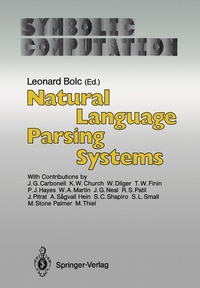
Natural Language Parsing Systems
Published on 8. December 2011
Book
Paperback/Softback
XVIII, 367 pages
978-3-642-83032-7 (ISBN)
Description
Up to now there has been no scientific publication on natural lan guage research that presents a broad and complex description of the current problems of parsing in the context of Artificial Intelli gence. However, there are many interesting results from this domain appearing mainly in numerous articles published in pro fessional journals. In view of this situation, the objective of this book is to enable scientists from different countries to present the results of their research on natural language parsing in the form of more detailed papers than would be possible in professional jour nals. This book thus provides a collection of studies written by well known scientists whose earlier publications have greatly contributed to the development of research on natural language parsing. Jaime G. Carbonell and Philip J. Hayes present in their paper "Robust Parsing Using Multiple Construction-Specific Strategies" two small experimental parsers, implemented to illustrate the advantages of a multi-strategy approach to parsers, with strategies selected according to the type of construction being parsed at any given time. This presentation is followed by the description of a parsing algorithm, integrating some of the best features of the two smaller parsers, including case-frame instantiation and partial pat tern-matching strategies.
More details
Series
Edition
Softcover reprint of the original 1st ed. 1987
Language
English
Place of publication
Berlin
Germany
Publishing group
Springer Berlin
Target group
Professional and scholarly
Research
Illustrations
XVIII, 367 p.
Dimensions
Height: 244 mm
Width: 170 mm
Thickness: 21 mm
Weight
668 gr
ISBN-13
978-3-642-83032-7 (9783642830327)
DOI
10.1007/978-3-642-83030-3
Schweitzer Classification
Other editions
Additional editions
Leonard Bolc
Natural Language Parsing Systems
E-Book
12/2012
1st Edition
Springer
€96.29
Available for download

Leonard Bolc
Natural Language Parsing Systems
Book
09/1987
Springer
€139.09
Article exhausted; check different version
Persons
Content
Robust Parsing Using Multiple Construction-Specific Strategies.- 1 Introduction.- 2 Construction-Specific Flexible Parsing.- 3 The Representation of Ambiguity and Focused Interaction.- 4 Limited-Domain Language Definition.- 5 Parsing Data Base Queries and Updates.- 6 The CASPAR Parser.- 7 The DYPAR Parser.- 8 Combining the Strengths of CASPAR and DYPAR.- 9 Conclusion.- References.- Parsing with Logical Variables.- 1 Introduction.- 2 Definite Clause Grammars.- 3 Comparing DC and ATN Grammars.- 4 Replacing ATN Registers with ATN Variables.- 5 Conclusions.- References.- Knowledge-Based Parsing.- 1 Introduction.- 2 Core Knowledge and Representations.- 3 Increasing the System's Language Capability Through Its Language Capability.- 4 Language Use-Mention Distinction.- 5 Summary.- Appendix: Chronological Summary of Input to the System as Presented in This Chapter.- References.- Using Declarative Knowledge for Understanding Natural Language.- 1 Introduction.- 2 The Knowledge.- 3 The Interpreter.- 4 Discussion.- 5 Conclusion.- References.- Weighted Parsing.- 1 The Need for Weighting.- 2 A Digression: Regulation Processes.- 3 Aspects of System Control.- 4 Types of Weighting.- 5 The Application of Weighting in an MT-System.- 6 Examples of the Application of Weighting.- 7 Computation of Weights.- 8 Evaluation of Weights.- References.- A Distributed Word-Based Approach to Parsing.- 1 Introduction.- 2 Background Motivations.- 3 The Parsing System.- 4 Example: "The man throws in the towel".- 5 Word Expert Definition.- 6 Summary and Conclusions.- References.- Parsing by Means of Uppsala Chart Processor (UCP).- 1 Introduction.- 2 Background.- 3 Uppsala Chart Processor.- 4 Applications.- 5 Summary of Experience with UCP.- References.- Preliminary Analysis of a Breadth-First ParsingAlgorithm: Theoretical and Experimental Results.- 1 An Introduction to Chart Parsing.- 2 Taking Advantage of Restricted Grammars.- 3 Transformations and Lexical Rules.- 4 Experimental Results.- 5 Conclusion.- Appendix I Results with the MALHOTRA Corpus.- Appendix II Results with the LADDER-TODS Collection.- References.- Syntax Directed Translation in the Natural Language Information System PLIDIS.- 1 Some Notation and Basic Definitions.- 2 Tree Directed Grammars.- 3 Tree Transducers.- 4 Tree Directed Grammars and Tree Transducers.- References.