

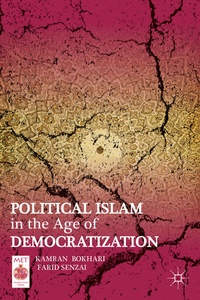
Political Islam in the Age of Democratization
Published on 18. December 2013
Book
Hardback
XVII, 258 pages
978-1-137-00848-0 (ISBN)
Description
The continued prominence of Islam in the struggle for democracy in the Muslim world has confounded Western democracy theorists who largely consider secularism a prerequisite for democratic transitions. Kamran Bokhari and Farid Senzai offer a comprehensive view of the complex nature of contemporary political Islam and its relationship to democracy.
Reviews / Votes
"Bokhari and Senzai present a generally persuasive, informed, and nuanced conceptual framework for understanding different 'Islamists' behavior in relation to democracy' and the different ways democracy can be interpreted and operationalized within Islamic societies . . Overall, this book constitutes a must read for students of Muslim politics; it is an informative, resourceful, and easily comprehensible text for anyone who desires to understand political Islam today." (Ravza Altuntas-Çakır, Insight Turkey, insightturkey.com, December, 2015)
More details
Series
Edition
2013 edition
Language
English
Place of publication
New York
United States
Target group
Professional and scholarly
Product notice
sewn/stitched
Cloth over boards
Illustrations
1 s/w Abbildung
XVII, 258 p. 1 illus.
Dimensions
Height: 241 mm
Width: 156 mm
Thickness: 22 mm
Weight
533 gr
ISBN-13
978-1-137-00848-0 (9781137008480)
DOI
10.1057/9781137313492
Schweitzer Classification
Other editions
Additional editions
Kamran Bokhari | Farid Senzai
Political Islam in the Age of Democratization
Book
02/2015
Palgrave
€64.19
Shipment within 10-20 days
K. Bokhari | F. Senzai
Political Islam in the Age of Democratization
E-Book
12/2013
1st Edition
Palgrave MacMillan
€53.49
Available for download
Persons
Author Kamran Bokhari: Kamran Bokhari is Vice President of Middle Eastern & South Asian Affairs at Stratfor, USA. He is also a Visiting Lecturer in the Department of Politics & International Relations at the University of Westminster, UK and a fellow with the Institute for Social Policy and Understanding, USA.
Author Farid Senzai: Farid Senzai is Assistant Professor of Political Science at Santa Clara University, USA and Director of Research at the Institute for Social Policy and Understanding. He is the author of Educating the Muslims of America (Oxford University Press, 2009)
Content
Foreword; Fawaz A. Gerges 1. Introduction: The Role of Religion in Politics 2. The Complexity of Political Islam 3. Theoretical Framework: Democratization and Islamists 4. Participatory Islamists: The Case of the Muslim Brotherhood 5. Conditionalist Islamists: The Case of the Salafis 6. Rejector Islamists: al-Qaeda and Transnational Jihadism 7. Rejector Islamists: Taliban and Nationalist Jihadism 8. Participatory Shia Islamism: The Islamic Republic of Iran 9. Arab Shia Islamism: Hezbollah and Iraqi Shia Islamists 10. Post-Islamism: The Case of Turkey's AKP 11. Conclusion: Prospect for Muslim Democracies