

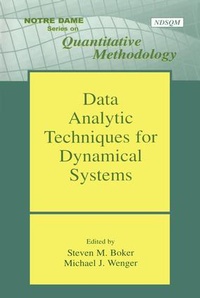
Data Analytic Techniques for Dynamical Systems
1st Edition
Published on 30. January 2007
Book
Paperback/Softback
292 pages
978-0-8058-5013-0 (ISBN)
Description
Each volume in the Notre Dame Series on Quantitative Methodology features leading methodologists and substantive experts who provide instruction on innovative techniques designed to enhance quantitative skills in a substantive area. This latest volume focuses on the methodological issues and analyses pertinent to understanding psychological data from a dynamical system perspective. Dynamical systems analysis (DSA) is increasingly used to demonstrate time-dependent variable change. It is used more and more to analyze a variety of psychological phenomena such as relationships, development and aging, emotional regulation, and perceptual processes.
The book opens with the best occasions for using DSA methods. The final two chapters focus on the application of dynamical systems methods to problems in psychology such as substance use and gestural dynamics. In addition, it reviews how and when to use:
time series models from a discrete time perspective
stochastic differential equations in continuous time
estimating continuous time differential equation models
multilevel models of differential equations to estimate within-person dynamics and the corresponding population means
new SEM models for dynamical systems data
Data Analytic Techniques for Dynamical Systems is beneficial to advanced students and researchers in the areas of developmental psychology, family studies, language processes, cognitive neuroscience, social and personality psychology, medicine, and emotion. Due to the book's instructive nature, it serves as an excellent text for advanced courses on this particular technique.
The book opens with the best occasions for using DSA methods. The final two chapters focus on the application of dynamical systems methods to problems in psychology such as substance use and gestural dynamics. In addition, it reviews how and when to use:
time series models from a discrete time perspective
stochastic differential equations in continuous time
estimating continuous time differential equation models
multilevel models of differential equations to estimate within-person dynamics and the corresponding population means
new SEM models for dynamical systems data
Data Analytic Techniques for Dynamical Systems is beneficial to advanced students and researchers in the areas of developmental psychology, family studies, language processes, cognitive neuroscience, social and personality psychology, medicine, and emotion. Due to the book's instructive nature, it serves as an excellent text for advanced courses on this particular technique.
Reviews / Votes
'Editors Boker and Wenger have produced a readable, educational, and thorough volume.' - James J. Jakubow, PsycCRITIQUESMore details
Series
Language
English
Place of publication
Philadelphia
United States
Publishing group
Taylor & Francis Inc
Target group
Professional and scholarly
Dimensions
Height: 229 mm
Width: 152 mm
Weight
408 gr
ISBN-13
978-0-8058-5013-0 (9780805850130)
Copyright in bibliographic data and cover images is held by Nielsen Book Services Limited or by the publishers or by their respective licensors: all rights reserved.
Schweitzer Classification
Other editions
Additional editions
Steven M. Boker | Michael J. Wenger
Data Analytic Techniques for Dynamical Systems
E-Book
10/2012
1st Edition
Psychology Press Ltd
€72.49
Available for download
Steven M. Boker | Michael J. Wenger
Data Analytic Techniques for Dynamical Systems
E-Book
10/2012
1st Edition
Psychology Press Ltd
€72.49
Available for download
Steven M. Boker | Michael J. Wenger
Data Analytic Techniques for Dynamical Systems
Book
01/2007
1st Edition
Psychology Press
€215.41
Article not available at the moment
Persons
Steven M Boker, Michael J. Wenger
Content
Contents: S.M. Boker, Preface. B.I. Bertenthal, Dynamical Systems: It's About Time. M.W. Browne, Repeated Time Series Models for Learning Data. F. Hamagami, J.J. McArdle, Dynamic Extensions of Latent Difference Score Models. J.H.L. Oud, Continuous Time Modeling of Reciprocal Relationships in the Cross-Lagged Panel Design. S.M. Boker, Specifying Latent Differential Equations Models. S.E. Maxwell, S.M. Boker, Multilevel Models of Dynamical Systems. P.C.M. Molenaar, P. van Rijn, E. Hamaker, A New Class of SEM Model Equivalences and Its Implications. J.L. Rodgers, A.M. Johnson, Nonlinear Dynamic Models of Nonlinear Dynamic Behaviors: Social Contagion of Adolescent Smoking and Drinking at Aggregate and Individual Levels. M.J. Wenger, A.M. Copeland, C. Schuster, Gestures as Psychophysical Judgments.