

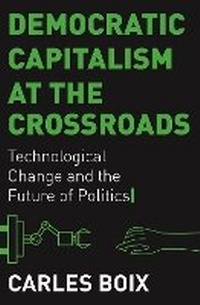
Democratic Capitalism at the Crossroads
Technological Change and the Future of Politics
Published on 28. May 2019
Book
Hardback
272 pages
978-0-691-19098-3 (ISBN)
Description
An incisive history of the changing relationship between democracy and capitalism
The twentieth century witnessed the triumph of democratic capitalism in the industrialized West, with widespread popular support for both free markets and representative elections. Today, that political consensus appears to be breaking down, disrupted by polarization and income inequality, widespread dissatisfaction with democratic institutions, and insurgent populism. Tracing the history of democratic capitalism over the past two centuries, Carles Boix explains how we got here-and where we could be headed.
Boix looks at three defining stages of capitalism, each originating in a distinct time and place with its unique political challenges, structure of production and employment, and relationship with democracy. He begins in nineteenth-century Manchester, where factory owners employed unskilled laborers at low wages, generating rampant inequality and a restrictive electoral franchise. He then moves to Detroit in the early 1900s, where the invention of the modern assembly line shifted labor demand to skilled blue-collar workers. Boix shows how growing wages, declining inequality, and an expanding middle class enabled democratic capitalism to flourish. Today, however, the information revolution that began in Silicon Valley in the 1970s is benefitting the highly educated at the expense of the traditional working class, jobs are going offshore, and inequality has risen sharply, making many wonder whether democracy and capitalism are still compatible.
Essential reading for these uncertain times, Democratic Capitalism at the Crossroads proposes sensible policy solutions that can help harness the unruly forces of capitalism to preserve democracy and meet the challenges that lie ahead.
The twentieth century witnessed the triumph of democratic capitalism in the industrialized West, with widespread popular support for both free markets and representative elections. Today, that political consensus appears to be breaking down, disrupted by polarization and income inequality, widespread dissatisfaction with democratic institutions, and insurgent populism. Tracing the history of democratic capitalism over the past two centuries, Carles Boix explains how we got here-and where we could be headed.
Boix looks at three defining stages of capitalism, each originating in a distinct time and place with its unique political challenges, structure of production and employment, and relationship with democracy. He begins in nineteenth-century Manchester, where factory owners employed unskilled laborers at low wages, generating rampant inequality and a restrictive electoral franchise. He then moves to Detroit in the early 1900s, where the invention of the modern assembly line shifted labor demand to skilled blue-collar workers. Boix shows how growing wages, declining inequality, and an expanding middle class enabled democratic capitalism to flourish. Today, however, the information revolution that began in Silicon Valley in the 1970s is benefitting the highly educated at the expense of the traditional working class, jobs are going offshore, and inequality has risen sharply, making many wonder whether democracy and capitalism are still compatible.
Essential reading for these uncertain times, Democratic Capitalism at the Crossroads proposes sensible policy solutions that can help harness the unruly forces of capitalism to preserve democracy and meet the challenges that lie ahead.
Reviews / Votes
"[Carles Boix] helps us see change in a comparative and historical context."---Michael Cornfield, The Guardian "Democratic Capitalism at the Crossroads . . . takes a political science perspective on . . . deep trends in technology . . . Coming from a different perspective, Boix provides new-to-me insights, and particularly about similarities between the successive technological revolutions."---Diane Coyle, Enlightened Economist "The book initiates discussion on an important, underresearched and relevant subject. Lucidly written, it is well-informed and rich with tables and figures. Readers of political economy, social and economic history, managementand business studies would benefit from this book.
"---Sujay Ghosh, Democratization
More details
Language
English
Place of publication
New Jersey
United States
Target group
College/higher education
Professional and scholarly
Product notice
Trade binding
Illustrations
30 b/w illus. 5 tables.
Dimensions
Height: 216 mm
Width: 140 mm
ISBN-13
978-0-691-19098-3 (9780691190983)
Copyright in bibliographic data and cover images is held by Nielsen Book Services Limited or by the publishers or by their respective licensors: all rights reserved.
Schweitzer Classification
Other editions
Additional editions
E-Book
05/2019
1st Edition
Princeton University Press
from
€45.95
Available for download
Person
Carles Boix is the Robert Garrett Professor of Politics and Public Affairs at Princeton University and director of the Institutions and Political Economy Research Group at the University of Barcelona. His books include Political Order and Inequality and Democracy and Redistribution. He lives in Princeton and Barcelona. Twitter @boixserra