

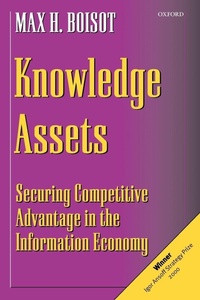
Knowledge Assets
Securing Competitive Advantage in the Information Economy
Published on 23. September 1999
Book
Paperback/Softback
308 pages
978-0-19-829607-2 (ISBN)
Description
It is now widely recognized that the effective management of knowledge assets is a key requirement for securing competitive advantage in the emerging information economy. Yet the physical and institutional differences between tangible assets and knowledge assets remain poorly understood.
In the case of knowledge, the ownership and control of assets are becoming ever more separate, a phenomenon that is actually exacerbated by the phenomenon of learning. If we are to meet the challenges of the information economy, then we need a new approach to property rights based on a deeper theoretical understanding of knowledge assets.
Max Boisot writes clearly and in accessible language providing some of the key building blocks which are needed for a theory of knowledge assets. He develops a powerful conceptual framework, the Information-Space or I-Space, for exploring the way knowledge flows within and between organizations. This framework will enable managers and students to explore and understand how knowledge and information assets differ from physical assets, and how to deal with them at a strategic level within their organizations.
In the case of knowledge, the ownership and control of assets are becoming ever more separate, a phenomenon that is actually exacerbated by the phenomenon of learning. If we are to meet the challenges of the information economy, then we need a new approach to property rights based on a deeper theoretical understanding of knowledge assets.
Max Boisot writes clearly and in accessible language providing some of the key building blocks which are needed for a theory of knowledge assets. He develops a powerful conceptual framework, the Information-Space or I-Space, for exploring the way knowledge flows within and between organizations. This framework will enable managers and students to explore and understand how knowledge and information assets differ from physical assets, and how to deal with them at a strategic level within their organizations.
Reviews / Votes
Max Boisot has written a book for any thinking manager, politician or lawyer interested in the role of information and intellectual property in the evolution of the information economy. * Ian MacMillan, George W. Taylor Professor of Entrepreneurial Studies, The Wharton School of Management. * For those struggling to understand how knowledge-based organizations can develop and exploit their distinctive competences, Boisot's book provides profound insights and challenges. * Dr Keith Blois, Templeton College, University of Oxford * ...this is for the scientist who want to impress managers. It's a serious book. * Harold Thimbleby. New Scientist * In his new book Boisot... addresses and explores new issues that are relevant from a managerial point of view. Without any doubt Boisot's I-space theory is one of the most comprehensive theories in the management literature. * Sage Publications * ...his book represents an important step towards the development of a knowledge-based theory of the firm. It is likely to be of use to academics, as well as the growing clan of practitioners in firms who are interested in management and organisational theory. * Jane Millar, Times Higher Education Supplement * If you accept that knowledge and the ability to use it is a key competitive resource, you must read this book. If you do not accept this, then also read it to discover where you are wrong before it is too late! * John Child, Guinness Professor of Management Studies, University of Cambridge *More details
Language
English
Place of publication
Oxford
United Kingdom
Target group
Professional and scholarly
Illustrations
numerous figures, and tables
Dimensions
Height: 234 mm
Width: 156 mm
Thickness: 17 mm
Weight
471 gr
ISBN-13
978-0-19-829607-2 (9780198296072)
Copyright in bibliographic data and cover images is held by Nielsen Book Services Limited or by the publishers or by their respective licensors: all rights reserved.
Schweitzer Classification
Other editions
Additional editions
Book
04/1998
Oxford University Press
€226.00
Shipment within 15-20 days
Person
Max Boisot is Professor of Strategic Management at ESADE in Barcelona. He is also Poh Seng Yeoh Research Fellow at the Sol Snider Entrepreneurial Center, The Wharton School, University of Pennsylvania; Senior Associate at the Judge Institute of Management Studies; and Visiting Fellow at the Management School, Imperial College in London. From 1984 to 1989 he was the first dean and director of the China-EC Management Programme in Beijing, which has now become the China-Europe International Business School (CEIBS).
Content
1. Introduction ; 2. The Information Perspective ; 3. The Information Space ; 4. The Paradox of Value ; 5. Neoclassical versus Schumpeterian Orientation to Learning ; 6. Culture as a Knowledge Asset ; 7. Products, Technologies, and Organizations in the Social Learning Cycle ; 8. Competence and Intent ; 9. IT and its Impact ; 10. Applying the I-Space ; 11. Recapitulation and Conclusion