

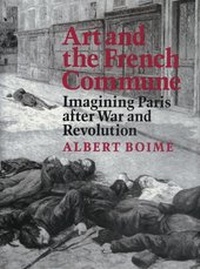
Art and the French Commune
Imagining Paris after War and Revolution
Published on 9. April 1995
Book
Hardback
256 pages
978-0-691-02962-7 (ISBN)
Description
In this bold exploration of the political forces that shaped Impressionism, Albert Boime proposes that at the heart of the modern is a 'guilty secret - the need of the dominant, mainly bourgeois, classes in Paris to expunge from historical memory the haunting nightmare of the Commune and its socialist ideology. The Commune of 1871 emerged after the Prussian war when the Paris militia chased the central government to Versailles, enabling the working class and its allies to seize control of the capital. Eventually violence engulfed the city as traditional liberals and moderates joined forces with reactionaries to restore Paris to 'order' - the bourgeois order.Here Boime examines the rise of Impressionism in relation to the efforts of the reinstated conservative government to 'rebuild' Paris, to return it to its Haussmannian appearance and erase all reminders of socialist threat. Boime contends that an organized Impressionist movement owed its initiating impulse to its complicity with the state's program.
The exuberant street scenes, spaces of leisure and entertainment, sunlit parks and gardens, the entire concourse of movement as filtered through an atmosphere of scintillating light and color all constitute an effort to reclaim Paris visually and symbolically for the bourgeoisie. Amply documented, richly illustrated, and compellingly argued, Boime's thesis serves as a challenge to all cultural historians interested in the rise of modernism.
The exuberant street scenes, spaces of leisure and entertainment, sunlit parks and gardens, the entire concourse of movement as filtered through an atmosphere of scintillating light and color all constitute an effort to reclaim Paris visually and symbolically for the bourgeoisie. Amply documented, richly illustrated, and compellingly argued, Boime's thesis serves as a challenge to all cultural historians interested in the rise of modernism.
Reviews / Votes
Henceforth, it will be impossible to treat the question of the origins of Impressionism without making reference to [Boime's] work, whether it be to extend it, amend it, or refute it. -- Barthelemy Jobert Revue de l'Art Through Boime's distinctive 'vision,' the book mounts an altogether new explanation of Impressionism, one that intentionally differs from the most influential, those of T. J. Clark and Robert Herbert. -- Hollis Clayson Apollo MagazineMore details
Series
Language
English
Place of publication
New Jersey
United States
Target group
Professional and scholarly
College/higher education
Product notice
Trade binding
Illustrations
160 Fotos bzw. Rasterbilder
160 halftones
Dimensions
Height: 254 mm
Width: 178 mm
Weight
794 gr
ISBN-13
978-0-691-02962-7 (9780691029627)
Copyright in bibliographic data and cover images is held by Nielsen Book Services Limited or by the publishers or by their respective licensors: all rights reserved.
Schweitzer Classification
Other editions
Additional editions
E-Book
05/2022
1st Edition
Princeton University Press
€66.99
Available for download
Person
Albert Boime, Professor of Art History at the University of California, Los Angeles, is the author of many books, including The Academy and French Painting in the Nineteenth Century and Art in the Age of Revolution
Content
LIST OF ILLUSTRATIONS XI ACKNOWLEDGMENTS XV 1. INTRODUCTION 3 2. THE CRITICAL RECEPTION 27 3. THE DISLOCATING IMPACT OF THE COMMUNE ON THE IMPRESSIONISTS 46 4. THE IMPRESSIONIST AGENDA 77 5. MAPPING THE TERRAIN 114 EPILOGUE: GEORGES SEURAT'S Un Dimanche a la Grande fatte AND POST-COMMUNE UTOPIANISM 140 APPENDIX: ON OLIN LEVI WARNER'S DRAFT OF A SPEECH IN DEFENSE OF THE FRENCH COMMUNE 186 NOTES 209 POSTSCRIPT 223 INDEX 225