

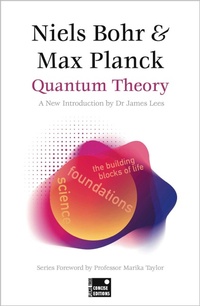
Quantum Theory (Concise Edition)
Published on 31. August 2023
Book
Paperback/Softback
256 pages
978-1-80417-568-2 (ISBN)
Description
A concise, uncluttered edition for the modern reader, with a new introduction. Quantum Theory contains two foundational works of quantum research from the early years of the 20th Century, representing breakthroughs in science that radically altered the landscape of modern knowledge: Quantum Theory of Line-Spectra by Niels Bohr and The Origin and Development of the Quantum Theory by Max Planck.
The FLAME TREE Foundations series features core publications which together have shaped the cultural landscape of the modern world, with cutting-edge research distilled into pocket guides designed to be both accessible and informative.
The FLAME TREE Foundations series features core publications which together have shaped the cultural landscape of the modern world, with cutting-edge research distilled into pocket guides designed to be both accessible and informative.
More details
Series
Language
English
Place of publication
London
United Kingdom
Product notice
Paperback (UK-B)
Illustrations
3 Line drawings, black and white
Dimensions
Height: 194 mm
Width: 129 mm
Thickness: 17 mm
Weight
242 gr
ISBN-13
978-1-80417-568-2 (9781804175682)
Copyright in bibliographic data and cover images is held by Nielsen Book Services Limited or by the publishers or by their respective licensors: all rights reserved.
Schweitzer Classification
Persons
Max Karl Ernst Ludwig Planck was a German theoretical physicist whose discovery of energy quanta won him the Nobel Prize in Physics in 1918. Planck made many contributions to theoretical physics, but his fame as a physicist rests primarily on his role as the originator of quantum theory, which revolutionized human understanding of atomic and subatomic processes.
Niels Henrik David Bohr was a Danish physicist who made foundational contributions to understanding atomic structure and quantum theory, for which he received the Nobel Prize in Physics in 1922. Bohr was also a philosopher and a promoter of scientific research.
Dr James Lees (introduction) is a Physicist, Author, and Science Communicator who studied at The University of York and Stanford. He works as a researcher and can be found giving talks and workshops across the UK at various educational festivals on a wide variety of scientific topics. He also has several other books including Physics in 50 Milestone Moments and Who Knew? Physics.
Professor Marika Taylor (Series Foreword) is a Professor of Theoretical Physics and Head of School within Mathematical Sciences at the University of Southampton. Her research interests include all aspects of string theory, gravitational physics and quantum field theory. In recent years much of her work has been focused on holographic dualities and their implications. Marika's research has featured in such publications as Physical Review, Journal of High Energy Physics and General Relativity and Gravitation among others.
Niels Henrik David Bohr was a Danish physicist who made foundational contributions to understanding atomic structure and quantum theory, for which he received the Nobel Prize in Physics in 1922. Bohr was also a philosopher and a promoter of scientific research.
Dr James Lees (introduction) is a Physicist, Author, and Science Communicator who studied at The University of York and Stanford. He works as a researcher and can be found giving talks and workshops across the UK at various educational festivals on a wide variety of scientific topics. He also has several other books including Physics in 50 Milestone Moments and Who Knew? Physics.
Professor Marika Taylor (Series Foreword) is a Professor of Theoretical Physics and Head of School within Mathematical Sciences at the University of Southampton. Her research interests include all aspects of string theory, gravitational physics and quantum field theory. In recent years much of her work has been focused on holographic dualities and their implications. Marika's research has featured in such publications as Physical Review, Journal of High Energy Physics and General Relativity and Gravitation among others.