

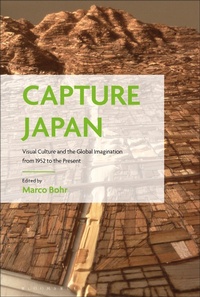
Capture Japan
Visual Culture and the Global Imagination from 1952 to the Present
Published on 29. December 2022
Book
Hardback
328 pages
978-1-350-18679-8 (ISBN)
Description
Capture Japan investigates the formation of visual tropes and how these have contributed to perceptions of Japan in the global imagination. The book proposes that images are not incidental in the formation of such perceptions, but central to notions about identity, history and memory. From a tentative western ally in 1952 to a 'soft power' superpower with a huge global influence in the 21st century, the book locates questions about Japan in the global imagination to the country's transforming geopolitical position. By adopting an interdisciplinary approach, with a multiplicity of perspectives from around the world, Capture Japan goes beyond binarisms to uncover how images can also produce discourses that challenge, subvert or even contradict each other.
The word 'capture' in the title of the book recognises both the deeply problematic role that images have played in relation to colonialism, as well as the potential dominance that visual spectacles can wield in a contemporary context. Diverse essays from a wide range of perspectives investigate the institutional framework that has allowed certain types of images of Japan to be promoted, while others have been suppressed.
In doing so, the book points to a vast network of images that have shaped the perception of Japan both from within and from outside, revealing how these images are inextricably linked to wider ideological, political, cultural or economic agendas.
The word 'capture' in the title of the book recognises both the deeply problematic role that images have played in relation to colonialism, as well as the potential dominance that visual spectacles can wield in a contemporary context. Diverse essays from a wide range of perspectives investigate the institutional framework that has allowed certain types of images of Japan to be promoted, while others have been suppressed.
In doing so, the book points to a vast network of images that have shaped the perception of Japan both from within and from outside, revealing how these images are inextricably linked to wider ideological, political, cultural or economic agendas.
Reviews / Votes
Is "capturing" Japan in images possible? Bohr's anthology provides intriguing answers to this challenging question. This is a genuinely interdisciplinary and transcultural work that traces the production and global reshaping of "Japanese" images in post-World War II Japan and beyond. * Mitsuyo Wada-Marciano, Graduate School of Letters, Kyoto University, Japan * Japan may not be quite the fearsome economic dynamo it once was, but for that very reason its art world is attracting ever more attention. This book is a compelling series of essays by major scholars on the full spread of Japanese art from the immediate post-War, to now. It is essential reading for all those interested in Japan, in Modernity, in Contemporary Art, and in how non-Western modes of expression compete and conflate with those coming from the West. * Timon Screech, International Research Center for Japanese Studies (Nichibunken), Kyoto, Japan * 'Rich in tangible examples ranging from art photography and film culture through to video games, this volume demonstrates the importance of studying Japan and "Japan", proving how inextricably linked they are. Capture Japan will prove highly valuable in the Japanese-studies classroom and beyond.' * Jaqueline Berndt, Professor in Japanese Language and Culture, Stockholm University, Sweden *More details
Language
English
Place of publication
London
United Kingdom
Publishing group
Bloomsbury Publishing PLC
Target group
College/higher education
Product notice
sewn/stitched
Cloth over boards
With dust jacket
Illustrations
46 bw illus
Dimensions
Height: 234 mm
Width: 156 mm
Thickness: 25 mm
Weight
454 gr
ISBN-13
978-1-350-18679-8 (9781350186798)
Copyright in bibliographic data and cover images is held by Nielsen Book Services Limited or by the publishers or by their respective licensors: all rights reserved.
Schweitzer Classification
Other editions
Additional editions
E-Book
12/2022
1st Edition
Bloomsbury Visual Arts
€32.99
Available for download
Person
Marco Bohr is Associate Professor in Visual Communication at Nottingham Trent University, UK. Previous to that he was the recipient of a JSPS Post-Doctoral Fellowship at Ritsumeikan University, Kyoto as well as a Japan Foundation Fellowship. With Basia Sliwinska, Marco co-edited the volume The Evolution of the Image: Political Action and the Digital Self (2020).
Content
List of Illustrations
Notes on Contributors
Acknowledgements
Note on Text and Translation
Introduction, Marco Bohr (Nottingham Trent University, UK)
Part One: Signs
Introduction to Part One, Marco Bohr
1. Le Samourai - Jean-Pierre Melville's Cinematic Japan, Miyao Daisuke (University of California, USA)
2. Dreaming of Mexico: Japanese Artists Discover the Other, Ramona Bajema (Japan Society, USA)
3. Re/Placing Barthes in the Post-Bubble Era: Youthful Disaffection, Online Fandom, and the Reoriented Visions of 'Japan' in Iwai Shunji's All About Lily Chou-Chou, Man-tat Terence Leung (Hong Kong Polytechnic University, Hong Kong)
Part Two: Myths
Introduction to Part Two, Marco Bohr
4. The 'Last Japanese Soldier': Putting the Nation into Play, Martin Picard (Leipzig University, Germany) and Martin Roth (Ritsumeikan University, Japan)
5. Sugimoto Hiroshi and the Emergence of a Geopolitical 'Japanese style', Marco Bohr (Nottingham Trent University, UK)
6. Japan as an 'erotic paradise' in the Sino-Japanese mobility context: ethnographic encounters, Jamie Coates (University of Sheffield, UK)
Part Three: Ruins
Introduction to Part Three, Marco Bohr
7. Shadows of the Atomic Bombings in The Family of Man: The American photographic exhibition tour of Japan in the post-occupation period, Takenaka Yumi Kim (Ritsumeikan University, Japan)
8. Fractured Land, Then and Now: The Resurgence of Ruins in the 1996 Japan Pavilion of the Venice Biennale, Carrie L. Cushman (University of Hartford, USA)
9. Burnt Dresses Left for the Future - Ishiuchi Miyako's photographic series hiroshima (2007-present), Hagiwara Hiroko (Osaka Prefecture University, Japan)
Part Four: Transformations
Introduction to Part Four, Marco Bohr
10. Representing Japan: Stereotyping and Self-Stereotyping in the many Careers of Yamaguchi Yoshiko, Jennifer Coates (University of Sheffield, UK)
11. Myth, Manga, Technology and Gender: Chobits and the Postwar Pygmalion, Selma A. Purac (Western University, Canada)
12. Personal Connections and Global Relations: Staging "Japan of the Imagination" in the 1980s, Melissa Miles (Monash University, Australia)
Index
Notes on Contributors
Acknowledgements
Note on Text and Translation
Introduction, Marco Bohr (Nottingham Trent University, UK)
Part One: Signs
Introduction to Part One, Marco Bohr
1. Le Samourai - Jean-Pierre Melville's Cinematic Japan, Miyao Daisuke (University of California, USA)
2. Dreaming of Mexico: Japanese Artists Discover the Other, Ramona Bajema (Japan Society, USA)
3. Re/Placing Barthes in the Post-Bubble Era: Youthful Disaffection, Online Fandom, and the Reoriented Visions of 'Japan' in Iwai Shunji's All About Lily Chou-Chou, Man-tat Terence Leung (Hong Kong Polytechnic University, Hong Kong)
Part Two: Myths
Introduction to Part Two, Marco Bohr
4. The 'Last Japanese Soldier': Putting the Nation into Play, Martin Picard (Leipzig University, Germany) and Martin Roth (Ritsumeikan University, Japan)
5. Sugimoto Hiroshi and the Emergence of a Geopolitical 'Japanese style', Marco Bohr (Nottingham Trent University, UK)
6. Japan as an 'erotic paradise' in the Sino-Japanese mobility context: ethnographic encounters, Jamie Coates (University of Sheffield, UK)
Part Three: Ruins
Introduction to Part Three, Marco Bohr
7. Shadows of the Atomic Bombings in The Family of Man: The American photographic exhibition tour of Japan in the post-occupation period, Takenaka Yumi Kim (Ritsumeikan University, Japan)
8. Fractured Land, Then and Now: The Resurgence of Ruins in the 1996 Japan Pavilion of the Venice Biennale, Carrie L. Cushman (University of Hartford, USA)
9. Burnt Dresses Left for the Future - Ishiuchi Miyako's photographic series hiroshima (2007-present), Hagiwara Hiroko (Osaka Prefecture University, Japan)
Part Four: Transformations
Introduction to Part Four, Marco Bohr
10. Representing Japan: Stereotyping and Self-Stereotyping in the many Careers of Yamaguchi Yoshiko, Jennifer Coates (University of Sheffield, UK)
11. Myth, Manga, Technology and Gender: Chobits and the Postwar Pygmalion, Selma A. Purac (Western University, Canada)
12. Personal Connections and Global Relations: Staging "Japan of the Imagination" in the 1980s, Melissa Miles (Monash University, Australia)
Index