

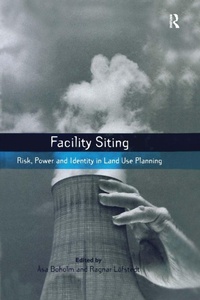
Facility Siting
Risk, Power and Identity in Land Use Planning
1st Edition
Published on 28. February 2016
Book
Paperback/Softback
256 pages
978-1-138-99087-6 (ISBN)
Description
From dams to landfill sites, and power plants to radioactive waste repositories, the siting of facilities is a veritable minefield of conflicts involving industry, planners, authorities, NGOs and citizens. This penetrating volume examines risk, power and identity in contests over the siting of infrastructure and industrial facilities. Going beyond nimby-ism, experts in a variety of fields bring a multiperspective analysis from science, law and media to case studies from the UK, USA and Europe, and expose the political and cultural dimensions of siting conflicts. In the process they show how place attachment and notions of landscape and local identity play a prominent role in resistance to 'development'.
Topics covered include the importance of context in siting controversies, siting methods and social representation, siting conflicts, the importance of institutional thinking in facility siting, risk, industrial encroachment and the sense of place, siting and sacred places, and law and fairness.
This book is essential reading for academics in social sciences, policy, planning, law and risk; policy makers, planners and decision makers at all levels of government; business and industry, particularly energy generation, including nuclear and renewables, transportation and large dams; risk assessment professionals; and NGOs and activists.
Topics covered include the importance of context in siting controversies, siting methods and social representation, siting conflicts, the importance of institutional thinking in facility siting, risk, industrial encroachment and the sense of place, siting and sacred places, and law and fairness.
This book is essential reading for academics in social sciences, policy, planning, law and risk; policy makers, planners and decision makers at all levels of government; business and industry, particularly energy generation, including nuclear and renewables, transportation and large dams; risk assessment professionals; and NGOs and activists.
More details
Series
Language
English
Place of publication
London
United Kingdom
Publishing group
Taylor & Francis Ltd
Target group
Professional and scholarly
Professional Practice & Development
Dimensions
Height: 234 mm
Width: 156 mm
Thickness: 14 mm
Weight
395 gr
ISBN-13
978-1-138-99087-6 (9781138990876)
Copyright in bibliographic data and cover images is held by Nielsen Book Services Limited or by the publishers or by their respective licensors: all rights reserved.
Schweitzer Classification
Other editions
Additional editions

E-Book
06/2013
1st Edition
Routledge
€64.49
Available for download

E-Book
06/2013
1st Edition
Routledge
€64.49
Available for download
Book
10/2004
Earthscan Ltd
€272.30
Shipment within 3-4 weeks
Persons
Asa Boholm is Professor of Social Anthropology at the School of Public Administration, Goteborg University, Sweden.
Ragnar E Lofstedt is a Professor in Risk Management and the Director of the Centre for Risk Management, Department of Geography, School of Social Science and Public Policy, Kings College London, UK. He is a renowned expert on risk communication and regulation issues and is editor-in-chief of the Journal of Risk Research and on the editorial board of Risk Analysis.
Ragnar E Lofstedt is a Professor in Risk Management and the Director of the Centre for Risk Management, Department of Geography, School of Social Science and Public Policy, Kings College London, UK. He is a renowned expert on risk communication and regulation issues and is editor-in-chief of the Journal of Risk Research and on the editorial board of Risk Analysis.
Content
Introduction * The Importance of Context in Siting Controversies: The Case of High-level Nuclear Waste in the US * Where Does It Go? Siting Methods and Social Representations of Radioactive Waste in France * Institutional Thinking in Siting Conflicts: The Case of stripa Mine * Siting Conflicts in Renewable Energy Projects: Biogas Case Study * The Smell of Money: Minor Risks and Olfactory Sensibilities (Anatomy of a Protest) * Living with Technological Risk: Industrial Encroachment on Sense of Place * Visualizing Place and Belonging: Landscape Refined in a Swedish Farming Community * Shifting Risks: Hoover Dam Impacts on American Indian Sacred Landscapes * The Invention of a Minority: A Case from the Aragonese Pyrenees * Schismogenesis in a Swedish Case of Rail Track Planning * When Complexity Becomes a Problem: 'Law' and 'Fairness' on Separate Tracks in Sweden * Notes * References * Index