

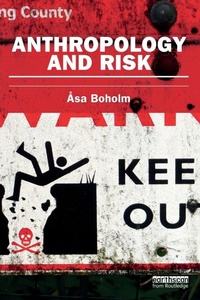
Anthropology and Risk
1st Edition
Published on 5. May 2015
Book
Paperback/Softback
190 pages
978-0-415-74563-5 (ISBN)
Description
Drawing on theory from anthropology, sociology, organisation studies and philosophy, this book addresses how the perception, communication and management of risk is shaped by culturally informed and socially embedded knowledge and experience. It provides an account of how interpretations of risk in society are conditioned by knowledge claims and cultural assumptions and by the orientationof actors based on roles, norms, expectations, identities, trust and practical rationality within a lived social world. By focusing on agency, social complexity and the production and interpretation of meaning, the book offers a comprehensive and holistic theoretical perspective on risk, based on empirical case studies and ethnographic enquiry.
As a selection of Asa Boholm's publications throughout her career, along with a newly written introduction overviewing the field, this book provides a unified perspective on risk as a construct shaped by social and cultural contexts.This collection should be of interest to students and scholars of risk communication, risk management, environmental planning, environmental management and environmental and applied anthropology.
As a selection of Asa Boholm's publications throughout her career, along with a newly written introduction overviewing the field, this book provides a unified perspective on risk as a construct shaped by social and cultural contexts.This collection should be of interest to students and scholars of risk communication, risk management, environmental planning, environmental management and environmental and applied anthropology.
Reviews / Votes
"This book is essential to anyone concerned with the predicaments of contemporary social life - uncertainty, contingency and risk. Asa Boholm skillfully zooms in on risk as a cultural category and situates risk perceptions and scenarios within larger frameworks of social and political change. Theoretically brilliant and thought provoking!" -Christina Garsten, Professor of Social Anthropology, University of Stockholm, Sweden"How individuals, groups and societies cope with contingency as part of their daily experiences is the main topic of this book. It broadens our understanding of the cultural meaning(s) of risk and uncertainty, provides a convincing middle ground between a realist and a constructivist view on risk, presents substantive evidence for the importance of cultural relationships between observer and perceived risk situations and draws valuable conclusions for informing risk policy and communication. This is a book that enlightens our understanding of risk and uncertainty." -Ortwin Renn, Professor of Environmental Sociology and Technology Assessment, University of Stuttgart, Germany
"This book provides a critical and timely review of the nature of risk in contemporary society that is well written, easily accessible to students and scholars alike and provides both the theoretical and practical understanding of the issues." - EcoHealth, Anita V. Shankar, Johns Hopkins University, USA
More details
Series
Language
English
Place of publication
London
United Kingdom
Publishing group
Taylor & Francis Ltd
Target group
College/higher education
Illustrations
11 s/w Abbildungen, 6 s/w Photographien bzw. Rasterbilder, 4 s/w Zeichnungen, 1 s/w Tabelle
1 Tables, black and white; 4 Line drawings, black and white; 6 Halftones, black and white; 11 Illustrations, black and white
Dimensions
Height: 234 mm
Width: 156 mm
Thickness: 11 mm
Weight
301 gr
ISBN-13
978-0-415-74563-5 (9780415745635)
Copyright in bibliographic data and cover images is held by Nielsen Book Services Limited or by the publishers or by their respective licensors: all rights reserved.
Schweitzer Classification
Other editions
Additional editions

Person
Asa Boholm is Professor of Social Anthropology at Gothenburg University, Sweden, and has published on historical, cultural, organizational and institutional dimensions of risk for over twenty years.
Content
1. Introduction 2. Comparative Studies of Risk Perception 3. Cultural Theory of Risk 4. The Cultural Nature of Risk 5. Speaking of Risk: Matters of Context 6. The Public Meeting as a Theatre of Dissent: Risk and Hazard in Land Use Planning 7. Visual Images and Risk Messages: Commemorating Chernobyl 8. On the Organizational Practice of Expert-based Risk Management: A Case of Railway Planning 9. Bibliography