

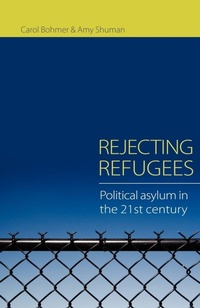
Rejecting Refugees
Political Asylum in the 21st Century
1st Edition
Published on 22. November 2007
Book
Paperback/Softback
292 pages
978-0-415-77376-8 (ISBN)
Description
Many nations recognize the moral and legal obligation to accept people fleeing from persecution, but political asylum applicants in the twenty-first century face restrictive policies and cumbersome procedures. So, what counts as persecution? How do applicants translate their stories of suffering and trauma into a narrative acceptable to the immigration officials? How can asylum officials weed out the fake from the genuine without resorting to inappropriate cultural definitions of behaviour?
Using both in depth accounts by asylum applicants and interviews with lawyers and others involved, this book takes the reader on a journey through the process of applying for asylum in both the United States and Great Britain. It describes how the systems address the conflicting needs of the state to protect their citizens from terrorists and the influx of hordes of unwelcome economic migrants, while at the same time adhering to their legal, moral and treaty obligations to provide safe haven for those fleeing persecution.
Rejecting Refugees is an insightful and fresh evaluation of the obstacles asylum applicants face and the cultural, procedural, and political discrepancies in the political asylum process. This makes it ideal reading to students and scholars of political science, international relations, sociology, law and anthropology.
Using both in depth accounts by asylum applicants and interviews with lawyers and others involved, this book takes the reader on a journey through the process of applying for asylum in both the United States and Great Britain. It describes how the systems address the conflicting needs of the state to protect their citizens from terrorists and the influx of hordes of unwelcome economic migrants, while at the same time adhering to their legal, moral and treaty obligations to provide safe haven for those fleeing persecution.
Rejecting Refugees is an insightful and fresh evaluation of the obstacles asylum applicants face and the cultural, procedural, and political discrepancies in the political asylum process. This makes it ideal reading to students and scholars of political science, international relations, sociology, law and anthropology.
Reviews / Votes
'Rejecting Refugees intelligently weaves together the experiences of asylum seekers with a detailed examination of refugee status determination in the US and UK to reveal the current state of political asylum. This is both a well-written introduction to the problems faced by refugees seeking protection and a valuable account of how asylum must be reformed if it is to conform to the values Western states claim to represent.' - Matthew J. Gibney, Elizabeth Colson Lecturer & Reader in Politics and Forced Migration, University of Oxford, UK'Bohmer and Shuman's declared hope is 'to provide greater self-consciousness of how the system responds to contemporary politics' and to explore 'the disconnect between the ideas of a nation welcoming asylum seekers and our actual practices'...in this aspect they have succeeded. This book is intended to have a broad appeal. It appears to be aimed at those interested in a general sweep of how the issue of asylum is handled in the UK and the US. It is not written in a particularly academic style and is an easy read. Whilst lacking detail in places, it provides helpful vignettes of actual cases, showing how some of the more contentious aspects of a claim - such has credibility findings - are handled by all parties from advisor to judge. The adoption of an inter-disciplinary approach has provided a novel approach on the subject.' - Dallal Stevens, University of Warwick, Journal of Immigration, Asylum and Nationality Law, Issue 23.2, 2009 'Bohmer and Shuman's declared hope is 'to provide greater self-consciousness of how the system responds to contemporary politics' and to explore 'the disconnect between the ideas of a nation welcoming asylum seekers and our actual practices'...in this aspect they have succeeded. This book is intended to have a broad appeal. It appears to be aimed at those interested in a general sweep of how the issue of asylum is handled in the UK and the US. It is not written in a particularly academic style and is an easy read. Whilst lacking detail in places, it provides helpful vignettes of actual cases, showing how some of the more contentious aspects of a claim - such has credibility findings - are handled by all parties from advisor to judge. The adoption of an inter-disciplinary approach has provided a novel approach on the subject.' - Dallal Stevens, University of Warwick, Journal of Immigration, Asylum and Nationality Law, Issue 23.2, 2009
More details
Language
English
Place of publication
London
United Kingdom
Publishing group
Taylor & Francis Ltd
Target group
College/higher education
Dimensions
Height: 198 mm
Width: 129 mm
Thickness: 16 mm
Weight
326 gr
ISBN-13
978-0-415-77376-8 (9780415773768)
Copyright in bibliographic data and cover images is held by Nielsen Book Services Limited or by the publishers or by their respective licensors: all rights reserved.
Schweitzer Classification
Other editions
Additional editions
Book
11/2007
1st Edition
Routledge
€231.70
Shipment within 15-20 days
E-Book
11/2007
Routledge
€64.49
Available for download
E-Book
11/2007
1st Edition
Routledge
€64.49
Available for download
Persons
Carol Bohmer is a lawyer and a sociologist by training. She teaches at Dartmouth College, USA and works pro bono for asylum applicants.
Amy Shuman is Professor of English, Women's Studies, and Anthropology at the Ohio State University, USA.
Amy Shuman is Professor of English, Women's Studies, and Anthropology at the Ohio State University, USA.
Content
Introduction 1. No More Huddled Masses 2. The System 3. Are You Who You Say You Are 4. Did this Really Happen to You?: The Problem of Credibility 5. Politics Gets Personal: What Counts as Persecution 6. The Personal is Political: Taking Gender Into Account. Conclusion