

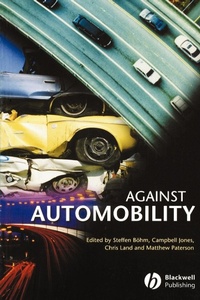
Against Automobility
Published on 21. September 2006
Book
Paperback/Softback
268 pages
978-1-4051-5270-9 (ISBN)
Description
Despite its promise of freedom and autonomy, the ubiquity of the automobile has influenced unforeseen ecological, social, and political change. In Against Automobility, a panel of distinguished scholars take a critical look at the contradiction of the automobile.
A critical account of the impact of the car on society, which is both liberated by and reliant upon motor vehicles.
Written by a panel of distinguished scholars from varying disciplines in the humanities and social sciences.
Examines automobility's effect on environmental, social, and political issues.
Will be of interest to those whose research focuses on geography, politics, consumption and cultural studies, critical theory, and the sociology of objects and everyday life.
A critical account of the impact of the car on society, which is both liberated by and reliant upon motor vehicles.
Written by a panel of distinguished scholars from varying disciplines in the humanities and social sciences.
Examines automobility's effect on environmental, social, and political issues.
Will be of interest to those whose research focuses on geography, politics, consumption and cultural studies, critical theory, and the sociology of objects and everyday life.
More details
Series
Language
English
Place of publication
Hoboken
United Kingdom
Publishing group
John Wiley and Sons Ltd
Target group
Professional and scholarly
Dimensions
Height: 229 mm
Width: 152 mm
Thickness: 14 mm
Weight
393 gr
ISBN-13
978-1-4051-5270-9 (9781405152709)
Copyright in bibliographic data and cover images is held by Nielsen Book Services Limited or by the publishers or by their respective licensors: all rights reserved.
Schweitzer Classification
Persons
Steffen Boehm is Lecturer in Management at the University of Essex and member of the editorial collective of ephemera: theory & politics in organization.
Campbell Jones is Director of the Centre for Philosophy and Political Economy and Senior Lecturer in Critical Theory and Business Ethics at the University of Leicester.
Chris Land is Lecturer in Management at the University of Essex. His research interests include the role of technology in the production and maintenance of human subjectivities and relationships of power and resistance within late-capitalist societies.
Matthew Paterson is Professor of Political Science at the University of Ottawa. His research focuses on the intersection between International Political Economy, International Relations theory and global environmental politics.
Campbell Jones is Director of the Centre for Philosophy and Political Economy and Senior Lecturer in Critical Theory and Business Ethics at the University of Leicester.
Chris Land is Lecturer in Management at the University of Essex. His research interests include the role of technology in the production and maintenance of human subjectivities and relationships of power and resistance within late-capitalist societies.
Matthew Paterson is Professor of Political Science at the University of Ottawa. His research focuses on the intersection between International Political Economy, International Relations theory and global environmental politics.
Content
Part One: Conceptualising Automobility. 1. Impossibilities of Automobility: Steffen Boehm, Campbell Jones, Chris Land and Matthew Paterson.
2. Inhabiting the Car: John Urry.
3. Driving the Social: Joanna Latimer and Rolland Munro.
Part Two: Governing Automobility.
4. Transport: Disciplining the Body that Travels: Jennifer Bonham.
5. 'Mirror, Signal, Manoeuvre': Assembling and Governing the Motorway Driver In Late Fifties Britain: Peter Merriman.
6. Quantifying Automobility: Speed, 'Zero Tolerance' and Democracy: Per-Anders Forstorp.
7. Automobility and the Liberal Disposition: Sudir Chella Rajan.
Part Three: Representing Automobility.
8. No Literal Connection: Images of Mass Commodification, US Militarism, and the Oil Industry, in The Big Lebowski: David Martin-Jones.
9. The Mimetics of Mobile Capital: Nicole Shukin.
10. Traffic, Desire, Modernism: The Hermaphrodite Singer and Beyond: Andrew Thacker.
Part Four: After Automobility.
11. Virtual Automobility: Two Ways To Get a Life: J. Hillis Miller.
12. Bicycle Messengers and the Road to Freedom: Ben Fincham.
13. "Always Crashing in the Same Car": A Head-On Collision with the Machinic Phylum: Mark Dery.
2. Inhabiting the Car: John Urry.
3. Driving the Social: Joanna Latimer and Rolland Munro.
Part Two: Governing Automobility.
4. Transport: Disciplining the Body that Travels: Jennifer Bonham.
5. 'Mirror, Signal, Manoeuvre': Assembling and Governing the Motorway Driver In Late Fifties Britain: Peter Merriman.
6. Quantifying Automobility: Speed, 'Zero Tolerance' and Democracy: Per-Anders Forstorp.
7. Automobility and the Liberal Disposition: Sudir Chella Rajan.
Part Three: Representing Automobility.
8. No Literal Connection: Images of Mass Commodification, US Militarism, and the Oil Industry, in The Big Lebowski: David Martin-Jones.
9. The Mimetics of Mobile Capital: Nicole Shukin.
10. Traffic, Desire, Modernism: The Hermaphrodite Singer and Beyond: Andrew Thacker.
Part Four: After Automobility.
11. Virtual Automobility: Two Ways To Get a Life: J. Hillis Miller.
12. Bicycle Messengers and the Road to Freedom: Ben Fincham.
13. "Always Crashing in the Same Car": A Head-On Collision with the Machinic Phylum: Mark Dery.