

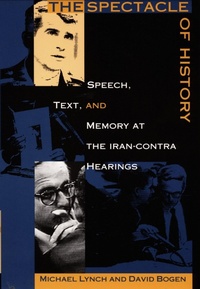
The Spectacle of History
Speech, Text, and Memory at the Iran-Contra Hearings
Published on 5. April 1996
Book
Hardback
368 pages
978-0-8223-1729-6 (ISBN)
Description
How is history produced? How do individuals write-or rewrite-their parts while engaged in the production of history? Michael Lynch and David Bogen take the example of the Iran-contra hearings to explore these questions. These hearings, held in 1987 by the Joint House-Senate Select Committee on Secret Military Assistance to Iran and the Nicaragua Opposition, provided the nation with a media spectacle and a rare chance to see a struggle over the writing of history. There was Oliver North, prime suspect and designated scapegoat, turning into a hero of the American Right before the very eyes of the nation. How this transformation occurred, with the complicity of the press and the public, becomes disturbingly clear in The Spectacle of History.
Lynch and Bogen detail the practices through which the historical agents at the center of the hearings composed, confirmed, used, erased, and denied the historical record. They show how partisan skirmishes over the disclosure of records and testimony led to a divided and irresolute outcome, an outcome further facilitated by the "applied deconstruction" deployed by North and his allies. The Spectacle of History immerses the reader in a crowded field of texts, utterances, visual displays, and media commentaries, but, more than a case study, it develops unique insight into problems at the heart of society and social theory-lying and credibility, the production of civic spectacle, the relationship between testimony and history, the uses of memory, and the interplay between speech and writing.
Drawing on themes from sociology, literary theory, and ethnomethodology and challenging prevailing concepts held by contemporary communication and cultural studies, Lynch and Bogen extract valuable theoretical lessons from this specific and troubling historical episode.
Lynch and Bogen detail the practices through which the historical agents at the center of the hearings composed, confirmed, used, erased, and denied the historical record. They show how partisan skirmishes over the disclosure of records and testimony led to a divided and irresolute outcome, an outcome further facilitated by the "applied deconstruction" deployed by North and his allies. The Spectacle of History immerses the reader in a crowded field of texts, utterances, visual displays, and media commentaries, but, more than a case study, it develops unique insight into problems at the heart of society and social theory-lying and credibility, the production of civic spectacle, the relationship between testimony and history, the uses of memory, and the interplay between speech and writing.
Drawing on themes from sociology, literary theory, and ethnomethodology and challenging prevailing concepts held by contemporary communication and cultural studies, Lynch and Bogen extract valuable theoretical lessons from this specific and troubling historical episode.
More details
Series
Language
English
Place of publication
North Carolina
United States
Target group
College/higher education
Professional and scholarly
Product notice
Cloth over boards
Illustrations
8 b&w photographs
Dimensions
Height: 234 mm
Width: 160 mm
Thickness: 30 mm
Weight
771 gr
ISBN-13
978-0-8223-1729-6 (9780822317296)
Copyright in bibliographic data and cover images is held by Nielsen Book Services Limited or by the publishers or by their respective licensors: all rights reserved.
Schweitzer Classification
Other editions
Additional editions
E-Book
04/1996
1st Edition
Duke University Press Books
€208.99
Available for download
Persons
Michael Lynch is Professor in the Department of Human Sciences at Brunel University, Middlesex.
David Bogen is Assistant Professor of Sociology at Emerson College.
David Bogen is Assistant Professor of Sociology at Emerson College.