

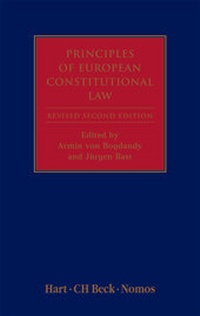
Principles of European Constitutional Law
2nd Edition
Published on 11. April 2011
Book
Paperback/Softback
929 pages
978-1-84946-211-2 (ISBN)
Description
For the time being, the political project of basing the European Union on a document entitled 'Constitution' has failed. The second, revised and enlarged edition of this volume retains its title nonetheless. Building on a scholarly rather than black-letter law account, it shows European constitutional law as it looks following the Treaty of Lisbon, with the EU's foundational treaties mandating the exercise of public authority, establishing a hierarchy of norms and legitimising legal acts, providing for citizenship, and granting fundamental rights. In this way the treaties shape the relations between legal orders, between public interest regulation and market economy, and between law and politics. The contributions demonstrate in detail how a constitutional approach furthers understanding of the core issues of EU law, how it offers theoretical and doctrinal insights, and how it adds critical perspective.
Reviews / Votes
Principles of European Constitutional Law provides an extensive and comprehensive study of European constitutional law examined from the perspective of constitutional scholarship. It consists of 21 original and incisive contributions from leading scholars on fundamental European constitutional law issues. These contributions, although often presenting controversial views, always emphasise both the achievements and the failings of the constitutional law of the European Union as it currently stands. ...the book is highly erudite and written in an intellectually sophisticated language and therefore will be mainly appreciated by legal professionals and scholars rather than by an average undergraduate student. The width of views presented by its contributors makes the book an intriguing read and can be seen as enhancing its value. A particular feature of Principles of European Constitutional Law is that although it was prepared and published before the entry into force of the Treaty of Lisbon, it is still fully up to date. This is because all contributions, in their own way, refer, analyse and assess the matters under consideration in the light of not only the EC treaty and the failed Constitutional Treaty but also from the perspective of the Treaty of Lisbon. Overall, the second edition of Principles of European Constitutional Law represents the highest standard of scholarly sophistication in terms of its content, presentation and quality of legal arguments, provides in valuable insight into European constitutional law, and will certainly stimulate many debates on European constitutional law. This is certainly not a book to be missed by anyone interested in EU law in general and in European constitutional law in particular. -- Professor Alina Kaczorowska European Law Review Volume 36, 2011 ... a thorough examination of the main themes underlying a more closely connected Europe...one can only recommend the purchase of this excellent second edition. -- Birgit Schlutter European Journal of International Law Volume 22, 2011 Reviews of the first edition ...Principles of European Constitutional Law constitutes a deep and thorough examination of most of the issues involved in the always complex and controversial European Union's constitutional debate, whose richness is impossible to give account of in this necessarily short review. -- Gonzalo Arruego Law and Politics Book Review Vol.19, No.10, October 20, 2009 Review of the first edition...presents the quintessence of German European law doctrine in a single volume and should therefore be mandatory reading for anyone who wants to get a holistic perspective of the academic debate on Europe's constitutional foundations...It is impossible to present the richness of thoughts contained in the 833 pages of the book in a short review. -- Daniel Thym Common Market Law Review Vol 44, May 2007 First ed review ...it recommends itself as an enduring scholarly work, which gives an English-speaking audience important, and overdue, access to the long-standing and forever-vigorous traditions of (European) constitutional law that are prevalent within Germany...I have happily passed the summer reading each of the contributions; am a far better (European and constitutional) lawyer for it; and would unhesitatingly recommend the purchase of this book, as well as the very careful perusal of every excellently crafted chapter. -- Michelle Everson European Law Journal Vol. 13 Jan 2007 Review of the first edition...a knowledgeable and detailed book, combining scientific discipline and the desire to shed new light on these issues. -- Frederik Ronse Bulletin Quotidien Europe, No 9219/693 June 2006 Review of the first edition This is real scholarship in the profound sense of the word. I find aspects of thought in it nowhere encountered elsewhere. I am sure I shall often use it. The whole performance underscores again the unique contribution to legal science of the Heidelberg Max Planck Institute -- K. Lenaerts, Professor of European Law, Leuven University May 2006 Review of the first edition The book also provides some useful insights into constitutional understandings. Equally, many of the contributions provide thoughtful analyses and assessments, such as those of Dann on the EU's institutional structure. These will be of particular interest to English readers. And the book provides very detailed expositions of German legal thinking and case law, although the contributors are not afraid to question it. -- Clive Church Journal of Contemporary European Research Vol 3, Issue 2 This is the second edition of a monumental book, updated since the abandonment of the constitutional treaty and its re-emergence in the form of the Lisbon treaty. The great strength of this book is that its authors back up their convictions scientifically by exploring and taking apart each dossier. The work is extremely rich and contains contributions from big academics and legal players. Agence Europe 13/4/2010 [A] thorough examination of the main themes underlying a more closely connected Europe. The book ... presents us with a holistic vision of a European constitutional law, addressing the European institutions and their interaction with the national and international levels, the position of the individual and the policing functions of the EU in the area of freedom, justice and security, as well as the general framework of the social order and visions of the EU's further development. ...one can only recommend the purchase of this excellent second edition. -- Birgit Schlutter International and European Law Book Reviews Online Feb 2011More details
Other editions
Additional editions
Armin von Bogdandy | Juergen Bast
Principles of European Constitutional Law
Book
12/2009
2nd Edition
Hart Publishing
€277.50
Shipment within 15-20 days
Persons
Armin von Bogdandy is director at the Max Planck Institute for Comparative Public Law and International Law, Heidelberg.
Jürgen Bast is a senior research fellow at the Max Planck Institute for Comparative Public Law and International Law, Heidelberg.
Jürgen Bast is a senior research fellow at the Max Planck Institute for Comparative Public Law and International Law, Heidelberg.
Content
Preface
Contents
Table of Cases
Table of European Founding Treaties
Table of National Constitutions
Table of Legislation
Table of International Treaties and Conventions
I Defining the Field of European Constitutional Law
1 Armin von Bogdandy: Constitutional Principles
2 Stefan Oeter: Federalism and Democracy
3 Christoph Grabenwarter: National Constitutional Law Relating to the European Union
4 Robert Uerpmann-Wittzack: The Constitutional Role of
Multilateral Treaty Systems
5 Christoph Möllers: Pouvoir Constituant-Constitution-Constitutionalisation
II Institutional Issues
6 Philipp Dann: The Political Institutions
7 Franz C Mayer: The European Constitution and the Courts
8 Armin von Bogdandy and Jürgen Bast: The Vertical Order of Competences
9 Jürgen Bast: Legal Instruments
10 Antje Wiener: Soft Institutions
III Individual Rights
11 Stefan Kadelbach: Union Citizenship
12 Jürgen Kühling: Fundamental Rights
13 Thorsten Kingreen: Fundamental Freedoms
IV Constitutional Aspects of Economic Law
14 Armin Hatje: The Economic Constitution
15 Josef Drexl: Competition Law as Part of the European Constitution
V On Finality: Contending Legal Visions
16 Ulrich Everling: The European Union Between Community and National Policies and Legal Orders
17 Ulrich Haltern: On Finality
18 Paul Kirchhof: The Legal Structure of the European Union as a Union of States
19 Manfred Zuleeg: The Advantages of the European Constitution-A German Perspective
Index
Contents
Table of Cases
Table of European Founding Treaties
Table of National Constitutions
Table of Legislation
Table of International Treaties and Conventions
I Defining the Field of European Constitutional Law
1 Armin von Bogdandy: Constitutional Principles
2 Stefan Oeter: Federalism and Democracy
3 Christoph Grabenwarter: National Constitutional Law Relating to the European Union
4 Robert Uerpmann-Wittzack: The Constitutional Role of
Multilateral Treaty Systems
5 Christoph Möllers: Pouvoir Constituant-Constitution-Constitutionalisation
II Institutional Issues
6 Philipp Dann: The Political Institutions
7 Franz C Mayer: The European Constitution and the Courts
8 Armin von Bogdandy and Jürgen Bast: The Vertical Order of Competences
9 Jürgen Bast: Legal Instruments
10 Antje Wiener: Soft Institutions
III Individual Rights
11 Stefan Kadelbach: Union Citizenship
12 Jürgen Kühling: Fundamental Rights
13 Thorsten Kingreen: Fundamental Freedoms
IV Constitutional Aspects of Economic Law
14 Armin Hatje: The Economic Constitution
15 Josef Drexl: Competition Law as Part of the European Constitution
V On Finality: Contending Legal Visions
16 Ulrich Everling: The European Union Between Community and National Policies and Legal Orders
17 Ulrich Haltern: On Finality
18 Paul Kirchhof: The Legal Structure of the European Union as a Union of States
19 Manfred Zuleeg: The Advantages of the European Constitution-A German Perspective
Index