

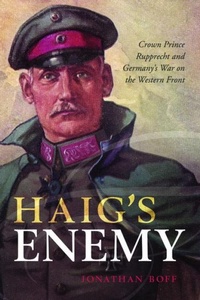
Haig's Enemy
Crown Prince Rupprecht and Germany's War on the Western Front
Published on 9. April 2020
Book
Paperback/Softback
400 pages
978-0-19-967047-5 (ISBN)
Description
During the First World War, the British Army's most consistent German opponent was Crown Prince Rupprecht of Bavaria. Commanding more than a million men as a General, and then Field Marshal, in the Imperial German Army, he held off the attacks of the British Expeditionary Force under Sir John French and then Sir Douglas Haig for four long years. But Rupprecht was to lose not only the war, but his son and his throne.
Haig's Enemy by Jonathan Boff explores the tragic tale of Rupprecht's war--the story of a man caught under the wheels of modern industrial warfare. Providing a fresh viewpoint on the history of the Western Front, Boff draws on extensive research in the German archives to offer a history of the First World War from the other side of the barbed wire. He revises conventional explanations of why the Germans lost with an in-depth analysis of the nature of command, and of the institutional development of the British, French, and German armies as modern warfare was born. Using Rupprecht's own diaries and letters, many of them never before published, Haig's Enemy views the Great War through the eyes of one of Germany's leading generals, shedding new light on many of the controversies of the Western Front.
The picture which emerges is far removed from the sterile stalemate of myth. Instead, Boff re-draws the Western Front as a highly dynamic battlespace, both physical and intellectual, where three armies struggled not only to out-fight, but also to out-think, their enemy. The consequences of falling behind in the race to adapt would be more terrible than ever imagined.
Haig's Enemy by Jonathan Boff explores the tragic tale of Rupprecht's war--the story of a man caught under the wheels of modern industrial warfare. Providing a fresh viewpoint on the history of the Western Front, Boff draws on extensive research in the German archives to offer a history of the First World War from the other side of the barbed wire. He revises conventional explanations of why the Germans lost with an in-depth analysis of the nature of command, and of the institutional development of the British, French, and German armies as modern warfare was born. Using Rupprecht's own diaries and letters, many of them never before published, Haig's Enemy views the Great War through the eyes of one of Germany's leading generals, shedding new light on many of the controversies of the Western Front.
The picture which emerges is far removed from the sterile stalemate of myth. Instead, Boff re-draws the Western Front as a highly dynamic battlespace, both physical and intellectual, where three armies struggled not only to out-fight, but also to out-think, their enemy. The consequences of falling behind in the race to adapt would be more terrible than ever imagined.
Reviews / Votes
Boff has provided a very informative, readable book for a wide audience combining military operational history with a vivid description of moving and even tragic elements of Rupprecht's life. * Christian Stachelbeck, Bundeswehr Centre of Military History and Social Sciences, Potsdam, Germany, First World War Studies * Beautifully written ... a firstclass guide to the way the war was fought from the German perspective. * Jack Sheldon, Western Front Association * Haig's Enemy helps us to understand how the German army developed and changed during the war, as well as how it came to lose. Boff charts an unedifying picture of lessons being learnt and forgotten, top-down interference from the higher command, as well as the growing intensity and lethality of the fighting ... [Haig's Enemy] illustrates the pressures and strains on one man at war, and how he did his best to mitigate them. * Nick Lloyd, The Times Literary Supplement * Using extensive German sources, Boffs scholarly military biography provides a fascinating insight not only into Rupprechts thinking, but also in the First World War from the German side. It is a fresh and unusual take on the war. * Taylor Downing, Military History Monthly * Compelling... both scholarly and very readable... I absolutely recommend it... * David Ian Hall, English Historical Review * Boff has produced a welcome study, which will interest many students of military history. He has introduced a leading German ?gure of the First World War to an anglo-phone audience, and he has offered a persuasive historical analysis of critical issues of staff and command. * Roger Chickering, Journal of Modern History * Boff has produced a welcome study, which will interest many students of military history. He has introduced a leading German figure of the First World War to an anglophone audience, and he has offered a persuasive historical analysis of critical issues of staff and command. * Journal of Modern History * The literature on the First World War has grown enormously over the past three decades, given a further recent boost by the centenary of the war. It thus comes as a surprise to realize that, apart from Paul von Hindenburg and Erich Ludendorff, no senior German commander has yet been the subject of a full English-language biography, though several memoirs appeared in English soon after the war. Historian Jonathan Boff (Univ. of Birmingham) has thus begun to fill a serious gap in the scholarship on World War I. Haig's Enemy centers specifically on Rupprecht, Crown Prince of Bavaria, who, for much of the war, commanded the main German forces opposing the British on the Western Front. * Michigan War Studies Review * Of all diaries and memoirs written by the senior German officers of the First World War, that of Crown Prince Rupprecht of Bavaria has long been regarded as the most revealing. Yet Rupprecht himself has remained elusive, his contribution eclipsed by his more voluble and histrionic contemporaries. Jonathan Boff has not only brought him to life (and to an English audience), but done so in a book that ranges far more widely than a conventional biography. Readers will gain fresh perspectives on the British and French as much as they learn about Rupprecht's Bavarians. * Sir Hew Strachan, University of St Andrews and Editor of the Great Battles series. * Crown Prince Rupprecht was one of the most significant German commanders to face the British Army across No Man's Land, but until now we have lacked a biography in English ... A triumph. * Gary Sheffield, Professor of War Studies, University of Wolverhampton. * This scholarly but lucid and beautifully written account of the German High Command is essential reading for anyone who wishes to understand how the fighting on the Western Front developed during the First World War. * Professor Sir Michael Howard *More details
Language
English
Place of publication
Oxford
United Kingdom
Target group
College/higher education
Professional and scholarly
Product notice
Paperback (trade)
Unsewn / adhesive bound
Illustrations
12 illustrations, 14 maps
Dimensions
Height: 213 mm
Width: 134 mm
Thickness: 40 mm
Weight
396 gr
ISBN-13
978-0-19-967047-5 (9780199670475)
Copyright in bibliographic data and cover images is held by Nielsen Book Services Limited or by the publishers or by their respective licensors: all rights reserved.
Schweitzer Classification
Other editions
Additional editions
E-Book
03/2018
1st Edition
OUP eBook
€9.49
Available for download
E-Book
03/2018
1st Edition
OUP eBook
€9.49
Available for download
Person
Jonathan Boff is a Senior Lecturer in History and War Studies at the University of Birmingham, where he teaches courses on conflict from Homer to Helmand. He specializes in the First World War and his previous book, Winning and Losing on the Western Front: The British Third Army and the Defeat of Germany in 1918 (CUP, 2012) was short-listed for the Templer Medal and for the British Army Book of the Year award. He was educated at Merton College, Oxford and the Department of War Studies, King's College London, and spent twenty years working in finance before returning to academia. He serves on the councils of the National Army Museum and Army Records Society, has worked as a historical consultant with the British Army and the BBC, and is a Fellow of the Royal Historical Society.
Content
Introduction
PART I. TO WAR 1914
1: Rupprecht's Road to War
2: The Battle of the Frontiers
3: The End of the Campaign in Lorraine
4: The First Battle of the Somme
5: To Ypres
PART II. THE ANVIL 1915-16
6: A Difficult Winter
7: A Successful Spring
8: Further Victories
9: Verdun and the Road to the Somme
10: Early Days on the Somme
11: Rupprecht the General
PART III. HOLDING THE LINE 1916-17
12: Rupprecht Takes Command
13: Autumn on the Somme
14: Scorched Earth
15: The Battle of Arras
16: The Battle for Flanders: Summer 1917
17: The Battle for Flanders: To Passchendaele
18: Cambrai
PART IV. YEAR OF DEFEATS 1918
19: Planning the Spring Offensives
20: Operation MICHAEL
21: Operation GEORGETTE and Summer 1918
22: The Hundred Days
23: Rupprecht on the Run
PART V. CONCLUSIONS
24: Rupprecht the Field Marshal
25: Rupprecht and Politics
26: Last Words
Appendix: Note on Military Terminology
PART I. TO WAR 1914
1: Rupprecht's Road to War
2: The Battle of the Frontiers
3: The End of the Campaign in Lorraine
4: The First Battle of the Somme
5: To Ypres
PART II. THE ANVIL 1915-16
6: A Difficult Winter
7: A Successful Spring
8: Further Victories
9: Verdun and the Road to the Somme
10: Early Days on the Somme
11: Rupprecht the General
PART III. HOLDING THE LINE 1916-17
12: Rupprecht Takes Command
13: Autumn on the Somme
14: Scorched Earth
15: The Battle of Arras
16: The Battle for Flanders: Summer 1917
17: The Battle for Flanders: To Passchendaele
18: Cambrai
PART IV. YEAR OF DEFEATS 1918
19: Planning the Spring Offensives
20: Operation MICHAEL
21: Operation GEORGETTE and Summer 1918
22: The Hundred Days
23: Rupprecht on the Run
PART V. CONCLUSIONS
24: Rupprecht the Field Marshal
25: Rupprecht and Politics
26: Last Words
Appendix: Note on Military Terminology