

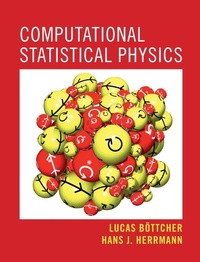
Computational Statistical Physics
Published on 26. August 2021
Book
Hardback
268 pages
978-1-108-84142-9 (ISBN)
Description
Providing a detailed and pedagogical account of the rapidly-growing field of computational statistical physics, this book covers both the theoretical foundations of equilibrium and non-equilibrium statistical physics, and also modern, computational applications such as percolation, random walks, magnetic systems, machine learning dynamics, and spreading processes on complex networks. A detailed discussion of molecular dynamics simulations is also included, a topic of great importance in biophysics and physical chemistry. The accessible and self-contained approach adopted by the authors makes this book suitable for teaching courses at graduate level, and numerous worked examples and end of chapter problems allow students to test their progress and understanding.
More details
Language
English
Place of publication
Cambridge
United Kingdom
Target group
Professional and scholarly
College/higher education
Illustrations
Worked examples or Exercises
Dimensions
Height: 260 mm
Width: 208 mm
Thickness: 19 mm
Weight
812 gr
ISBN-13
978-1-108-84142-9 (9781108841429)
Copyright in bibliographic data and cover images is held by Nielsen Book Services Limited or by the publishers or by their respective licensors: all rights reserved.
Schweitzer Classification
Other editions
Additional editions
Lucas Boettcher | Hans J. Herrmann
Computational Statistical Physics
E-Book
08/2021
Cambridge University Press
€63.49
Available for download
Persons
Lucas Böttcher is Assistant Professor of Computational Social Science at Frankfurt School of Finance and Management and Research Scientist at UCLA's Department of Computational Medicine. His research areas include statistical physics, applied mathematics, complex systems science, and computational physics. He is interested in the application of concepts and models from statistical physics to other disciplines, including biology, ecology, and sociology.
Content
Preface; Part I. Stochastic Methods: 1. Random Numbers; 2. Random-Geometrical Models; 3. Equilibrium Systems; 4. Monte-Carlo Methods; 5. Phase Transitions; 6. Cluster Algorithms; 7. Histogram Methods; 8. Renormalization Group; 9. Learning and Optimizing; 10. Parallelization; 11. Non-Equilibrium Systems; Part II. Molecular Dynamics: 12. Basic Molecular Dynamics; 13. Optimizing Molecular Dynamics; 14. Dynamics of Composed Particles; 15. Long-Range Potentials; 16. Canonical Ensemble; 17. Inelastic Collisions in Molecular Dynamics; 18. Event-Driven Molecular Dynamics; 19. Non-Spherical Particles; 20. Contact Dynamics; 21. Discrete Fluid Models; 22. Ab-Initio Simulations; References; Index.