

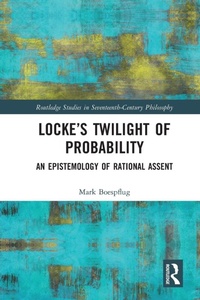
Locke's Twilight of Probability
An Epistemology of Rational Assent
1st Edition
Published on 26. August 2024
Book
Paperback/Softback
162 pages
978-1-032-29384-4 (ISBN)
Description
This book provides a systematic treatment of Locke's theory of probable assent, and shows how the theory applies to Locke's philosophy of science, moral epistemology, and religious epistemology.
There is a powerful case to be made that the most important dimension of Locke's philosophy is his theory of rational probable assent, rather than his theory of knowledge. According to Locke, we largely live our lives in the "twilight of probability" rather than in "the sunshine of certain knowledge." Locke's theory of probable assent has far-reaching significance insofar as it contains a wealth of novel, independently interesting, and prescient elements that precede the modern field of formal epistemology. In this book, the author argues for the central role of probable assent in Locke's philosophy. Locke's theory of probable assent is based on an epistemic modesty that claims, roughly, that our cognitive abilities are limited and that we ought to carry ourselves in believing with due caution. This modesty motivates the author's discussion of other aspects of Locke's epistemology, notably his principle of proportionality, his doxastic involuntarism, his epistemological pragmatism, and his theory of testimony. The book concludes by connecting the theory of probable assent with Locke's views on the limits of science, moral epistemology, and the rationality of faith.
Locke's Twilight of Probability will appeal to scholars and advanced students working on Locke and the history of early modern philosophy.
There is a powerful case to be made that the most important dimension of Locke's philosophy is his theory of rational probable assent, rather than his theory of knowledge. According to Locke, we largely live our lives in the "twilight of probability" rather than in "the sunshine of certain knowledge." Locke's theory of probable assent has far-reaching significance insofar as it contains a wealth of novel, independently interesting, and prescient elements that precede the modern field of formal epistemology. In this book, the author argues for the central role of probable assent in Locke's philosophy. Locke's theory of probable assent is based on an epistemic modesty that claims, roughly, that our cognitive abilities are limited and that we ought to carry ourselves in believing with due caution. This modesty motivates the author's discussion of other aspects of Locke's epistemology, notably his principle of proportionality, his doxastic involuntarism, his epistemological pragmatism, and his theory of testimony. The book concludes by connecting the theory of probable assent with Locke's views on the limits of science, moral epistemology, and the rationality of faith.
Locke's Twilight of Probability will appeal to scholars and advanced students working on Locke and the history of early modern philosophy.
More details
Series
Language
English
Place of publication
London
United Kingdom
Publishing group
Taylor & Francis Ltd
Target group
College/higher education
Professional and scholarly
Academic, Postgraduate, and Undergraduate Advanced
Dimensions
Height: 229 mm
Width: 152 mm
Thickness: 10 mm
Weight
262 gr
ISBN-13
978-1-032-29384-4 (9781032293844)
Copyright in bibliographic data and cover images is held by Nielsen Book Services Limited or by the publishers or by their respective licensors: all rights reserved.
Schweitzer Classification
Other editions
Additional editions
E-Book
10/2022
1st Edition
Routledge
€55.49
Available for download
E-Book
10/2022
1st Edition
Routledge
€55.49
Available for download
Book
10/2022
1st Edition
Routledge
€185.60
Shipment within 10-20 days
Person
Mark Boespflug is an Assistant Professor of Philosophy at Fort Lewis College. He is the author of a number of articles including "Locke on Testimony" (British Journal for the History of Philosophy, 2019) and "Why Reid is no Dogmatist" (Synthese, 2019). He completed his Ph.D. in philosophy at the University of Colorado.
Content
Introduction
1. Epistemic Modesty in a Twilight World
2. The Candle of Reason
3. Probability and Its Grounds
4. Reason's Demand: Proportionate Assent
5. The Involuntariness of Assent
6.
Uncertain Science7. The Elusive Knowledge of Morality
8. Faith as Rational Assent
1. Epistemic Modesty in a Twilight World
2. The Candle of Reason
3. Probability and Its Grounds
4. Reason's Demand: Proportionate Assent
5. The Involuntariness of Assent
6.
Uncertain Science7. The Elusive Knowledge of Morality
8. Faith as Rational Assent