

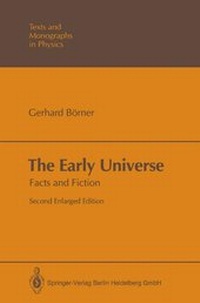
The Early Universe
Facts and Fiction
2nd Edition
Published on 16. April 1992
Book
Paperback/Softback
XVI, 462 pages
978-3-540-54656-6 (ISBN)
Description
Connections developed in recent years between particle
physics and cosmologyare the focus of attention in this new
textbook. The author describes some of the theories which
have been developed to describe the fundamental interaction
of elementary particles in the extremely high temperatures
of the early universe, taking care to distinguish facts and
well-established results from hypotheses and speculations. -
The three parts of the book discuss the standard hot big
bang model of the earlyuniverse, the basic ideas of the
standard and the grand unified theories of elementary
particles, and the influence of dark matter on the
large-scale evolution of structure. In addition to making
some minorcorrections the author has added an appendix
presenting new results and an updated bibliography.
Two main groups of readers are addressed: research students
in astronomy can use this book to understand the impact of
elementary particle theory on cosmology, while research
students in particle physics can use it to acquaint
themselves with the basic facts of cosmology. The book is
written carefully enough to appeal also to a wider audience
of physicists.
physics and cosmologyare the focus of attention in this new
textbook. The author describes some of the theories which
have been developed to describe the fundamental interaction
of elementary particles in the extremely high temperatures
of the early universe, taking care to distinguish facts and
well-established results from hypotheses and speculations. -
The three parts of the book discuss the standard hot big
bang model of the earlyuniverse, the basic ideas of the
standard and the grand unified theories of elementary
particles, and the influence of dark matter on the
large-scale evolution of structure. In addition to making
some minorcorrections the author has added an appendix
presenting new results and an updated bibliography.
Two main groups of readers are addressed: research students
in astronomy can use this book to understand the impact of
elementary particle theory on cosmology, while research
students in particle physics can use it to acquaint
themselves with the basic facts of cosmology. The book is
written carefully enough to appeal also to a wider audience
of physicists.
More details
Series
Edition
2nd enlarged ed.
Language
English
Place of publication
Heidelberg
Germany
Publishing group
Springer Berlin
Target group
College/higher education
Professional and scholarly
Edition type
Revised edition
Product notice
Paperback (UK-trade)
Illustrations
93 figures, 15 colour plates, bibliography
Dimensions
Height: 23.5 cm
Width: 15.5 cm
Weight
755 gr
ISBN-13
978-3-540-54656-6 (9783540546566)
DOI
10.1007/978-3-662-02734-9
Schweitzer Classification
Other editions
New editions
Book
01/2003
4th Edition
Springer
€139.09
Shipment within 10-15 days
Book
08/1993
3rd Edition
Springer
€85.59
Article exhausted; check for reprint
Additional editions
E-Book
04/2013
2nd Edition
Springer
€85.59
Available for download
Previous edition

Book
10/1988
Springer
€68.00
Article exhausted; check for reprint
Content
1 The Cosmological Models.- 2 Facts - Observations of Cosmological Significance.- 3 Thermodynamics of the Early Universe in the Classical Hot-Big-Bang Picture.- 4 Can the Standard Model be Verified Experimentally?.- 5 Gauge Theories and the Standard Model.- 6 Grand Unification Schemes.- 7 Relic Particles from the Early Universe.- 8 Baryon Synthesis.- 9 The Inflationary Universe.- 10 Typical Scales - From Observation and Theory.- 11 The Evolution of Small Perturbations.- 12 Computer Simulations and the Large-Scale Structure.- A.l The Gauge-Invariant Theory of Perturbations.- A. 1.2 Gauge-Invariant Variables.- A. 1.3 Linearized Einstein Equations for Gauge-Invariant Variables.- A. 1.4 Some Remarks on Multi-Component Systems.- Recent Developments.- A. The Cosmic Microwave Background.- B. Nucleosynthesis.- C. Large Scale Motions.- Peculiar Velocities.- D. Observations of the Galaxy Distribution/ Large Scale Structure.- Faint Galaxies.- High Redshift Objects.- Statistics.- E. Numerical Simulations of Galaxy Formation.- F. Some Remarks on Inflation.- References.