

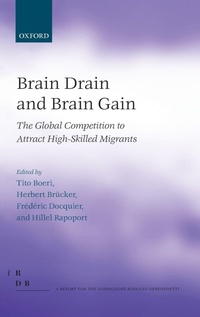
Brain Drain and Brain Gain
The Global Competition to Attract High-Skilled Migrants
Published on 26. July 2012
Book
Hardback
336 pages
978-0-19-965482-6 (ISBN)
Description
The worldwide race to attract talents is getting tougher. The US has been leading the race, with its ability to attract PhD candidates and graduates not only from emerging countries, but also from the European Union. However, a growing number of countries have adopted immigration policies specifically aimed at selecting and attracting skilled workers. This book describes the global competition to attract talents. It focuses in particular on two phenomena: the brain gain and brain drain associated with high-skilled migration.
Part I provides an overview of immigration policies designed to draw in skilled workers. It describes the economic gains associated with skilled immigration in the destination countries and the main determinants of the inflows of skilled immigrants (such as wage premia on education and R&D spending). It also discusses why skill-selective immigration policies do not find more support in receiving countries and shows that interest groups are actively engaged in affecting policies towards skilled migrants. Part II examines the consequences of brain drain for the sending countries. It reviews the channels through which skilled emigration can affect the source countries and looks at remittances, return migration, diaspora externalities, and network effects that may compensate the sending countries for their loss of human capital. Contrary to traditional wisdom, the results indicate that most developing countries experience a net gain from skilled emigration.
Part I provides an overview of immigration policies designed to draw in skilled workers. It describes the economic gains associated with skilled immigration in the destination countries and the main determinants of the inflows of skilled immigrants (such as wage premia on education and R&D spending). It also discusses why skill-selective immigration policies do not find more support in receiving countries and shows that interest groups are actively engaged in affecting policies towards skilled migrants. Part II examines the consequences of brain drain for the sending countries. It reviews the channels through which skilled emigration can affect the source countries and looks at remittances, return migration, diaspora externalities, and network effects that may compensate the sending countries for their loss of human capital. Contrary to traditional wisdom, the results indicate that most developing countries experience a net gain from skilled emigration.
Reviews / Votes
...a collection of valuable academic contributions. * Karin Mayr, London School of Economics *More details
Series
Language
English
Place of publication
Oxford
United Kingdom
Target group
College/higher education
Professional and scholarly
Illustrations
38 Figures, 45 tables, 6 Boxes
Dimensions
Height: 240 mm
Width: 161 mm
Thickness: 23 mm
Weight
669 gr
ISBN-13
978-0-19-965482-6 (9780199654826)
Copyright in bibliographic data and cover images is held by Nielsen Book Services Limited or by the publishers or by their respective licensors: all rights reserved.
Schweitzer Classification
Persons
After obtaining his Ph.D. in Economics from New York University, Tito Boeri was senior economist at the Organisation for Economic Co-operation and Development (OECD) from 1987 to 1996. In this position, among other things, he coordinated all the work carried out by the OECD in the field of human resource policies in the central and eastern European economies in transition after 1990. He was also consultant to the International Monetary Fund and the World Bank. Professor Boeri teaches courses on labour economics and the economics of transition and he is affiliated with the Innocenzo Gasparini Institute for Economic Research (IGIER). He is research fellow of CEPR (Centre for Economic Policy Research) and of the Davidson Institute at the University of Michigan.
Herbert BrA1/4cker studied economics, sociology, and politics at the University of Frankfurt am Main, where he received his doctoral degree in economics in 1994. He received his Habilitation degree in economics from the University of Technology (TU) in Berlin in 2005. He holds the positions of Visiting Professor at the Aarhus School of Business, of senior researcher at the German Institute for Economic Research (DIW Berlin) and the German Development Institute (GDI), and of research associate at the University of Frankfurt.
FrA (c)dA (c)ric Docquier is a Consultant for the World Bank and Economic Advisor at the Regional Government of Wallonia. He holds a Ph.D. in Economics from the University of Aix-Marseille 2. His research interests are in computable general equilibrium models, intergenerational transfers and aging, international migration, and economic development.
Hillel Rapoport holds a Ph.D. in Economics from the University of Paris II. He has been Visiting Assistant Professor at the Stanford University. He also serves or has served as consultant on migration issues for the World Bank, the Inter-American Development Bank, the G-20, and the United Nations University World Institute for Development Economics Research. Hillel's research focuses on the growth and developmental impact of migration on source countries.
Herbert BrA1/4cker studied economics, sociology, and politics at the University of Frankfurt am Main, where he received his doctoral degree in economics in 1994. He received his Habilitation degree in economics from the University of Technology (TU) in Berlin in 2005. He holds the positions of Visiting Professor at the Aarhus School of Business, of senior researcher at the German Institute for Economic Research (DIW Berlin) and the German Development Institute (GDI), and of research associate at the University of Frankfurt.
FrA (c)dA (c)ric Docquier is a Consultant for the World Bank and Economic Advisor at the Regional Government of Wallonia. He holds a Ph.D. in Economics from the University of Aix-Marseille 2. His research interests are in computable general equilibrium models, intergenerational transfers and aging, international migration, and economic development.
Hillel Rapoport holds a Ph.D. in Economics from the University of Paris II. He has been Visiting Assistant Professor at the Stanford University. He also serves or has served as consultant on migration issues for the World Bank, the Inter-American Development Bank, the G-20, and the United Nations University World Institute for Development Economics Research. Hillel's research focuses on the growth and developmental impact of migration on source countries.
Editor
, Professor of Economics, Universita Bocconi and Scientific Director of Fondazione Rodolfo Debenedetti, Italy
, Professor of Economics, University of Bamberg, Germany and Head of Department, International Comparisons and European Integration, Institute for Employment Research (IAB)
, Professor of Economics, Universite Catholique de Louvain, Belgium and Research Associate at the National Fund for Economic Research
, Associate Professor, Bar-Ilan University, Israel
Content
PART I: UNDERSTANDING HIGHLY SKILLED MIGRATION IN DEVELOPED COUNTRIES: THE UPCOMING BATTLE FOR BRAINS; PART II: QUANTIFYING THE IMPACT OF HIGHLY-SKILLED EMIGRATION ON DEVELOPING COUNTRIES