

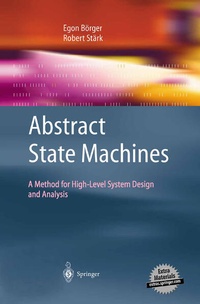
Abstract State Machines
A Method for High-Level System Design and Analysis
Published on 3. October 2013
Book
Paperback/Softback
X, 438 pages
978-3-642-62116-1 (ISBN)
Description
Written for hardware-software system engineers, researchers and students, this text introduces a systems engineering method that guides the development of software and embedded hardware-software systems seamlessly from requirements capture to their implementation. It helps the designer to cope with the three stumbling-blocks of building modern software based systems: size, complexity and trustworthiness. It covers within a single conceptual framework both design, verification by reasoning techniques, and experimental validation by simulation and testing. The text contains detailed proofs, exercises, as well as numerous real-world examples and case studies.
Reviews / Votes
From the reviews:"The Turing Test gives a comprehensive, in-depth and contemporary assessment of this classic topic in artificial intelligence. This book elaborates in detail the numerous conflicting points of view on many aspects of this multifaceted, controversial subject. . This volume is a valuable reading for research on the Turing test and for teaching undergraduate and graduate students in philosophy, computer science, and cognitive science." (Jörg Desel, Zentralblatt MATH, Vol. 1040 (9), 2004)"Borger and Stark do an admirable job of documention and extending a method for bridging the considerable gap between theoretical system models, which often only allow for toy systems to be modeled and require proofs to be done only by hand, and real-life systems and practices." (Shrisha, Rao, Ceda Rapids, IA, Computing Reviews, February, 2004)More details
Edition
Softcover reprint of the original 1st ed. 2003
Language
English
Place of publication
Berlin
Germany
Publishing group
Springer Berlin
Target group
Professional and scholarly
Professional/practitioner
Illustrations
X, 438 p.
Dimensions
Height: 235 mm
Width: 155 mm
Thickness: 25 mm
Weight
680 gr
ISBN-13
978-3-642-62116-1 (9783642621161)
DOI
10.1007/978-3-642-18216-7
Schweitzer Classification
Other editions
Additional editions
Egon Börger | Robert Stärk
Abstract State Machines
A Method for High-Level System Design and Analysis
E-Book
12/2012
Springer
€53.49
Available for download
Egon Börger | Robert Stärk
Abstract State Machines
A Method for High-Level System Design and Analysis
Book
04/2003
Springer
€53.49
Shipment within 7-9 days
Persons
Egon Boerger has worked since 1972 as professor of computer science at the Universities of Salerno, Muenster, Dortmund, Udine and Pisa (since 1985). He spent sabbatical years with IBM, Siemens, Microsoft, SAP and ETH Zürich. He is the author of seven books on logic, computer science and modeling business processes. In 2007 he received the Humboldt Research Award for his work in logic and computer science. His current interest is in rigorous design and analysis methods for concurrent software-intensive systems.
Vincenzo Gervasi is an Associate Professor with the Computer Science Department of the University of Pisa, Italy. His main research interests lie in the cognitive aspects of the construction and comprehension of software. His current work areas include requirements engineering, software engineering, formal specifications, natural language processing, distributed algorithms and applications, and AI for biomedical applications. On these subjects he has published over 120 contributions in international venues. He is a member of IFIP WG 2.9 (Requirements Engineering).
Content
1 Introduction.- 1.1 Goals of the Book and Contours of its Method.- 1.2 Synopsis of the Book.- 2 ASM Design and Analysis Method.- 2.1 Principles of Hierarchical System Design.- 2.2 Working Definition.- 2.3 Explanation by Example: Correct Lift Control.- 2.4 Detailed Definition (Math. Foundation).- 2.5 Notational Conventions.- 3 Basic ASMs.- 3.1 Requirements Capture by Ground Models.- 3.2 Incremental Design by Refinements.- 3.3 Microprocessor Design Case Study.- 4 Structured ASMs (Composition Techniques).- 4.1 Turbo ASMs (seq, iterate, submachines, recursion).- 4.2 Abstract State Processes (Interleaving).- 5 Synchronous Multi-Agent ASMs.- 5.1 Robot Controller Case Study.- 5.2 Real-Time Controller (Railroad Crossing Case Study).- 6 Asynchronous Multi-Agent ASMs.- 6.1 Async ASMs: Definition and Network Examples.- 6.2 Embedded System Case Study.- 6.3 Time-Constrained Async ASMs.- 6.4 Async ASMs with Durative Actions.- 6.5 Event-Driven ASMs.- 7 Universal Design and Computation Model.- 7.1 Integrating Computation and Specification Models.- 7.2 Sequential ASM Thesis (A Proof from Postulates).- 8 Tool Support for ASMs.- 8.1 Verification of ASMs.- 8.2 Model Checking of ASMs.- 8.3 Execution of ASMs.- 9 History and Survey of ASM Research.- 9.1 The Idea of Sharpening Turing's Thesis.- 9.2 Recognizing the Practical Relevance of ASMs.- 9.3 Testing the Practicability of ASMs.- 9.4 Making ASMs Fit for their Industrial Deployment.- 9.5 Conclusion and Outlook.- References.- List of Problems.- List of Figures.- List of Tables.