

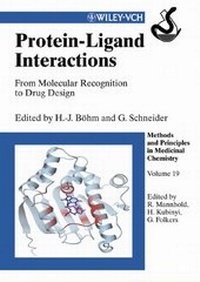
Protein-Ligand Interactions
From Molecular Recognition to Drug Design
1st Edition
Published on 11. March 2003
Book
Hardback
XX, 242 pages
978-3-527-30521-6 (ISBN)
Description
The lock-and-key principle formulated by Emil Fischer as early as the end of the 19th century has still not lost any of its significance for the life sciences. The basic aspects of ligand-protein interaction may be summarized under the term 'molecular recognition' and concern the specificity as well as stability of ligand binding.
Molecular recognition is thus a central topic in the development of active substances, since stability and specificity determine whether a substance can be used as a drug. Nowadays, computer-aided prediction and intelligent molecular design make a large contribution to the constant search for, e. g., improved enzyme inhibitors, and new concepts such as that of pharmacophores are being developed.
An up-to-date presentation of an eternally young topic, this book is an indispensable information source for chemists, biochemists and pharmacologists dealing with the binding of ligands to proteins.
Reviews / Votes
"...well written, organized, indexed, and covers the essentials of molecular recognition or protein-ligand interactions." (SIM News, November/December 2004)More details
Series
Edition
1., Auflage
Language
English
Place of publication
Weinheim
Germany
Target group
Professional and scholarly
Medizinische Chemiker, Biochemiker, Proteinchemiker, Pharmazeutische Chemiker, Pharmaindustrie
Illustrations
101
78 s/w Abbildungen, 14 farbige Abbildungen, 9 s/w Tabellen
illustrations
Dimensions
Height: 24 cm
Width: 17 cm
Weight
637 gr
ISBN-13
978-3-527-30521-6 (9783527305216)
Schweitzer Classification
Other editions
Additional editions
Hans-Joachim Böhm | Gisbert Schneider
Protein-Ligand Interactions
From Molecular Recognition to Drug Design
E-Book
03/2006
1st Edition
Wiley-VCH
€124.99
Available for download
Persons
Content
Prologue
Prediction of non-bonded interactions in drug design
Introduction to molecular recognition models
Experimental approaches to determine the thermodynamics of protein-ligand interactions
The biophore concept
Receptor-ligand interaction
Hydrogen bonds in protein-ligand complexes
Principles of enzyme inhibitor design
Tailoring protein scaffolds for ligand binding
Small molecule screening on chemical microarrays