

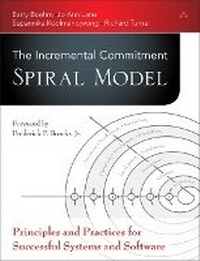
The Incremental Commitment Spiral Model
Principles and Practices for Successful Systems and Software
Published on 19. June 2014
Book
Paperback/Softback
336 pages
978-0-321-80822-6 (ISBN)
Description
"The title makes a huge promise: a way to divide commitment into increments that are both meetable (good news for developers) and meaningful (good news for managers and stakeholders). And the book makes good on that promise." -Tom DeMarco, Principal, The Atlantic Systems Guild, author of Peopleware, Deadline, and Slack
"I am seriously impressed with this ICSM book. Besides being conceptually sound, I was amazed by the sheer number of clear and concise characterizations of issues, relationships, and solutions. I wanted to take a yellow highlighter to it until I realized I'd be highlighting most of the book."
-Curt Hibbs, Chief Agile Evangelist, Boeing
Use the ICSM to Generate and Evolve Your Life-Cycle Process Assets to Best Fit Your Organization's Diverse and Changing Needs
Many systems development practitioners find traditional "one-size-fits-all" processes inadequate for the growing complexity, diversity, dynamism, and assurance needs of their products and services. The Incremental Commitment Spiral Model (ICSM) responds with a principle- and risk-based framework for defining and evolving your project and corporate process assets, avoiding pitfalls and disruption, and leveraging opportunities to increase value.
This book explains ICSM's framework of decision criteria and principles, and shows how to apply them through relevant examples. It demonstrates ICSM's potential for reducing rework and technical debt, improving maintainability, handling emergent requirements, and raising assurance levels.
Its coverage includes
What makes a system development successful
ICSM's goals, principles, and usage as a process-generation framework
Creating and evolving processes to match your risks and opportunities
Integrating your current practices and adopting ICSM concepts incrementally, focusing on your greatest needs and opportunities
About the Website: Download the evolving ICSM guidelines, subprocesses, templates, tools, white papers, and academic support resources at csse.usc.edu/ICSM.
"I am seriously impressed with this ICSM book. Besides being conceptually sound, I was amazed by the sheer number of clear and concise characterizations of issues, relationships, and solutions. I wanted to take a yellow highlighter to it until I realized I'd be highlighting most of the book."
-Curt Hibbs, Chief Agile Evangelist, Boeing
Use the ICSM to Generate and Evolve Your Life-Cycle Process Assets to Best Fit Your Organization's Diverse and Changing Needs
Many systems development practitioners find traditional "one-size-fits-all" processes inadequate for the growing complexity, diversity, dynamism, and assurance needs of their products and services. The Incremental Commitment Spiral Model (ICSM) responds with a principle- and risk-based framework for defining and evolving your project and corporate process assets, avoiding pitfalls and disruption, and leveraging opportunities to increase value.
This book explains ICSM's framework of decision criteria and principles, and shows how to apply them through relevant examples. It demonstrates ICSM's potential for reducing rework and technical debt, improving maintainability, handling emergent requirements, and raising assurance levels.
Its coverage includes
What makes a system development successful
ICSM's goals, principles, and usage as a process-generation framework
Creating and evolving processes to match your risks and opportunities
Integrating your current practices and adopting ICSM concepts incrementally, focusing on your greatest needs and opportunities
About the Website: Download the evolving ICSM guidelines, subprocesses, templates, tools, white papers, and academic support resources at csse.usc.edu/ICSM.
Reviews / Votes
"The Incremental Commitment Spiral Model is an extraordinary work. Boehm and his colleagues have succeeded in creating a readable, practical, and eminently usable resource for the practicing systems engineer. . . . ICSM embodies systems thinking and engineering principles and best practices using real-life examples from many different application domains. This is exactly the kind of treatment that an engineer needs to translate the book's considerable wisdom into practical on-the-job solutions." -George Rebovich, Jr., Director, Systems Engineering Practice Office, The MITRE Corporation"One might think of this new book as an update of the old (1988) Spiral Model, but it is actually much more than that. It is a ground-breaking treatment that expertly blends together four specific and key principles, risk-opportunity management, the use of existing assets and processes, and lessons learned from both success and failure examples and case studies. This extraordinary treatise will very likely lead to improvements in many of the current software development approaches and achieve the authors' intent 'to better integrate the hardware, software, and human factors aspects of such systems, to provide value to the users as quickly as possible, and to handle the increasingly rapid pace of change.' If one is looking for specific ways to move ahead, use this book and its well-articulated advancements in the state-of-the-art."
-Dr. Howard Eisner, Professor Emeritus and Distinguished Research Professor, George Washington University
"Dr. Boehm and his coauthors have integrated a wealth of field experience in many domains and created a new kind of life cycle, one that you have to construct based on the constraints and objectives of the project. It is based on actively trading off risks and demonstrating progress by showing actual products, not paper substitutes. And the model applies to everything we build, not just software and conceptual systems, but also to hardware, buildings, and garden plots. We have long needed this experience-based critical thinking, this summative and original work, that will help us avoid chronic systems development problems (late, over-budget, doesn't work) and instead build new life cycles matched to the circumstances of the real world."
-Stan Rifkin, Principal, Master Systems
"Barry Boehm and his colleagues have created a practical methodology built upon the one fundamental truth that runs through all competitive strategies: The organization with the clearest view of cold, brutal reality wins. Uniquely, their methodology at every stage incorporates the coldest reality of them all-the customer's willingness to continue paying, given where the project is today and where it is likely ever to be."
-Chet Richards, author of Certain to Win: The Strategy of John Boyd Applied to Business
"I really like the concept of the ICSM and have been using some of the principles in my work over the past few years. This book has the potential to be a winner!"
-Hillary Sillito, INCOSE Fellow, Visiting Professor University of Bristol, formerly Thales UK Director of Systems Engineering
"The Incremental Commitment Spiral Model deftly combines aspects of the formerly isolated major systems approaches of systems engineering, lean, and agile. It also addresses perhaps the widest span of system sizes and time scales yet. Two kinds of systems enterprises especially need this capability: those at the 'heavy' end where lean and agile have had little impact to date, and those that deal with a wide span of system scales. Both will find in the ICSM's combination of systems approaches a productive and quality advantage that using any one approach in isolation cannot touch."
-James Maxwell Sutton, President, Lean Systems Society and Shingo Prize winner
"The potential impact of this book cannot be overstressed. Software-intensive systems that are not adequately engineered and managed do not adequately evolve over the systems life cycle. The beauty of this book is that it describes an incremental capability decision path for being successful in developing and acquiring complex systems that are effective, resilient, and affordable with respect to meeting stakeholders' needs. I highly recommend this book as a 'must read' for people directly involved in the development, acquisition, and management of software-intensive systems."
-Dr. Kenneth E. Nidiffer, Director of Strategic Plans for Government Programs, Software Engineering Institute, Carnegie Mellon University
"This text provides a significant advance in the continuing work of the authors to evolve the spiral model by integrating it with the incremental definition and the incremental development and evolution life-cycle stages. Case studies illustrate how application of the four principles and the Fundamental Systems Success Theorem provides a framework that advances previous work. Emphasis is placed throughout on risk-based analysis and decision making. The text concludes with guidance for applying ICSM in your organization plus some helpful appendices. We concur with the authors' statement: 'we are confident that this incarnation of the spiral model will be useful for a long time to come.'"
-Dick Fairley, PhD, Software and Systems Engineering Associates (S2EA)
"This book nicely integrates the different refinements of the spiral model and the various additions made over the years. . . . the book contains great material for classes on software engineering in general and software processes in particular. I have been teaching the spiral model and its invariants for more than 10 years now, and I will use material from this book in the years to come."
-Paul Gru?nbacher, Associate Professor, Johannes Kepler University Linz, Head of the Christian Doppler Lab for Monitoring and Evolution of Very-Large-Scale Software Systems
"What I found most useful in The Incremental Commitment Spiral Model were the stories of where we have gone wrong in the past, and how using the four key ICSM principles articulated by Barry and his co-authors could have helped these failed efforts maintain a course to success. ICSM is not a new method. It does not ask you to discard what has proved useful in the past and start over. Rather, it provides a set of guideposts that can help any organization facing increasingly challenging endeavors make more timely evidence-based decisions. We have been hearing about the 'what' for many years, this book gives you the needed 'how' and, more importantly, the needed 'how much' guidance that has been sorely missing."
-Paul E. McMahon, author of Integrating CMMI and Agile Development
"The authors are uniquely qualified to bring together a historical context and a modern problem: successful development of engineered systems with ever greater complexity and richer than ever functionality, enabled by software. They do not disappoint!"
-Dinesh Verma, PhD, Professor and Dean, School of Systems and Enterprises, Stevens Institute of Technology
More details
Other editions
Additional editions
Barry Boehm | Jo Ann Lane | Supannika Koolmanojwong
Incremental Commitment Spiral Model, The
Principles and Practices for Successful Systems and Software
E-Book
05/2014
1st Edition
Addison Wesley
€45.99
Available for download
Barry Boehm | Jo Ann Lane | Supannika Koolmanojwong
Incremental Commitment Spiral Model, The
Principles and Practices for Successful Systems and Software
E-Book
05/2014
1st Edition
Addison Wesley
€47.49
Available for download
Persons
Barry Boehm developed a conceptual version of the spiral model at TRW in 1978, but only in 1981 was he able to employ it in successfully, leading the development of a corporate TRW software development environment. SInce the formal publication of this model in 1988, he and his colleagues have devoted extensive efforts to clarifying and evolving it through several intermediate versions into the ICSM. He is the USC Distinguished Professor of Computer Sciences, Industrial and Systems Engineering, and Astronautics; the TRW Professor of Software Engineering; the Chief Scientist of the DoD-Stevens-USC Systems Engineering Research Center, and the founding Director of the USC Center for Systems and Software Engineering. He was director of DARPA-ISTO for 1989-92, at TRW for 1973-89, at Rand Corporation for 1959-73, and at General Dynamics for 1955-59. He is a Fellow of the primary professional societies in computing (ACM), aerospace (AIAA), electronics (IEEE), systems engineering (INCOSE), and lean and agile development (LSS), and a member of the U.S. National Academy of Engineering.
Jo Ann Lane is currently the systems engineering Co-Director of the University of Southern California Center for Systems and Software Engineering, a member of the Systems Engineering Research Center (SERC) Research Council representing the system of systems research area, and emeritus professor of computer science at San Diego State University. Her current areas of research include system of systems engineering, system affordability, expediting systems engineering, balancing lean and agile techniques with technical debt, and innovation in systems engineering. Previous publications include over 50 journal articles and conference papers. In addition, she was co-author of the 2008 Department of Defense Systems Engineering Guide for Systems of Systems and a contributor to the Systems Engineering Body of Knowledge (SEBoK). Prior to her current work in academia, she was a Vice President in SAIC's Healthcare and Software and Systems Integration groups.
Supannika Koolmanojwong is a faculty member and a researcher at the University of Southern California Center for Systems and Software Engineering. Her primary research areas are systems and software process modeling, software process improvement, software process quality assurance, software metrics and measurement, agile and lean software development and expediting systems engineering. She is a certified ScrumMaster and a certified Product Owner. Prior to joining USC, Dr. Koolmanojwong was a software engineer and a RUP/OpenUp Content Developer at IBM RationalSoftware Group.
Dr. Richard Turner has more than 30 years of experience in systems, software, and acquisition engineering. He is currently a Distinguished Service Professor at the Stevens Institute of Technology in Hoboken, New Jersey, and a Principle Investigator with the Systems Engineering Research Center. Although on the author team for CMMI, Dr. Turner is now active in the agile, lean, and kanban communities. He is currently studying agility and lean approaches as a means to solve large-systems issues. Dr. Turner is a member of the Executive Committee of the NDIA/AFEI Agile for Defense Adoption Proponent Team, the INCOSE Agile SE Working Group, and was an author of the groundbreaking IEEE Computer Society/PMI Software Extension for the Guide to the PMBOK that spans the gap between traditional and agile approaches. He is a Fellow of the Lean Systems Society, a Golden Core awardee of the IEEE Computer Society, and co-author of three other books: Balancing Agility and Discipline: A Guide for the Perplexed, co-written with Barry Boehm, CMMI Survival Guide: Just Enough Process Improvement, coauthored with Suzanne Garcia, and CMMI Distilled.
Jo Ann Lane is currently the systems engineering Co-Director of the University of Southern California Center for Systems and Software Engineering, a member of the Systems Engineering Research Center (SERC) Research Council representing the system of systems research area, and emeritus professor of computer science at San Diego State University. Her current areas of research include system of systems engineering, system affordability, expediting systems engineering, balancing lean and agile techniques with technical debt, and innovation in systems engineering. Previous publications include over 50 journal articles and conference papers. In addition, she was co-author of the 2008 Department of Defense Systems Engineering Guide for Systems of Systems and a contributor to the Systems Engineering Body of Knowledge (SEBoK). Prior to her current work in academia, she was a Vice President in SAIC's Healthcare and Software and Systems Integration groups.
Supannika Koolmanojwong is a faculty member and a researcher at the University of Southern California Center for Systems and Software Engineering. Her primary research areas are systems and software process modeling, software process improvement, software process quality assurance, software metrics and measurement, agile and lean software development and expediting systems engineering. She is a certified ScrumMaster and a certified Product Owner. Prior to joining USC, Dr. Koolmanojwong was a software engineer and a RUP/OpenUp Content Developer at IBM RationalSoftware Group.
Dr. Richard Turner has more than 30 years of experience in systems, software, and acquisition engineering. He is currently a Distinguished Service Professor at the Stevens Institute of Technology in Hoboken, New Jersey, and a Principle Investigator with the Systems Engineering Research Center. Although on the author team for CMMI, Dr. Turner is now active in the agile, lean, and kanban communities. He is currently studying agility and lean approaches as a means to solve large-systems issues. Dr. Turner is a member of the Executive Committee of the NDIA/AFEI Agile for Defense Adoption Proponent Team, the INCOSE Agile SE Working Group, and was an author of the groundbreaking IEEE Computer Society/PMI Software Extension for the Guide to the PMBOK that spans the gap between traditional and agile approaches. He is a Fellow of the Lean Systems Society, a Golden Core awardee of the IEEE Computer Society, and co-author of three other books: Balancing Agility and Discipline: A Guide for the Perplexed, co-written with Barry Boehm, CMMI Survival Guide: Just Enough Process Improvement, coauthored with Suzanne Garcia, and CMMI Distilled.
Content
Foreword xiii Preface xv
About the Authors xxi
Prologue 3
Chapter 0: Introduction 7
0.1 A World of Change 7
0.2 Creating Successful 21st-Century Systems 9
0.3 ICSM Distilled 16
0.4 Using the ICSM 25
0.5 Incremental ICSM Adoption Approaches 28
0.6 Examples of ICSM Use 29
0.7 How ICSM Might Have Helped a Complex Government Acquisition (healthcare.gov) 30
References 32
Part I: The Four ICSM Principles 35
Chapter 1: The First Principle: Stakeholder Value-Based Guidance 37
1.1 Failure Story: The Too-Good Road Surface Assessment Robot 38
1.2 Success Story: The Hospira Next-Generation Intravenous Medical Pump 42
1.3 The Fundamental System Success Theorem and Its Implications 47
1.4 The System Success Realization Theorem and Its Implications 49
References 55
Chapter 2: The Second Principle: Incremental Commitment and Accountability 57
2.1 A Failed Total-Commitment Project: Bank of America's MasterNet 59
2.2 A Successful Incremental-Commitment Project: The TRW Software Productivity System 63
2.3 The Two Cones of Uncertainty and the ICSM Stages I and II 69
2.4 Alternative Incremental and Evolutionary Development Models 71
2.5 Development as C2ISR 75
References 78
Chapter 3: The Third Principle: Concurrent Multidiscipline Engineering 81
3.1 Failure Story: Sequential RPV Systems Engineering and Development 84
3.2 Success Story: Concurrent Competitive-Prototyping RPV Systems Development 86
3.3 Concurrent Development and Evolution Engineering 89
3.4 Concurrent Engineering of Hardware, Software, and Human Factors Aspects 92
3.5 Concurrent Requirements and Solutions Engineering 94
References 96
Chapter 4: The Fourth Principle: Evidence- and Risk-Based Decisions 97
4.1 Failure Story: The Unaffordable Requirement 99
4.2 Success Story: CCPDS-R 101
4.3 Feasibility Evidence as a First-Class Deliverable 104
4.4 How Much of Anything Is Enough? 107
4.5 Summing Up the Principles 108
References 109
Part II: ICSM Life Cycle and Stage I: Incremental Definition 113
Chapter 5: The ICSM Life Cycle 115
5.1 ICSM Life Cycle 115
5.2 Comparison of ICSM to Other Life-Cycle Models 115
5.3 Stage I: Deciding Why, What, When, Who, Where, How, and How Much 119
5.4 ICSM Case Study 120
Chapter 6: Exploration Phase 123
6.1 What Is the Exploration Phase? 123
6.2 What Are the Potential Pitfalls during Exploration? 126
6.3 Potential Major Risks to Watch for at the End of Exploration 127
6.4 How Exploration Scales from Small to Large, Complex Systems 128
6.5 Role of Principles in Exploration Activities 128
6.6 Exploration for the MedFRS Initiative 129
Chapter 7: Valuation Phase 133
7.1 What Is the Valuation Phase? 133
7.2 What Are the Potential Pitfalls during Valuation? 135
7.3 Major Risks to Watch for at End of Valuation 136
7.4 How Valuation Scales from Small to Large, Complex Systems 137
7.5 Role of Principles in Valuation Activities 138
7.6 Valuation for the MedFRS Initiative 139
Chapter 8: Foundations Phase 143
8.1 What Is the Foundations Phase? 143
8.2 What Are the Potential Pitfalls during Foundations? 146
8.3 Major Risks to Watch for at the End of Foundations 146
8.4 How Foundations Effort Scales from Small to Large, Complex Systems 147
8.5 Role of Principles in Foundations Activities 149
8.6 Foundations for the MedFRS System of Systems 150
8.7 Stage I Summary 152
Reference 152
Part III: Stage II: Incremental Development and Evolution 155
Chapter 9: Development Phase 157
9.1 What Is the Development Phase? 157
9.2 Ready to Release? 169
9.3 What Are the Potential Pitfalls during Development? 171
9.4 Major Risks to Watch for during Development 171
9.5 How Development Scales from Small to Large, Complex Systems 172
9.6 Role of Principles in Development Activities 174
9.7 MedFRS Development 174
Reference 178
Chapter 10: System Production and Operations 179
10.1 What Is "Production"? 179
10.2 What Are the Potential Pitfalls during Production? 180
10.3 Major Risks to Watch for during Production 181
10.4 What Is the Systems Operations Phase? 181
10.5 What Are the Potential Pitfalls during Operations? 183
10.6 Major Risks to Watch for during Operations 183
10.7 Production and Operations for the MedFRS Initiative 184
10.8 Stage II Summary 185
Part IV: Applying ICSM to Your Organization 189
Chapter 11: ICSM Patterns and Common Cases 191
11.1 ICSM Patterns 192
11.2 ICSM Common Cases 194
11.3 Common Case Examples 201
11.4 Summary: The ICSM Common Cases Overview 204
References 204
Chapter 12: ICSM and Your Organization 205
12.1 Leveraging Your Current Process Investments 205
12.2 Maximizing the Value of Your Organizational Knowledge 208
12.3 Where the Impact Is 208
References 210
Chapter 13: Evidence-Based Life-Cycle Management 211
13.1 Motivation and Context 211
13.2 Commitment Review Process Overview 212
13.3 Feasibility Evidence Description Development Process 213
13.4 Evaluation Framework for the FED 217
13.5 Example of Use 218
13.6 Applicability Outside ICSM 221
References 222
Chapter 14: Cost and Schedule Evidence Development 223
14.1 A Review of Primary Methods for Cost and Schedule Estimation 225
14.2 Estimations and the ICSM 228
14.3 The Bottom Line 233
References 233
Chapter 15: Risk-Opportunity Assessment and Control 235
15.1 The Duality of Risks and Opportunities 235
15.2 Fundamentals of Risk-Opportunity Management 236
15.3 Risk Management within ICSM 244
15.4 Risk and Opportunity Management Tools 245
15.5 Using Risk to Determine How Much Evidence Is Enough 247
References 247
Afterword 249
Appendix A: Evidence Evaluation Framework 253
Appendix B: Mapping between ICSM and Other Standards 261
Appendix C: A Value-Based Theory of Systems Engineering 277
Index 299
About the Authors xxi
Prologue 3
Chapter 0: Introduction 7
0.1 A World of Change 7
0.2 Creating Successful 21st-Century Systems 9
0.3 ICSM Distilled 16
0.4 Using the ICSM 25
0.5 Incremental ICSM Adoption Approaches 28
0.6 Examples of ICSM Use 29
0.7 How ICSM Might Have Helped a Complex Government Acquisition (healthcare.gov) 30
References 32
Part I: The Four ICSM Principles 35
Chapter 1: The First Principle: Stakeholder Value-Based Guidance 37
1.1 Failure Story: The Too-Good Road Surface Assessment Robot 38
1.2 Success Story: The Hospira Next-Generation Intravenous Medical Pump 42
1.3 The Fundamental System Success Theorem and Its Implications 47
1.4 The System Success Realization Theorem and Its Implications 49
References 55
Chapter 2: The Second Principle: Incremental Commitment and Accountability 57
2.1 A Failed Total-Commitment Project: Bank of America's MasterNet 59
2.2 A Successful Incremental-Commitment Project: The TRW Software Productivity System 63
2.3 The Two Cones of Uncertainty and the ICSM Stages I and II 69
2.4 Alternative Incremental and Evolutionary Development Models 71
2.5 Development as C2ISR 75
References 78
Chapter 3: The Third Principle: Concurrent Multidiscipline Engineering 81
3.1 Failure Story: Sequential RPV Systems Engineering and Development 84
3.2 Success Story: Concurrent Competitive-Prototyping RPV Systems Development 86
3.3 Concurrent Development and Evolution Engineering 89
3.4 Concurrent Engineering of Hardware, Software, and Human Factors Aspects 92
3.5 Concurrent Requirements and Solutions Engineering 94
References 96
Chapter 4: The Fourth Principle: Evidence- and Risk-Based Decisions 97
4.1 Failure Story: The Unaffordable Requirement 99
4.2 Success Story: CCPDS-R 101
4.3 Feasibility Evidence as a First-Class Deliverable 104
4.4 How Much of Anything Is Enough? 107
4.5 Summing Up the Principles 108
References 109
Part II: ICSM Life Cycle and Stage I: Incremental Definition 113
Chapter 5: The ICSM Life Cycle 115
5.1 ICSM Life Cycle 115
5.2 Comparison of ICSM to Other Life-Cycle Models 115
5.3 Stage I: Deciding Why, What, When, Who, Where, How, and How Much 119
5.4 ICSM Case Study 120
Chapter 6: Exploration Phase 123
6.1 What Is the Exploration Phase? 123
6.2 What Are the Potential Pitfalls during Exploration? 126
6.3 Potential Major Risks to Watch for at the End of Exploration 127
6.4 How Exploration Scales from Small to Large, Complex Systems 128
6.5 Role of Principles in Exploration Activities 128
6.6 Exploration for the MedFRS Initiative 129
Chapter 7: Valuation Phase 133
7.1 What Is the Valuation Phase? 133
7.2 What Are the Potential Pitfalls during Valuation? 135
7.3 Major Risks to Watch for at End of Valuation 136
7.4 How Valuation Scales from Small to Large, Complex Systems 137
7.5 Role of Principles in Valuation Activities 138
7.6 Valuation for the MedFRS Initiative 139
Chapter 8: Foundations Phase 143
8.1 What Is the Foundations Phase? 143
8.2 What Are the Potential Pitfalls during Foundations? 146
8.3 Major Risks to Watch for at the End of Foundations 146
8.4 How Foundations Effort Scales from Small to Large, Complex Systems 147
8.5 Role of Principles in Foundations Activities 149
8.6 Foundations for the MedFRS System of Systems 150
8.7 Stage I Summary 152
Reference 152
Part III: Stage II: Incremental Development and Evolution 155
Chapter 9: Development Phase 157
9.1 What Is the Development Phase? 157
9.2 Ready to Release? 169
9.3 What Are the Potential Pitfalls during Development? 171
9.4 Major Risks to Watch for during Development 171
9.5 How Development Scales from Small to Large, Complex Systems 172
9.6 Role of Principles in Development Activities 174
9.7 MedFRS Development 174
Reference 178
Chapter 10: System Production and Operations 179
10.1 What Is "Production"? 179
10.2 What Are the Potential Pitfalls during Production? 180
10.3 Major Risks to Watch for during Production 181
10.4 What Is the Systems Operations Phase? 181
10.5 What Are the Potential Pitfalls during Operations? 183
10.6 Major Risks to Watch for during Operations 183
10.7 Production and Operations for the MedFRS Initiative 184
10.8 Stage II Summary 185
Part IV: Applying ICSM to Your Organization 189
Chapter 11: ICSM Patterns and Common Cases 191
11.1 ICSM Patterns 192
11.2 ICSM Common Cases 194
11.3 Common Case Examples 201
11.4 Summary: The ICSM Common Cases Overview 204
References 204
Chapter 12: ICSM and Your Organization 205
12.1 Leveraging Your Current Process Investments 205
12.2 Maximizing the Value of Your Organizational Knowledge 208
12.3 Where the Impact Is 208
References 210
Chapter 13: Evidence-Based Life-Cycle Management 211
13.1 Motivation and Context 211
13.2 Commitment Review Process Overview 212
13.3 Feasibility Evidence Description Development Process 213
13.4 Evaluation Framework for the FED 217
13.5 Example of Use 218
13.6 Applicability Outside ICSM 221
References 222
Chapter 14: Cost and Schedule Evidence Development 223
14.1 A Review of Primary Methods for Cost and Schedule Estimation 225
14.2 Estimations and the ICSM 228
14.3 The Bottom Line 233
References 233
Chapter 15: Risk-Opportunity Assessment and Control 235
15.1 The Duality of Risks and Opportunities 235
15.2 Fundamentals of Risk-Opportunity Management 236
15.3 Risk Management within ICSM 244
15.4 Risk and Opportunity Management Tools 245
15.5 Using Risk to Determine How Much Evidence Is Enough 247
References 247
Afterword 249
Appendix A: Evidence Evaluation Framework 253
Appendix B: Mapping between ICSM and Other Standards 261
Appendix C: A Value-Based Theory of Systems Engineering 277
Index 299