

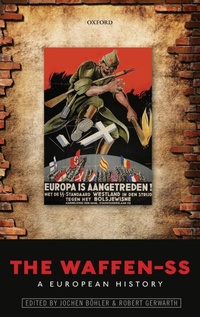
The Waffen-SS
A European History
Published on 22. December 2016
Book
Hardback
408 pages
978-0-19-879055-6 (ISBN)
Description
This is the first systematic pan-European study of the hundreds of thousands of non-Germans who fought -- either voluntarily or under different kinds of pressures -- for the Waffen-SS (or auxiliary police formations operating in the occupied East). Building on the findings of regional studies by other scholars -- many of them included in this volume -- The Waffen-SS aims to arrive at a fuller picture of those non-German citizens (from Eastern as well as Western Europe) who served under the SS flag. Where did the non-Germans in the SS come from (socially, geographically, and culturally)? What motivated them? What do we know about the practicalities of international collaboration in war and genocide, in terms of everyday life, language, and ideological training? Did a common transnational identity emerge as a result of shared ideological convictions or experiences of extreme violence? In order to address these questions (and others), The Waffen-SS adopts an approach that does justice to the complexity of the subject, adding a more nuanced, empirically sound understanding of collaboration in Europe during World War II, while also seeking to push the methodological boundaries of the historiographical genre of perpetrator studies by adopting a transnational approach.
Reviews / Votes
[an] important contribution to the history of Nazi Germany, the Holocaust and the social and cultural history of the Second World War. * Angel Alcalde, Contemporary European History * the authors unpack a complex and multivarious set of motives for joining the Waffen-SS ... The result is a much more complete yet nuanced view of the Waffen-SS than has been typical. The volume editors deserve commendation for this important addition to the literature. * Robert M. Citino, Holocaust and Genocide Studies * [O]utstanding.[P]rovides a comprehensive examination of the SS's mobilization of Europe's manpower for the German war effort * Jeff Rutherford, H-German * Mandatory reading on Nazi collaborators... Essential. * CHOICE * it will be essential reading to better understand this military and political institution in all its strange and malevolent detail. * Adrian Gilbert, War Books Review *More details
Language
English
Place of publication
Oxford
United Kingdom
Target group
College/higher education
Professional and scholarly
Illustrations
20 black and white images
Dimensions
Height: 240 mm
Width: 161 mm
Thickness: 26 mm
Weight
775 gr
ISBN-13
978-0-19-879055-6 (9780198790556)
Copyright in bibliographic data and cover images is held by Nielsen Book Services Limited or by the publishers or by their respective licensors: all rights reserved.
Schweitzer Classification
Other editions
Additional editions
E-Book
12/2016
1st Edition
OUP eBook
€71.99
Available for download
E-Book
12/2016
1st Edition
OUP eBook
€81.49
Available for download
Persons
Jochen Boehler is a Research Associate at the Imre Kertesz Kolleg in Jena, where he teaches courses on the history of early twentieth-century Central and Eastern Europe. His recent major publications include: War, Pacification, and Mass Murder, 1939: The Einsatzgruppen in Poland (2014, with Jurgen Matthaeus and Klaus-Michael Mallmann) SS-Oberscharfuehrer Hermann Baltruschat's Career 1939-1943 (2014, with Jacek Sawicki) and Legacies of Violence: Eastern Europe's First World War (2014, with Joachim von Puttkamer and W?odzimierz Borodziej). He is also currently preparing a monograph on Embattled Poland 1918-1921 for Oxford University Press.
Robert Gerwarth is Professor of Modern History at University College Dublin and Director of the Centre for War Studies. He is the author of The Bismarck Myth (2005) and a biography of Reinhard Heydrich (2011). His third monograph, The Vanquished: Why the First World War Failed to End will be published in late 2016. He has also published ten edited collections, including, most recently, War in Peace: Paramilitary Violence in Europe after the Great War (2012, with John Horne) and Empires at War, 1911-1923 (2014, with Erez Manela).
Robert Gerwarth is Professor of Modern History at University College Dublin and Director of the Centre for War Studies. He is the author of The Bismarck Myth (2005) and a biography of Reinhard Heydrich (2011). His third monograph, The Vanquished: Why the First World War Failed to End will be published in late 2016. He has also published ten edited collections, including, most recently, War in Peace: Paramilitary Violence in Europe after the Great War (2012, with John Horne) and Empires at War, 1911-1923 (2014, with Erez Manela).
Content
1: Jochen Boehler and Robert Gerwarth: Non-Germans in the Waffen-SS: An Introduction
2: Peter Black and Martin Gutmann: Racial Theory and Realities of Conquest in the Occupied East: The Nazi Leadership and Non-German Nationals in the SS and Police
3: Claus Bundgard Christensen, Niels Bo Poulsen, and Peter Scharff Smith: Germanic Volunteers from Northern Europe
4: Georgios Antoniou, Philippe Carrard, Stratos Dordanas, Carlo Gentile, Christopher Hale, and Xose M. Nunez Seixas: Western and Southern Europe: The Cases of Spain, France, Italy, and Greece
5: Matthew Kott, Arunas Bubnys, and UElle Kraft: The Baltic States: Auxiliaries and Waffen-SS soldiers from Estonia, Latvia, and Lithuania
6: Jacek Andrzej Mlynarczyk, Leonid Rein, Andrii Bolianovskyi, and Oleg Romanko: The Special Cases of Eastern Europe: The Polish Blue Police, Auxiliaries, and SS Formations
7: Thomas Casagrande, Michal Schvarc, Norbert Spannenberger, and Otmar Trasca: The "Volksdeutsche": A Case Study from South-Eastern Europe
8: Xavier Bougarel, Alexander Korb, Stefan Petke, and Franziska Zaugg: Muslim SS Units in the Balkans and the Soviet Union
9: Immo Rebitschek, Gerald Steinacher, Mats Deland, Sabina Ferhadbegovic, and Frank Seberechts: Prosecution and Trajectories after 1945
10: Steffen Werther and Madeleine Hurd: Waffen-SS Veterans and their Sites of Memory Today
2: Peter Black and Martin Gutmann: Racial Theory and Realities of Conquest in the Occupied East: The Nazi Leadership and Non-German Nationals in the SS and Police
3: Claus Bundgard Christensen, Niels Bo Poulsen, and Peter Scharff Smith: Germanic Volunteers from Northern Europe
4: Georgios Antoniou, Philippe Carrard, Stratos Dordanas, Carlo Gentile, Christopher Hale, and Xose M. Nunez Seixas: Western and Southern Europe: The Cases of Spain, France, Italy, and Greece
5: Matthew Kott, Arunas Bubnys, and UElle Kraft: The Baltic States: Auxiliaries and Waffen-SS soldiers from Estonia, Latvia, and Lithuania
6: Jacek Andrzej Mlynarczyk, Leonid Rein, Andrii Bolianovskyi, and Oleg Romanko: The Special Cases of Eastern Europe: The Polish Blue Police, Auxiliaries, and SS Formations
7: Thomas Casagrande, Michal Schvarc, Norbert Spannenberger, and Otmar Trasca: The "Volksdeutsche": A Case Study from South-Eastern Europe
8: Xavier Bougarel, Alexander Korb, Stefan Petke, and Franziska Zaugg: Muslim SS Units in the Balkans and the Soviet Union
9: Immo Rebitschek, Gerald Steinacher, Mats Deland, Sabina Ferhadbegovic, and Frank Seberechts: Prosecution and Trajectories after 1945
10: Steffen Werther and Madeleine Hurd: Waffen-SS Veterans and their Sites of Memory Today