

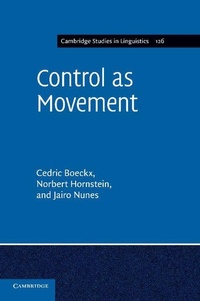
Control as Movement
Published on 17. April 2014
Book
Paperback/Softback
274 pages
978-1-107-67206-2 (ISBN)
Description
The Movement Theory of Control (MTC) makes one major claim: that control relations in sentences like 'John wants to leave' are grammatically mediated by movement. This goes against the traditional view that such sentences involve not movement, but binding, and analogizes control to raising, albeit with one important distinction: whereas the target of movement in control structures is a theta position, in raising it is a non-theta position; however the grammatical procedures underlying the two constructions are the same. This book presents the main arguments for MTC and shows it to have many theoretical advantages, the biggest being that it reduces the kinds of grammatical operations that the grammar allows, an important advantage in a minimalist setting. It also addresses the main arguments against MTC, using examples from control shift, adjunct control, and the control structure of 'promise', showing MTC to be conceptually, theoretically, and empirically superior to other approaches.
More details
Series
Language
English
Place of publication
Cambridge
United Kingdom
Target group
Professional and scholarly
Product notice
Paperback (trade)
Illustrations
Worked examples or Exercises; Printed music items
Dimensions
Height: 229 mm
Width: 152 mm
Thickness: 15 mm
Weight
402 gr
ISBN-13
978-1-107-67206-2 (9781107672062)
Copyright in bibliographic data and cover images is held by Nielsen Book Services Limited or by the publishers or by their respective licensors: all rights reserved.
Schweitzer Classification
Other editions
Additional editions
Cedric Boeckx | Norbert Hornstein | Jairo Nunes
Control as Movement
E-Book
09/2010
1st Edition
Cambridge University Press
€29.49
Available for download
Cedric Boeckx | Norbert Hornstein | Jairo Nunes
Control as Movement
Book
08/2010
Cambridge University Press
€140.80
Shipment within 15-20 days
Persons
Cedrick Boeckx is Research Professor at the Catalan Institute for Advanced Studies (ICREA), and a member of the Center for Theoretical Linguistics at the Universitat Autonoma de Barcelona. Norbert Hornstein is Professor in the Department of Linguistics at the University of Maryland, College Park. Jairo Nunes is Associate Professor at the University of Sao Paulo, Brazil.
Content
1. Introduction; 2. Some historical background; 3. Basic properties of the Movement Theory of Control; 4. Empirical advantages; 5. Empirical challenges and solutions; 6. On non-obligatory control; 7. Some notes on semantic approaches to control; 8. The movement theory of control and the minimalist program.