

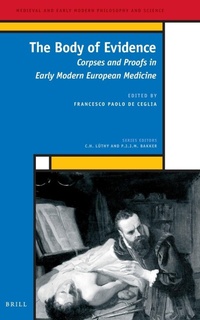
The Body of Evidence
Corpses and Proofs in Early Modern European Medicine
Brill (Publisher)
Published on 23. January 2020
Book
Hardback
366 pages
978-90-04-28481-4 (ISBN)
Description
When, why and how was it first believed that the corpse could reveal 'signs' useful for understanding the causes of death and eventually identifying those responsible for it? The Body of Evidence. Corpses and Proofs in Early Modern European Medicine, edited by Francesco Paolo de Ceglia, shows how in the late Middle Ages the dead body, which had previously rarely been questioned, became a specific object of investigation by doctors, philosophers, theologians and jurists. The volume sheds new light on the elements of continuity, but also on the effort made to liberate the semantization of the corpse from what were, broadly speaking, necromantic practices, which would eventually merge into forensic medicine.
Reviews / Votes
"The Body of Evidence is a welcome contribution to the history of science that moves the history of the body, and scientific interest in it, away from anatomical textbooks and treatises to look at how that knowledge was deployed in legal contexts."- Sarah Tarlow, University of Leicester, in: Journal of British Studies, January 2022, Vol. 61, No. 1: pp. 190-91.
More details
Series
Language
English
Place of publication
Leiden
Netherlands
Target group
Professional and scholarly
Product notice
sewn/stitched
Cloth over boards
Illustrations
7 s/w Abbildungen, 3 farbige Abbildungen
3 Illustrations, color; 7 Illustrations, black and white
Dimensions
Height: 234 mm
Width: 155 mm
Thickness: 21 mm
Weight
680 gr
ISBN-13
978-90-04-28481-4 (9789004284814)
Copyright in bibliographic data and cover images is held by Nielsen Book Services Limited or by the publishers or by their respective licensors: all rights reserved.
Schweitzer Classification
Persons
Francesco Paolo de Ceglia, Ph.D. (2001), is a Professor of History of Science at the University of Bari, where he directs the Interuniversity Research Center, Seminary of the History of Science. He has often been a fellow at the Max Planck Institute for the History of Science in Berlin. He has published monographs and articles on the relationship between the history of science and theology, including The Secret of Saint Januarius. Natural History of a Neapolitan Miracle (Einaudi, 2016).
Content
List of Figures
Contributing Authors
Introduction: Corpses, Evidence and Medical Knowledge in the Late Middle Ages and the Early Modern Age
Francesco Paolo de Ceglia
SECTION 1. FROM DIVINATION TO AUTOPSY
1. Saving the Phenomenon: Why Corpses Bled in the Presence of their Murderer in Early Modern Science
Francesco Paolo de Ceglia
2. Unfamiliar Faces: The Identification of Corpses In Late Medieval Valencia
Carmel Ferragud
3. Reading the Corpse (Bologna, Mid 13th-Early 16thth Century)
Tommaso Duranti
SECTION 2. THE UNCERTAINTIES OF THE ANATOMICAL GAZE
4. Dissection Techniques, Forensics and Anatomy in the Sixteenth Century
Allen Shotwell
5. Monstrous Exegesis: Opening Up Double Monsters in Early Modern Europe
Alan W.H. Bates
6. Corpses, Contagion and Courage: Fear and the Inspection of Bodies in Seventeenth-Century London
Kevin Siena
7. Knowledge from and on Bodies and Resistance to Anatomical Discourse (Padua, 16th-18th Centuries)
Massimo Galtarossa
SECTION 3: CORPSES AND EVIDENCES
8. Reading Deeds, Lifestyles and Bodies: The Classification of Suicide in Early Modern Europe
Alexander Kaestner
9. Corpses and Confessions: Forensic Investigation and Infanticide in Early Modern Germany
Margaret Brannan Lewis
10. Visum et Repertum: Medical Doctrine and Criminal Procedures in France and Naples (17th-18th Centuries)
Diego Carnevale
11. Frightening Whirlpools: Drowning in France in the Eighteenth Century
Lucia De Frenza and Caterina Tisci
Bibliography
Index
Contributing Authors
Introduction: Corpses, Evidence and Medical Knowledge in the Late Middle Ages and the Early Modern Age
Francesco Paolo de Ceglia
SECTION 1. FROM DIVINATION TO AUTOPSY
1. Saving the Phenomenon: Why Corpses Bled in the Presence of their Murderer in Early Modern Science
Francesco Paolo de Ceglia
2. Unfamiliar Faces: The Identification of Corpses In Late Medieval Valencia
Carmel Ferragud
3. Reading the Corpse (Bologna, Mid 13th-Early 16thth Century)
Tommaso Duranti
SECTION 2. THE UNCERTAINTIES OF THE ANATOMICAL GAZE
4. Dissection Techniques, Forensics and Anatomy in the Sixteenth Century
Allen Shotwell
5. Monstrous Exegesis: Opening Up Double Monsters in Early Modern Europe
Alan W.H. Bates
6. Corpses, Contagion and Courage: Fear and the Inspection of Bodies in Seventeenth-Century London
Kevin Siena
7. Knowledge from and on Bodies and Resistance to Anatomical Discourse (Padua, 16th-18th Centuries)
Massimo Galtarossa
SECTION 3: CORPSES AND EVIDENCES
8. Reading Deeds, Lifestyles and Bodies: The Classification of Suicide in Early Modern Europe
Alexander Kaestner
9. Corpses and Confessions: Forensic Investigation and Infanticide in Early Modern Germany
Margaret Brannan Lewis
10. Visum et Repertum: Medical Doctrine and Criminal Procedures in France and Naples (17th-18th Centuries)
Diego Carnevale
11. Frightening Whirlpools: Drowning in France in the Eighteenth Century
Lucia De Frenza and Caterina Tisci
Bibliography
Index