

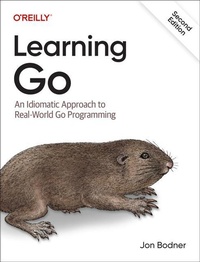
Learning Go
An Idiomatic Approach to Real-World Go Programming
2nd Edition
Published on 31. January 2024
Book
Paperback/Softback
478 pages
978-1-0981-3929-2 (ISBN)
Description
Go has rapidly become the preferred language for building web services. Plenty of tutorials are available to teach Go's syntax to developers with experience in other programming languages, but tutorials aren't enough. They don't teach Go's idioms, so developers end up recreating patterns that don't make sense in a Go context. This practical guide provides the essential background you need to write clear and idiomatic Go.
No matter your level of experience, you'll learn how to think like a Go developer. Author Jon Bodner introduces the design patterns experienced Go developers have adopted and explores the rationale for using them. This updated edition also shows you how Go's generics support fits into the language.
This book helps you:
Write idiomatic code in Go and design a Go project
Understand the reasons behind Go's design decisions
Set up a Go development environment for a solo developer or team
Learn how and when to use reflection, unsafe, and cgo
Discover how Go's features allow the language to run efficiently
Know which Go features you should use sparingly or not at all
Use Go's tools to improve performance, optimize memory usage, and reduce garbage collection
Learn how to use Go's advanced development tools
No matter your level of experience, you'll learn how to think like a Go developer. Author Jon Bodner introduces the design patterns experienced Go developers have adopted and explores the rationale for using them. This updated edition also shows you how Go's generics support fits into the language.
This book helps you:
Write idiomatic code in Go and design a Go project
Understand the reasons behind Go's design decisions
Set up a Go development environment for a solo developer or team
Learn how and when to use reflection, unsafe, and cgo
Discover how Go's features allow the language to run efficiently
Know which Go features you should use sparingly or not at all
Use Go's tools to improve performance, optimize memory usage, and reduce garbage collection
Learn how to use Go's advanced development tools
More details
Edition
2nd edition
Language
English
Place of publication
Sebastopol
United States
Product notice
Paperback (trade)
Unsewn / adhesive bound
Dimensions
Height: 231 mm
Width: 173 mm
Thickness: 28 mm
Weight
870 gr
ISBN-13
978-1-0981-3929-2 (9781098139292)
Copyright in bibliographic data and cover images is held by Nielsen Book Services Limited or by the publishers or by their respective licensors: all rights reserved.
Schweitzer Classification
Other editions
Additional editions
Previous edition
Book
03/2021
O'Reilly
€85.60
Article exhausted; check for reprint
Person
Jon Bodner has been a software engineer, lead developer and architect for over 20 years. In that time, he has worked on software across many fields, including education, finance, commerce, healthcare, law, government, and internet infrastructure. Currently, he is a Staff Engineer at Datadog, leading the effort to simplify onboarding for their APM product. Previously, Jon was a Senior Distinguished Engineer at Capital One, working on tech commercialization, open source, testing, the semantic engine that provides payment page detection and population for Capital One's Eno browser extension (www.capitalone.com/applications/eno/virtualnumbers), and improving support for virtual credit card numbers inside of Capital One. Jon is a frequent speaker at Go conferences, and his blog posts on Go and software engineering have been read by more than 150,000 people. He is the creator of the Proteus data access library (github.com/jonbodner/proteus) and co-developer of checks-out, a fork of the LGTM project (github.com/capitalone/checks-out).