

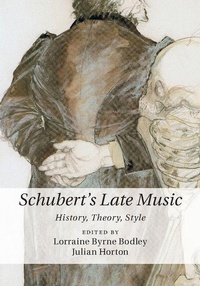
Schubert's Late Music
History, Theory, Style
Published on 7. April 2016
Book
Hardback
490 pages
978-1-107-11129-5 (ISBN)
Description
Schubert's late music has proved pivotal for the development of diverse fields of musical scholarship, from biography and music history to the theory of harmony. This collection addresses current issues in Schubert studies including compositional technique, the topical issue of 'late' style, tonal strategy and form in the composer's instrumental music, and musical readings of the 'postmodern' Schubert. Offering fresh approaches to Schubert's instrumental and vocal works and their reception, this book argues that the music that the composer produced from 1822-8 is central to a paradigm shift in the history of music during the nineteenth century. The contributors provide a timely reassessment of Schubert's legacy, assembling a portrait of the composer that is very different from the sentimental Schubert permeating nineteenth-century culture and the postmodern Schubert of more recent literature.
More details
Language
English
Place of publication
Cambridge
United Kingdom
Target group
Professional and scholarly
Illustrations
187 Printed music items; 18 Tables, black and white; 5 Halftones, unspecified; 5 Halftones, black and white
Dimensions
Height: 250 mm
Width: 175 mm
Thickness: 31 mm
Weight
1017 gr
ISBN-13
978-1-107-11129-5 (9781107111295)
Copyright in bibliographic data and cover images is held by Nielsen Book Services Limited or by the publishers or by their respective licensors: all rights reserved.
Schweitzer Classification
Other editions
Additional editions
Book
01/2019
Cambridge University Press
€47.60
Shipment within 15-20 days
E-Book
06/2016
Cambridge University Press
€30.99
Available for download
E-Book
04/2016
Cambridge University Press
€25.49
Available for download
Persons
Lorraine Byrne Bodley is Senior Lecturer in Musicology at the National University of Ireland, Maynooth. She is the first woman in Ireland to be awarded a DMUS in Musicology (NUI, 2012) and has recently been elected a Member of the Royal Irish Academy. She has published 10 books and is currently writing a new biography of Schubert. Her awards include two DAAD Senior Academic Awards (2010 and 2014), a Gerda-Henkel Foundation Scholarship (2014) and an IRCHSS Scholarship (2001-3). Julian Horton is Professor of Music and Head of Department at the University of Durham. He is author of monographs including Bruckner's Symphonies: Analysis, Reception and Cultural Politics (2004) and editor of The Cambridge Companion to the Symphony (2013). In 2012, he was awarded the Westrup Prize of the Music and Letters Trust and in 2014, he was elected President of the Society for Music Analysis.
Content
Introduction: Schubert's late style and current musical scholarship Lorraine Byrne Bodley; Part I. Reception Histories: 1. 'Classical' music and Viennese resistance to Schubert's Beethoven project John M. Gingerich; 2. Beethoven, Schubert, and the movement of phenomena Scott Burnham; 3. [Un]Himmlische Laenge: editorial intervention as reception history Anne M. Hyland; 4. Citation, narrative and meaning: Woody Allen and the late Schubert Harry White; Part II. The Late Instrumental Music (1): Hermeneutics and Performance: 5. Schubert's alchemy: transformative surfaces, transfiguring depths Robert S. Hatten; 6. Against the grain: Op. 78 and a hermeneutics of late style Richard Kramer; 7. Schubert's Wiegenlied: the Andante sostenuto from the Piano Sonata in B flat, D. 960 Eric Wen; 8. Schubert's reconciliation of gothic and classical influences Marjorie Hirsch; 9. The first movement of Schubert's Piano Sonata D. 959 and the performance of analysis Julian Horton; Part III. The Late Instrumental Music (2): Meaning and Genre: 10. Schubert hearing Don Giovanni: Mozartian death music in the 'Unfinished' Symphony Glenn Stanley; 11. Longing for the unattainable: the second movement of the 'Great' C major Symphony Lauri Suurpaeae; 12. Tonal recollection in Schubert's late instrumental music Ryan McClelland; 13. Detours, wrong tracks, and dead ends: the 'wanderer' in the labyrinth of Schubert's late instrumental music Xavier Hascher; 14. Formal ambiguity and generic reinterpretation in the late instrumental music Su-Yin Mak; Part IV. Defining Late Style: 15. The 'problem of solitude' and critique in song: Schubert's loneliness Susan Youens; 16. Music of the orphaned self? Schubert and concepts of late style Lorraine Byrne Bodley; 17. Bounded finitude and boundless infinitude: Schubert's contradictions at the 'final barrier' Blake Howe; 18. Invocations of memory in Schubert's last songs Juergen Thym; 19. 'The prerogative of late style': thoughts on the expressive world of Schubert's late works Benjamin M. Korstvedt; 20. Singing against late style: the problem of performance history Laura Tunbridge.