

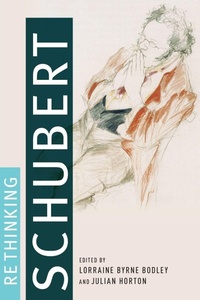
Rethinking Schubert
Published on 5. April 2018
Book
Paperback/Softback
552 pages
978-0-19-087413-1 (ISBN)
Description
In Rethinking Schubert, today's leading Schubertians offer fresh perspectives on the composer's importance and our perennial fascination with him. Subjecting recurring issues in historical, biographical and analytical research to renewed scrutiny, the twenty-two chapters yield new insights into Schubert, his music, his influence and his legacy, and broaden the interpretative context for the music of his final years.
With close attention to matters of style, harmonic and formal analysis, and text setting, the essays gathered here explore a significant portion of the composer's extensive output across a range of genres. The most readily explicable aspect of Schubert's appeal is undoubtedly our continuing engagement with the songs. Schubert will always be the first port of call for scholars interested in the relationship between music and the poetic text, and several essays in Rethinking Schubert offer welcome new inquiries into this subject. Yet perhaps the most striking feature of modern scholarship is the new depth of thought that attaches to the instrumental works. This music's highly protracted dissemination has combined with a habitual critical hostility to produce a reception history that is hardly congenial to musical analysis. Empowered by the new momentum behind theories of nineteenth-century harmony and form and recently-published source materials, the sophisticated approaches to the instrumental music in Rethinking Schubert show decisively that it is no longer acceptable to posit Schubert's instrumental forms as flawed lyric alternatives to Beethoven.
What this volume provides, then, is not only a fresh portrait of one of the most loved composers of the nineteenth century but also a conspectus of current Schubertian research. Whether perusing unknown repertoire or refreshing canonical works, Rethinking Schubert reveals the extraordinary methodological variety that is now available to research, painting a portrait of Schubert that is vibrant, plural, trans-national, and complex.
With close attention to matters of style, harmonic and formal analysis, and text setting, the essays gathered here explore a significant portion of the composer's extensive output across a range of genres. The most readily explicable aspect of Schubert's appeal is undoubtedly our continuing engagement with the songs. Schubert will always be the first port of call for scholars interested in the relationship between music and the poetic text, and several essays in Rethinking Schubert offer welcome new inquiries into this subject. Yet perhaps the most striking feature of modern scholarship is the new depth of thought that attaches to the instrumental works. This music's highly protracted dissemination has combined with a habitual critical hostility to produce a reception history that is hardly congenial to musical analysis. Empowered by the new momentum behind theories of nineteenth-century harmony and form and recently-published source materials, the sophisticated approaches to the instrumental music in Rethinking Schubert show decisively that it is no longer acceptable to posit Schubert's instrumental forms as flawed lyric alternatives to Beethoven.
What this volume provides, then, is not only a fresh portrait of one of the most loved composers of the nineteenth century but also a conspectus of current Schubertian research. Whether perusing unknown repertoire or refreshing canonical works, Rethinking Schubert reveals the extraordinary methodological variety that is now available to research, painting a portrait of Schubert that is vibrant, plural, trans-national, and complex.
Reviews / Votes
Deeply thoughtful and hugely challenging, insightful and inciteful, these essays throw brilliant prismatic light on Schubert's indispensable oeuvre. They untangle the thorny paradox of an individual style that furnished the pivot for a crucial juncture in music history." - Scott Messing, author of Schubert in the European Imagination and Marching to the Canon: The Life of Schubert's Marche militaire This stirringly diverse collection of essays brings the recent surge of Schubert scholarship to its first full flood. With an international and intergenerational abundance of perspective, Rethinking Schubert encourages the sense that we are just now beginning to discern the impact and range of this miraculously multidimensional composer." - Scott Burnham, Princeton University Inspired by the music of Schubert and the man himself, the contexts and riddling controversies promised in the title of this rich collection are engaged here in a range of brilliant rethinkings, from a brace of fresh theoretical constructs to the seasoned insights of time-honored Schubertians. A signal contribution among the busy competition." Richard Kramer, Author of Unfinished Music and Distant Cycles: Schubert and the Conceiving of SongMore details
Language
English
Place of publication
New York
United States
Target group
College/higher education
Illustrations
175 musical examples; 1 photo
Dimensions
Height: 234 mm
Width: 156 mm
Thickness: 33 mm
Weight
929 gr
ISBN-13
978-0-19-087413-1 (9780190874131)
Copyright in bibliographic data and cover images is held by Nielsen Book Services Limited or by the publishers or by their respective licensors: all rights reserved.
Schweitzer Classification
Other editions
Additional editions
Lorraine Byrne Bodley | Julian Horton
Rethinking Schubert
Book
09/2016
Oxford University Press Inc
€177.10
Shipment within 15-20 days
Lorraine Byrne Bodley | Julian Horton
Rethinking Schubert
E-Book
08/2016
1st Edition
OUP eBook
€26.49
Available for download
Lorraine Byrne Bodley | Julian Horton
Rethinking Schubert
E-Book
08/2016
1st Edition
OUP eBook
€33.99
Available for download
Persons
Lorraine Byrne Bodley is Senior Lecturer and Director of Research at the Department of Music, Maynooth University. She is the first woman in Ireland to have conferred on her a D.Mus. in Musicology, a higher doctorate awarded for published work (NUI, 2012). She also holds a Ph.D. in Music and in German from University College Dublin (2000). Her numerous other awards include a Gerda-Henkel Foundation Scholarship (2014); two DAAD Senior Academics Awards (2010 and 2014); an IRCHSS Post-Doctoral Scholarship (2001-03) and the Goethe Prize of the English Goethe Society (2001). She has published 12 books including: A Community of the Imagination: Seoirse Bodley's Goethe's Settings (Carysfort Press, 2013); Goethe and Zelter: Musical Dialogues (Ashgate, 2009); The Unknown Schubert (Ashgate, 2008); Proserpina: Goethe's Melodrama with Music by Carl Eberwein (Carysfort Press, 2007) and Schubert's Goethe Settings (2003).
Julian Horton is Professor of Music and Head of Department at Durham University. He was educated at Trinity College, Cambridge, and has taught at University College Dublin and King's College, London. He is the author of Bruckner's Symphonies: Analysis, Reception and Cultural Politics (Cambridge, 2004) and editor of The Cambridge Companion to the Symphony (2013). In 2012, he was recipient of the Westrup Prize; in 2014, he was elected President of the Society for Music Analysis.
Julian Horton is Professor of Music and Head of Department at Durham University. He was educated at Trinity College, Cambridge, and has taught at University College Dublin and King's College, London. He is the author of Bruckner's Symphonies: Analysis, Reception and Cultural Politics (Cambridge, 2004) and editor of The Cambridge Companion to the Symphony (2013). In 2012, he was recipient of the Westrup Prize; in 2014, he was elected President of the Society for Music Analysis.
Content
Introduction
Lorraine Byrne Bodley and Julian Horton: 'Rethinking Schubert: Contexts and Controversies
Part I: Style
1. Hans-Joachim Hinrichsen: Is there a Late Style in Schubert's Oeuvre?
2. Walter Duerr: Compositional Strategies of late Schubert
3. William Kinderman: Franz Schubert's 'New Style' and the Legacy of Beethoven
4. Susan Wollenberg: From Song to Instrumental Style: Some Schubert 'Fingerprints'
5. Brian Black: The Sensual as a Constructive Element in Schubert's Late Works
Part II: Instrumental Music
6. Andrea Lindmayr-Brandl: The Myth of the 'Unfinished'?
7. Xavier Hascher: Narrative Dislocations in the First Movement of Schubert's 'Unfinished' Symphony
8. Cameron Gardner: Reappraising Schubert's 'Reliquie': Precedents, the 'Great' Symphony and Narrative
9. Anne Hyland and Walburga Litschauer: 'Records of Inspiration': Schubert's drafts for the last three piano sonatas reappraised
10. Julian Caskel: Musical Causality in Schubert's Piano Sonata D 959, first movement
11. David Damschroder: Conspicuous 6-Phase Chords in the Closing Movement of Schubert's Piano Sonata in B flat Major, D 960
12. Leon Plantinga: Schubert, Popular Music, and Melancholy
Part III: Music and Text
13. Michael Spitzer: Axial Lyric Space in Two Late Songs: 'Im Freien' and 'Der Winterabend'
14. Suzannah Clark: Schubert Through a Neo-Riemannian Lens.
15. James Sobaskie: Contextual Processes in Schubert's Late Church Music
16. Lisa Feurzeig: Elusive Intimacy in Schubert's Final Opera, Der Graf von Gleichen
17. Deborah Stein: The Wanderer's Chromatic Journey in Schubert's Winterreise
18. David Ferris: Dissociation and Declamation in Schubert's Heine Songs
19. Richard Giarusso: 'The Messenger of a Faithful Heart': Reassessing the Role of 'Die Taubenpost' in Schubert's Schwanengesang
20. Benjamin Binder: Disability, Self-Critique, and Failure in Schubert's 'Der Doppelgaenger'
21. Lorraine Byrne Bodley: Challenging the Context: Reception and Transformation in Schubert's 'Der Musensohn', D 764, Op. 92, no.1
22. Susan Youens: Mayrhofer's 'Der Einsame': A Gauntlet Thrown: Schubert's 'Einsamkeit', D 620, and Beethoven's An die ferne Geliebte'
Postlude
Graham Johnson
Lorraine Byrne Bodley and Julian Horton: 'Rethinking Schubert: Contexts and Controversies
Part I: Style
1. Hans-Joachim Hinrichsen: Is there a Late Style in Schubert's Oeuvre?
2. Walter Duerr: Compositional Strategies of late Schubert
3. William Kinderman: Franz Schubert's 'New Style' and the Legacy of Beethoven
4. Susan Wollenberg: From Song to Instrumental Style: Some Schubert 'Fingerprints'
5. Brian Black: The Sensual as a Constructive Element in Schubert's Late Works
Part II: Instrumental Music
6. Andrea Lindmayr-Brandl: The Myth of the 'Unfinished'?
7. Xavier Hascher: Narrative Dislocations in the First Movement of Schubert's 'Unfinished' Symphony
8. Cameron Gardner: Reappraising Schubert's 'Reliquie': Precedents, the 'Great' Symphony and Narrative
9. Anne Hyland and Walburga Litschauer: 'Records of Inspiration': Schubert's drafts for the last three piano sonatas reappraised
10. Julian Caskel: Musical Causality in Schubert's Piano Sonata D 959, first movement
11. David Damschroder: Conspicuous 6-Phase Chords in the Closing Movement of Schubert's Piano Sonata in B flat Major, D 960
12. Leon Plantinga: Schubert, Popular Music, and Melancholy
Part III: Music and Text
13. Michael Spitzer: Axial Lyric Space in Two Late Songs: 'Im Freien' and 'Der Winterabend'
14. Suzannah Clark: Schubert Through a Neo-Riemannian Lens.
15. James Sobaskie: Contextual Processes in Schubert's Late Church Music
16. Lisa Feurzeig: Elusive Intimacy in Schubert's Final Opera, Der Graf von Gleichen
17. Deborah Stein: The Wanderer's Chromatic Journey in Schubert's Winterreise
18. David Ferris: Dissociation and Declamation in Schubert's Heine Songs
19. Richard Giarusso: 'The Messenger of a Faithful Heart': Reassessing the Role of 'Die Taubenpost' in Schubert's Schwanengesang
20. Benjamin Binder: Disability, Self-Critique, and Failure in Schubert's 'Der Doppelgaenger'
21. Lorraine Byrne Bodley: Challenging the Context: Reception and Transformation in Schubert's 'Der Musensohn', D 764, Op. 92, no.1
22. Susan Youens: Mayrhofer's 'Der Einsame': A Gauntlet Thrown: Schubert's 'Einsamkeit', D 620, and Beethoven's An die ferne Geliebte'
Postlude
Graham Johnson