

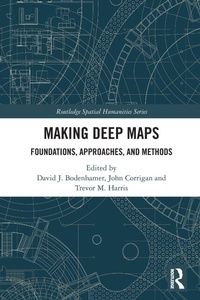
Making Deep Maps
Foundations, Approaches, and Methods
1st Edition
Published on 31. May 2023
Book
Paperback/Softback
184 pages
978-0-367-74385-7 (ISBN)
Description
This book explores how we create deep maps, delving into the development of methods and approaches that move beyond standard two-dimensional cartography.
Deep mapping offers a more detailed exploration of the world we inhabit. Moving from concept to practice, this book addresses how we make deep maps. It explores what methods are available, what technologies and approaches are favorable when designing deep maps, and what lessons assist the practitioner during their construction. This book aims to create an open-ended way in which to understand complex problems through multiple perspectives, while providing a means to represent the physical properties of the real world and to respond to the needs of contemporary scholarship. With contributions from leading experts in the spatial humanities, chapters focus on the linked layers of quantitative and qualitative data, maps, photographs, images, and sound that offer a dynamic view of past and present worlds.
This innovative book is the first to offer these insights on the construction of deep maps. It will be a key point of reference for students and scholars in the digital and spatial humanities, geographers, cartographers, and computer scientists who work on spatiality, sensory experience, and perceptual learning.
Deep mapping offers a more detailed exploration of the world we inhabit. Moving from concept to practice, this book addresses how we make deep maps. It explores what methods are available, what technologies and approaches are favorable when designing deep maps, and what lessons assist the practitioner during their construction. This book aims to create an open-ended way in which to understand complex problems through multiple perspectives, while providing a means to represent the physical properties of the real world and to respond to the needs of contemporary scholarship. With contributions from leading experts in the spatial humanities, chapters focus on the linked layers of quantitative and qualitative data, maps, photographs, images, and sound that offer a dynamic view of past and present worlds.
This innovative book is the first to offer these insights on the construction of deep maps. It will be a key point of reference for students and scholars in the digital and spatial humanities, geographers, cartographers, and computer scientists who work on spatiality, sensory experience, and perceptual learning.
More details
Series
Language
English
Place of publication
London
United Kingdom
Publishing group
Taylor & Francis Ltd
Target group
College/higher education
Postgraduate and Undergraduate
Illustrations
50 s/w Abbildungen, 50 s/w Photographien bzw. Rasterbilder
50 Halftones, black and white; 50 Illustrations, black and white
Dimensions
Height: 234 mm
Width: 156 mm
Thickness: 12 mm
Weight
316 gr
ISBN-13
978-0-367-74385-7 (9780367743857)
Copyright in bibliographic data and cover images is held by Nielsen Book Services Limited or by the publishers or by their respective licensors: all rights reserved.
Schweitzer Classification
Other editions
Additional editions
David J. Bodenhamer | John Corrigan | Trevor M. Harris
Making Deep Maps
Foundations, Approaches, and Methods
Book
09/2021
1st Edition
Routledge
€205.30
Shipment within 15-20 days
David J. Bodenhamer | John Corrigan | Trevor M. Harris
Making Deep Maps
Foundations, Approaches, and Methods
E-Book
09/2021
1st Edition
Routledge
€59.49
Available for download
David J. Bodenhamer | John Corrigan | Trevor M. Harris
Making Deep Maps
Foundations, Approaches, and Methods
E-Book
09/2021
1st Edition
Routledge
€59.49
Available for download
Persons
David J. Bodenhamer is founding executive director of The Polis Center and professor of history and informatics at Indiana University-Purdue University, Indianapolis. He writes widely in the field of spatial humanities and is co-editor of the Routledge Series on Spatial Humanities.
John Corrigan is the Lucius Moody Bristol Distinguished Professor of Religion and Professor of History at Florida State University. His previous co-authored books with Routledge include Religion in America and Jews, Christians Muslims: A Comparative Introduction to Monotheistic Religions. He is coeditor of the Routledge Series on Spatial Humanities.
Trevor M. Harris is Eberly Distinguished Professor of Geography Emeritus at West Virginia University. He is co-editor of the Routledge Series on Spatial Humanities. His research focuses on GISc, immersive and virtual GIS; Spatial Humanities; Deep Mapping; Exploratory Spatial Data Analysis; and Critical and Participatory GIS.
John Corrigan is the Lucius Moody Bristol Distinguished Professor of Religion and Professor of History at Florida State University. His previous co-authored books with Routledge include Religion in America and Jews, Christians Muslims: A Comparative Introduction to Monotheistic Religions. He is coeditor of the Routledge Series on Spatial Humanities.
Trevor M. Harris is Eberly Distinguished Professor of Geography Emeritus at West Virginia University. He is co-editor of the Routledge Series on Spatial Humanities. His research focuses on GISc, immersive and virtual GIS; Spatial Humanities; Deep Mapping; Exploratory Spatial Data Analysis; and Critical and Participatory GIS.
Content
1. The Varieties of Deep Maps 2. The Art of Deep Mapping 3. Designing for Mysterious Encounter: Three Scales of Integration in Deep Mapmaking 4. Spatializing Text for Deep Mapping 5. Representational Issues in Deep Mapping: Peeling the 'Poetic and Positivistic' from the Western Geosophical Onion 6. Indigenous Deep Mapping: A Conceptual and Representational analysis of Space in Mesoamerica and New Spain 7. Deep Mapping the Lived World: Immersive Geographies, Agency, and the Virtual Umwelt 8. Navigating through Narrative 9. Cultural Heritage Institutions and Deep Maps 10. The Inexactitude of Science: Deep Mapping and Scholarship 11. Convergence: GIScience Turns to the Spatial Humanities