

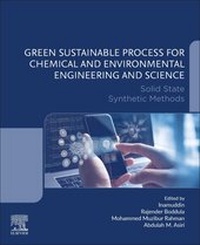
Green Sustainable Process for Chemical and Environmental Engineering and Science
Solid State Synthetic Methods
Published on 19. March 2021
Book
Paperback/Softback
453 pages
978-0-12-819720-2 (ISBN)
Description
Green Sustainable Process for Chemical and Environmental Engineering and Science: Solid State Synthetic Methods cover recent advances made in the field of solid-state materials synthesis and its various applications. The book provides a brief introduction to the topic and the fundamental principles governing the various methods. Sustainable techniques and green processes development in solid-state chemistry are also highlighted. This book also provides a comprehensive literature on the industrial application using solid-state materials and solid-state devices. Overall, this book is intended to explore green solid-state techniques, eco-friendly materials involved in organic synthesis and real-time applications.
More details
Language
English
Place of publication
United States
Target group
Professional and scholarly
Researchers and academicians in chemistry, analytical chemistry, bio chemical engineering, biotechnology
Dimensions
Height: 235 mm
Width: 191 mm
Weight
880 gr
ISBN-13
978-0-12-819720-2 (9780128197202)
Copyright in bibliographic data and cover images is held by Nielsen Book Services Limited or by the publishers or by their respective licensors: all rights reserved.
Schweitzer Classification
Other editions
Additional editions
Rajender Boddula | Mohammed Muzibur Rahman | Abdullah M. Asiri
Green Sustainable Process for Chemical and Environmental Engineering and Science
Solid State Synthetic Methods
E-Book
03/2021
Elsevier
€200.00
Available for download
Persons
Dr. Rajender Boddula is currently working as CAS-PIFI Fellow in the CAS Key Laboratory of Nanosystems and Hierarchical Fabrication, National Center for Nanoscience and Technology, Beijing, China. He has published many scientific articles in international peer-reviewed journals and has authored nine book chapters, and also serving as editorial board member and referee for reputed international peer-reviewed journals. His specialized areas of energy conversion and storage technologies, which include nanomaterials, graphene, polymer composites, heterogeneous catalysis, photoelectrocatalytic water splitting, biofuel cell, and supercapacitor applications Mohammed Muzibur Rahman received his B.Sc. and M.Sc. from Shahjalal University of Science & Technology, Sylhet, Bangladesh on 1999 and 2001 respectively. He received his Ph.D. from the Chonbuk National University, South Korea, in 2007. After his Ph.D., he worked as postdoctoral fellowship and assistant professor in pioneer research centers and universities located in South Korea, Japan, and Saudi Arabia (2007 to 2011). Presently, he is working a professor in Center of Excellence for Advanced Materials Research (CEAMR) and Chemistry department at King Abdulaziz University, Saudi Arabia since 2015. He published more than 300 research articles, attended over 50 international and domestic conferences; and published several book chapters and ten-books as an editor. His research work has been largely in the area of Sensors; Photocatalysis; Semiconductor; Nanoparticles; Carbon nanotubes; Nanotechnology; Electrocatalysis; Ionic liquid; Surface Chemistry; Gold nanoparticles; Electrochemistry; Instrumental Science; Nanomaterials; Self-Assembled monolayers; Photochemistry; & ?-Chips; and Devices etc. Abdullah Mohammed Ahmed Asiri is a full Professor in the Chemistry Department, at the Faculty of Science, King Abdulaziz University, Saudi Arabia. His research interests include: color chemistry, synthesis of novel photochromic and thermochromic systems, synthesis of novel colorants and coloration of textiles and plastics, molecular modeling, applications of organic materials into optics such as OEDS, high performance organic dyes and pigments, new applications of organic photochromic compounds, organic synthesis of heterocyclic compounds as precursor for dyes, synthesis of polymers functionalized with organic dyes, preparation of some coating formulations for different applications. Dr. Inamuddin, is an Assistant professor at Department of Applied Chemistry, Zakir Husain College of Engineering and Technology, Faculty of Engineering and Technology, Aligarh Muslim University, Aligarh, India. He has extensive research experience in multidisciplinary fields of analytical chemistry, materials chemistry, electrochemistry, renewable energy and environmental science. He has worked on different research projects funded by various government agencies and universities and is the recipient of awards, including the Fast-Track Young Scientist Award and young researcher of the year award-2020 of the university. His current research interests include ion exchange materials, a sensor for heavy metal ions, biofuel cells, supercapacitors and bending actuators.
Editor
CAS Key Laboratory of Nanosystems and Hierarchical Fabrication, National Center for Nanoscience and Technology, China
Chemistry Department, Faculty of Science, King Abdulaziz University, Jeddah 21589, Saudi Arabia
Professor, Chemistry Department, Faculty of Science-King Abdulaziz University, Saudi Arabia
Assistant Professor, Department of Applied Chemistry, Zakir Husain College of Engineering and Technology, Faculty of Engineering and Technology, Aligarh Muslim University, Aligarh, India
Content
1. Solid-state fermentation
2. Solid state synthetic methods
3. Solid electrolytes for fuel cells
4. Utilization of Agro-industrial Residues for the Production of Microbial Secondary Metabolites: General Aspects
5. Current progress in the Solid-state fermentation and utilization of agro-industrial residues for the production of biologically active secondary metabolites
6. Solid state sensors for fluoride
7. Role of graphene in solid-state asymmetric supercapacitors
8. Polycrystalline powder
9. Homogeneous solid-state catalysis
10. Photochemical solid-state reactions
11. Solid-state materials for hydrogen storage
12. Microwave assisted catalyst as well as solvent-free synthesis of bioactive heterocycles
13. Chalcogenide Compounds for Solar Cells
14. Polycrystalline silicon solar cells
15. Applications of quantum dots in batteries
16. Application of Quantum Dots in Electronics
17. Quantum dot for photonic application
18. Gas Sensors-Based on Field-Effect Transistors
19. Transparent conducting electrode materials for solar cell technologies
2. Solid state synthetic methods
3. Solid electrolytes for fuel cells
4. Utilization of Agro-industrial Residues for the Production of Microbial Secondary Metabolites: General Aspects
5. Current progress in the Solid-state fermentation and utilization of agro-industrial residues for the production of biologically active secondary metabolites
6. Solid state sensors for fluoride
7. Role of graphene in solid-state asymmetric supercapacitors
8. Polycrystalline powder
9. Homogeneous solid-state catalysis
10. Photochemical solid-state reactions
11. Solid-state materials for hydrogen storage
12. Microwave assisted catalyst as well as solvent-free synthesis of bioactive heterocycles
13. Chalcogenide Compounds for Solar Cells
14. Polycrystalline silicon solar cells
15. Applications of quantum dots in batteries
16. Application of Quantum Dots in Electronics
17. Quantum dot for photonic application
18. Gas Sensors-Based on Field-Effect Transistors
19. Transparent conducting electrode materials for solar cell technologies