

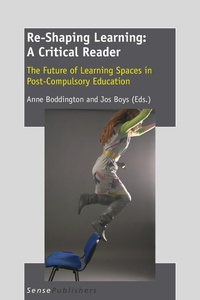
Re-Shaping Learning: A Critical Reader
The Future of Learning Spaces in Post-Compulsory Education
Published on 1. January 2011
Book
Paperback/Softback
261 pages
978-94-6091-607-6 (ISBN)
Description
Learning Spaces is an emerging field, fuelled by a growing interest in the relationships between learning and spaces in which it takes place, whether conceptual, personal, social, physical and/or virtual. It is concerned with making learning spaces that can better meet the needs of 21st century learners, academics and other related publics.
In post-compulsory education this has opened up many interesting and important issues. There remains a lack of any theoretical understanding as to how such spaces should be conceived or designed; and hardly any critical discussion about effective frameworks for either the development of contemporary learning spaces or for assessing their impact on learning, teaching and research. At the same time, there is much debate about what the purposes of post-compulsory education should be, as well as concerns about where and by whom it should be provided.
We therefore need to urgently improve our understanding of the interactions between learning and space. It is essential that we not only share perspectives, theories and methodologies but also critically reflect on our own different assumptions, and work together to build better models for post-compulsory education in the future. To help in this process this book is designed as a 'critical reader' that can enable researchers, academics, students and managers involved in Learning Spaces to share and engage with some key ideas, issues and texts. A central aim is to bring together some of the best research from across the many different disciplines concerned with learning spaces, including education, architecture, anthropology, human-computer interaction, estate planning and museum studies.
In post-compulsory education this has opened up many interesting and important issues. There remains a lack of any theoretical understanding as to how such spaces should be conceived or designed; and hardly any critical discussion about effective frameworks for either the development of contemporary learning spaces or for assessing their impact on learning, teaching and research. At the same time, there is much debate about what the purposes of post-compulsory education should be, as well as concerns about where and by whom it should be provided.
We therefore need to urgently improve our understanding of the interactions between learning and space. It is essential that we not only share perspectives, theories and methodologies but also critically reflect on our own different assumptions, and work together to build better models for post-compulsory education in the future. To help in this process this book is designed as a 'critical reader' that can enable researchers, academics, students and managers involved in Learning Spaces to share and engage with some key ideas, issues and texts. A central aim is to bring together some of the best research from across the many different disciplines concerned with learning spaces, including education, architecture, anthropology, human-computer interaction, estate planning and museum studies.
More details
Language
English
Place of publication
Rotterdam
Netherlands
Target group
Professional and scholarly
Product notice
Paperback (trade)
Unsewn / adhesive bound
Dimensions
Height: 233 mm
Width: 156 mm
Thickness: 17 mm
Weight
396 gr
ISBN-13
978-94-6091-607-6 (9789460916076)
Copyright in bibliographic data and cover images is held by Nielsen Book Services Limited or by the publishers or by their respective licensors: all rights reserved.
Schweitzer Classification
Other editions
Additional editions

Anne Boddington | Jos Boys
Re-Shaping Learning: A Critical Reader
The Future of Learning Spaces in Post-Compulsory Education
Book
01/2011
Sense Publishers
€114.50
Shipment within 15-20 days