

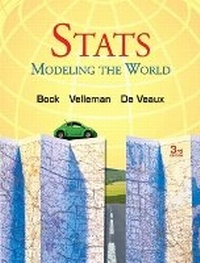
Stats
Modeling the World
3rd Edition
Published on 23. April 2009
Book
Mixed media product
792 pages
978-0-321-57044-4 (ISBN)
Description
By leading with practical data analysis and graphics, Stats: Modeling the World, Third Edition, engages students and gets them to do statistics and think statistically from the start. With the authors' signature Think, Show, Tell problem-solving method, students learn what we can find in data, why we find it interesting and how to report it to others. Instructors praise this text as clear and accessible, while students report that they actually enjoy reading the book while learning how to do statistics. Additional examples with updated data make this new edition even easier to read and use.
Datasets and other resources (where applicable) for this book are available here.
Datasets and other resources (where applicable) for this book are available here.
More details
Edition
3rd edition
Language
English
Place of publication
United States
Publishing group
Pearson Education (US)
Target group
College/higher education
Dimensions
Height: 279 mm
Width: 221 mm
Thickness: 33 mm
Weight
1850 gr
ISBN-13
978-0-321-57044-4 (9780321570444)
Copyright in bibliographic data and cover images is held by Nielsen Book Services Limited or by the publishers or by their respective licensors: all rights reserved.
Schweitzer Classification
Other editions
New editions
Book
02/2014
4th Edition
Pearson
€210.86
Shipment within 10-20 days
Previous edition
Book
04/2006
2nd Edition
Pearson
€59.71
Article exhausted; check for reprint
Persons
David Bock (Cornell University) has won awards as a high school teacher of AP calculus and statistics and was a grader for the AP Statistics program from its inception. He now is the chief extension officer for the Cornell University mathematics department in charge of outreach to K-12 teachers. Dave's wisdom about how students learn helps shape the book's pedagogy.
Paul Velleman (Cornell University) is the only statistician to win the EDUCAUSE award for innovating technology for learning. The developer of ActivStats (R) multimedia software, Data Desk statistics software, and the DASL online archive of teaching datasets, his understanding of using and teaching with technology informs much of the book's approach.
Richard D. De Veaux (Williams College) is an award-winning teacher and consultant to major corporations. Dick has taught business students at Wharton, engineering students at Princeton, and liberal arts students at Williams. His real-world experiences and anecdotes illustrate many of this book's chapters.
Paul Velleman (Cornell University) is the only statistician to win the EDUCAUSE award for innovating technology for learning. The developer of ActivStats (R) multimedia software, Data Desk statistics software, and the DASL online archive of teaching datasets, his understanding of using and teaching with technology informs much of the book's approach.
Richard D. De Veaux (Williams College) is an award-winning teacher and consultant to major corporations. Dick has taught business students at Wharton, engineering students at Princeton, and liberal arts students at Williams. His real-world experiences and anecdotes illustrate many of this book's chapters.
Content
I. EXPLORING AND UNDERSTANDING DATA
1. Stats Start Here
2. Data
3. Displaying and Describing Categorical Data
4. Displaying and Comparing Qualitative Data
5. Understanding and Comparing Distributions
6. The Standard Deviation as a Ruler and the Normal Model
II EXPLORING RELATIONSHIPS BETWEEN VARIABLES
7. Scatterplots, Association, and Correlation
8. Linear Regression
9. Regression Wisdom
10. Re-expressing Data: Get it Straight!
III. GATHERING DATA
11. Understanding Randomness
12. Sample Surveys
13. Experiments and Observational Studies
IV. RANDOMNESS AND PROBABILITY
14. From Randomness to Probability
15. Probability Rules!
16. Random Variables
17. Probability Models
V. FROM THE DATA AT HAND TO THE WORLD AT LARGE
18. Sampling Distribution Models
19. Confidence Intervals for Proportions
20. Testing Hypotheses About Proportions
21. More About Tests and Intervals
22. Comparing Two Proportions
VI. LEARNING ABOUT THE WORLD
23. Inferences about Means
24. Comparing Means
25. Paired Samples and Blocks
VII. INFERENCE WHEN VARIABLES ARE RELATED
26. Comparing Counts
27. Inferences for Regression
28. Analysis of Variance (on DVD)
29. Multiple Regression (on DVD)
1. Stats Start Here
2. Data
3. Displaying and Describing Categorical Data
4. Displaying and Comparing Qualitative Data
5. Understanding and Comparing Distributions
6. The Standard Deviation as a Ruler and the Normal Model
II EXPLORING RELATIONSHIPS BETWEEN VARIABLES
7. Scatterplots, Association, and Correlation
8. Linear Regression
9. Regression Wisdom
10. Re-expressing Data: Get it Straight!
III. GATHERING DATA
11. Understanding Randomness
12. Sample Surveys
13. Experiments and Observational Studies
IV. RANDOMNESS AND PROBABILITY
14. From Randomness to Probability
15. Probability Rules!
16. Random Variables
17. Probability Models
V. FROM THE DATA AT HAND TO THE WORLD AT LARGE
18. Sampling Distribution Models
19. Confidence Intervals for Proportions
20. Testing Hypotheses About Proportions
21. More About Tests and Intervals
22. Comparing Two Proportions
VI. LEARNING ABOUT THE WORLD
23. Inferences about Means
24. Comparing Means
25. Paired Samples and Blocks
VII. INFERENCE WHEN VARIABLES ARE RELATED
26. Comparing Counts
27. Inferences for Regression
28. Analysis of Variance (on DVD)
29. Multiple Regression (on DVD)