

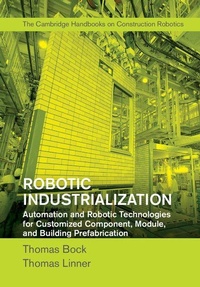
Robotic Industrialization
Automation and Robotic Technologies for Customized Component, Module, and Building Prefabrication
Published on 10. August 2015
Book
Hardback
260 pages
978-1-107-07639-6 (ISBN)
Description
In this volume, concepts, technologies and developments in the field of building-component manufacturing - based on concrete, brick, wood and steel as building materials and on large-scale prefabrication, delivering complex, customized components and products - are introduced and discussed. Robotic industrialization refers to the transformation of parts and low-level components into higher-level components, modules and finally building systems by highly mechanized, automated, or robot-supported industrial settings in structured off-site environments. Components and modules are open building systems (in modular building product structures) that are delivered by suppliers to original equipment manufacturers such as, for example, large-scale prefabrication companies or automated/robotic on-site factories. In particular, innovative large-scale prefabrication companies have altered the building structures, manufacturing processes, and organizational structures significantly to be able to assemble in their factories high-level components and modules from Tier-1 suppliers into customized buildings by heavily utilizing robotic technology in combination with automated logistics and production lines.
More details
Language
English
Place of publication
Cambridge
United Kingdom
Target group
Professional and scholarly
Illustrations
85 Tables, unspecified; 377 Halftones, unspecified; 105 Line drawings, unspecified
Dimensions
Height: 260 mm
Width: 183 mm
Thickness: 19 mm
Weight
698 gr
ISBN-13
978-1-107-07639-6 (9781107076396)
Copyright in bibliographic data and cover images is held by Nielsen Book Services Limited or by the publishers or by their respective licensors: all rights reserved.
Schweitzer Classification
Other editions
Additional editions
Thomas Bock
Robotic Industrialization
Automation and Robotic Technologies for Customized Component, Module, and Building Prefabrication
E-Book
08/2015
Cambridge University Press
€77.49
Available for download
Thomas Bock | Thomas Linner
Robotic Industrialization
Automation and Robotic Technologies for Customized Component, Module, and Building Prefabrication
E-Book
07/2015
Cambridge University Press
€91.99
Available for download
Persons
Thomas Bock is a professor of building realization and robotics at Technische Universitaet Muenchen (TUM). His research has focussed for thirty-five years on automation and robotics in building construction, from the planning, prefabrication, on-site production and utilization phases to the reorganization and deconstruction of a building. He is a member of several boards of directors of international associations and is a member of several international academies in Europe, the Americas and Asia. He consulted several international ministries and evaluates research projects for various international funding institutions. He holds honorary doctor and professorship degrees. Professor Bock serves on several editorial boards, heads various working commissions and groups of international research organizations, and has authored or coauthored more than four hundred articles. Thomas Linner is a postdoctoral researcher in building realization and robotics and a research associate at Technische Universitaet Muenchen (TUM). He completed his dissertation (Dr.-Ing.) in 2013 in the field of automation and mass customization in construction with a particular focus on automated/robotic on-site factories. Dr Linner is a specialist in the area of automated, robotic production of building 'products' as well as in the conception and performance enhancement of those products through the embedding of advanced technology (service robots, microsystems technology). Today, more and more, issues related to innovation management are becoming key topics in his research. Dr Linner is a frequently invited speaker at universities such as the University of Tokyo and Cambridge University.
Content
1. Introduction; 2. Automation and robotics in building-component manufacturing; 3. Building-module manufacturing; 4. Comparison of large-scale building manufacturing in different countries; 5. Large-scale building-system manufacturing in Japan.