

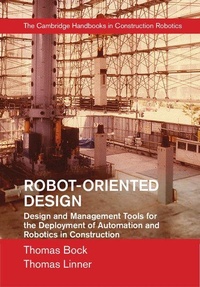
Robot-Oriented Design
Design and Management Tools for the Deployment of Automation and Robotics in Construction
Published on 5. May 2015
Book
Hardback
352 pages
978-1-107-07638-9 (ISBN)
Description
Robot-Oriented Design introduces the design, innovation, and management methodologies that are key to the realization and implementation of the advanced concepts and technologies presented in the subsequent volumes of The Cambridge Handbooks in Construction Robotics series. This book describes the efficient deployment of advanced construction and building technology. It is concerned with the co-adaptation of construction products, processes, organization, and management, and with automated/robotic technology, so that the implementation of modern technology becomes easier and more efficient. It is also concerned with technology and innovation management methodologies and the generation of life cycle-oriented views related to the use of advanced technologies in construction.
More details
Language
English
Place of publication
Cambridge
United Kingdom
Target group
Professional and scholarly
Illustrations
34 Tables, unspecified; 145 Plates, color; 94 Halftones, unspecified; 73 Line drawings, unspecified
Dimensions
Height: 260 mm
Width: 183 mm
Thickness: 21 mm
Weight
777 gr
ISBN-13
978-1-107-07638-9 (9781107076389)
Copyright in bibliographic data and cover images is held by Nielsen Book Services Limited or by the publishers or by their respective licensors: all rights reserved.
Schweitzer Classification
Other editions
Additional editions
Thomas Bock
Robot-Oriented Design
Design and Management Tools for the Deployment of Automation and Robotics in Construction
E-Book
05/2015
Cambridge University Press
€110.99
Available for download
Thomas Bock | Thomas Linner
Robot-Oriented Design
Design and Management Tools for the Deployment of Automation and Robotics in Construction
E-Book
04/2015
Cambridge University Press
€130.99
Available for download
Persons
Thomas Bock is a professor of building realization and robotics at Technische Universitaet Muenchen (TUM). His research has focussed for thirty-five years on automation and robotics in building construction, from the planning, prefabrication, on-site production and utilization phases to the reorganization and deconstruction of a building. He is a member of several boards of directors of international associations and is a member of several international academies in Europe, the Americas and Asia. He consulted several international ministries and evaluates research projects for various international funding institutions. He holds honorary doctor and professorship degrees. Professor Bock serves on several editorial boards, heads various working commissions and groups of international research organizations, and has authored or coauthored more than four hundred articles. Thomas Linner is a postdoctoral researcher in building realization and robotics and a research associate at Technische Universitaet Muenchen (TUM). He completed his dissertation (Dr.-Ing.) in 2013 in the field of automation and mass customization in construction with a particular focus on automated/robotic on-site factories. Dr Linner is a specialist in the area of automated, robotic production of building 'products' as well as in the conception and performance enhancement of those products through the embedding of advanced technology (service robots, microsystems technology). Today, more and more, issues related to innovation management are becoming key topics in his research. Dr Linner is a frequently invited speaker at universities such as the University of Tokyo and Cambridge University.
Content
1. Advanced construction and building technology; 2. The structure of this volume; 3. The role of complementarity of products, organization, information, and machine technology; 4. Introduction of relevant terms, concepts, and technologies; 5. Complex products in other industries and relevance of fixed-site/ONM technology; 6. Synchronization of organization, building structure, and manufacturing technology by robot-oriented design; 7. Utilizing innovation science to develop and deploy automated/robotic systems in construction; 8. Competitive advantage by coadapting and taking products and manufacturing systems further.