

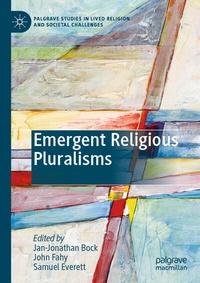
Emergent Religious Pluralisms
Description
In a rapidly changing world, in which religious identities emerge as crucial fault lines in political and public discourse, this volume brings together multiple disciplinary perspectives in order to investigate shifting conceptions of, and commitments to, the ideals of religious pluralism.
Spanning theology, sociology, politics and anthropology, the chapters explore various approaches to coexistence, political visions of managing diversity and lived experiences of multireligiosity, in order to examine how modes of religious pluralism are being constructed and contested in different parts of the world. Contributing authors analyse challenges to religious pluralism, as well as innovative kinds of conviviality, that produce meaningful engagements with diversity and shared community life across different social, political and economic settings.
This book will be relevant to scholars of religion, community life, social change and politics, and will also be of interest to civil society organisations, NGOs, international agencies and local, regional and national policymakers.
Reviews / Votes
"This is an exciting collection that engagingly explores one of the most challenging issues of our time, religious pluralism, and the intrinsic value of what cultures and traditions other than our own can teach us. By incisively probing local, national and global interpretations of religious diversity, and focusing on lived experiences, its contributors collectively underline the situated character of contemporary pluralisms. Indeed, their multi-sited, multi-scale and non-aligned geographical deliberations demonstrate, with nuance, that micro-negotiations can produce ideological shifts towards pluralistic modes of engagement, in liberal-leaning, consociational and non-liberal regimes alike. Emergent Religious Pluralisms, thus, encourages its readers to better understand the world from different vantage points, arguably a necessary first step if pluralism is to be successfully incorporated into the 21st-century political mainstream." (Humayun Ansari OBE, Professor of Islam and CulturalDiversity, Royal Holloway, University of London, UK)"Emergent Religious Pluralisms brings together an international cadre of scholars to dissect and propose refreshing solutions for some of the most intractable 'religious' problems that face us and future generations. Defining ourselves by what-we- are-not is a recurrent theme, as are wilful misunderstandings about the nature of core concepts like citizenship and multiculturalism. This collection offers clear analyses of contrasting arguments, and case studies of practical projects, online and offline, from Lebanon to Berlin and Rome. Such discourse will then strengthen faith communities' self-understanding and facilitate discussion with the powerful forces that shape the dominant ideologies of increasingly right-wing state apparatuses. I commend this book to all those who seek a clear, fresh, solution-focused approach to dilemmas that are often framed as if race or otherness, faith or social practice, are existential threats to be resolved by exclusion." (Alison Scott-Baumann, Professor of Society and Belief, SOAS University of London, UK)
"Emergent Religious Pluralisms is a distinctive contribution to the ever-growing literature in this broad field, bringing together a range of contributions that are fully rooted in specific social, political, religious and geographical contexts, but which by their specificity also make a shared contribution to the book's other unifying emphasis on the importance of lived religious pluralism." (Paul Weller, Emeritus Professor, University of Derby; Professor, Centre for Trust, Peace and Social Relations, Coventry University; and Research Fellow in Religion and Society, Regent's Park College, University of Oxford, UK)
More details
Other editions
Additional editions
Persons
Jan-Jonathan Bock is Programme Director of Cumberland Lodge, Windsor Great Park, UK.
John Fahy is Research Affiliate at the Woolf Institute, University of Cambridge, UK.
Samuel Everett is Research Associate at the Centre for Research in the Arts, Social Sciences and Humanities (CRASSH), University of Cambridge, UK.