

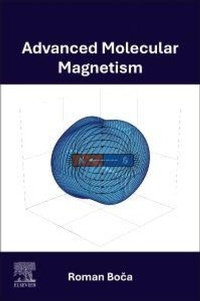
Advanced Molecular Magnetism
Published on 17. March 2026
Book
Paperback/Softback
656 pages
978-0-443-44984-0 (ISBN)
Description
Advanced Molecular Magnetism provides a rigorous overview of the magnetic properties of molecular and extended inorganic systems. Sections cover the fundamentals of magnetic data recording and analysis, establishing exchange interactions as a foundational concept, including discussions on exchange interactions involving both d- and f-block elements, the role of magnetic anisotropy, single-molecule magnets, and spin crossover phenomena. Content emphasizes the correlation of magnetic property analysis with complementary techniques such as UV-Vis and electron paramagnetic resonance (EPR) spectroscopy. In addition, the book provides a thorough overview of electronic energy levels in transition metal complexes is provided, covering electronic terms, multiplets, and Zeeman splitting.
The interface between quantum mechanics and macroscopic thermodynamic properties is explored through statistical thermodynamics, and the book reviews the major types of magnetic materials-diamagnetic, paramagnetic, ferromagnetic, and antiferromagnetic-with a focus on their underlying principles and real-world examples. Methods for deriving magnetochemical formulae for Curie paramagnets, zero-field splitting systems, T- and E-term systems, and pure multiplet systems are clearly presented, alongside practical guidance for magnetic data collection and analysis. Special attention is given to the magnetism of f-elements and the unique properties of single-molecule magnets, as well as to the correct description of many-electron states in both free atoms and those influenced by crystal fields.
The interface between quantum mechanics and macroscopic thermodynamic properties is explored through statistical thermodynamics, and the book reviews the major types of magnetic materials-diamagnetic, paramagnetic, ferromagnetic, and antiferromagnetic-with a focus on their underlying principles and real-world examples. Methods for deriving magnetochemical formulae for Curie paramagnets, zero-field splitting systems, T- and E-term systems, and pure multiplet systems are clearly presented, alongside practical guidance for magnetic data collection and analysis. Special attention is given to the magnetism of f-elements and the unique properties of single-molecule magnets, as well as to the correct description of many-electron states in both free atoms and those influenced by crystal fields.
More details
Language
English
Place of publication
Philadelphia
United States
Target group
Professional and scholarly
Product notice
Paperback (trade)
Unsewn / adhesive bound
Dimensions
Height: 228 mm
Width: 152 mm
Thickness: 32 mm
Weight
1043 gr
ISBN-13
978-0-443-44984-0 (9780443449840)
Copyright in bibliographic data and cover images is held by Nielsen Book Services Limited or by the publishers or by their respective licensors: all rights reserved.
Schweitzer Classification
Other editions
Additional editions
Person
Roman Boca is a Professor of Inorganic Chemistry, affiliated previously at the Slovak University of Technology in Bratislava, and presently at University of SS Cyril and Methodius in Trnava, Slovakia. He has published about 400 scientific papers dealing with methodological development and applications of quantum chemical methods to coordination compounds, and in recent years to theoretical and experimental magnetochemistry of single-molecule and single-ion magnets.
Content
Electromagnetic phenomena
Angular momentum
Statistical thermodynamics in magnetism
Energy levels in many-electron atoms
Energy levels in the crystal field
Zeeman effect
Types of magnetism
Magnetic data taking and analysis
Magnetism of mononuclear complexes
Exchange interaction
Molecular magnetism
Quantum-chemical calculations
Worked examples
Magnetostructural correlations
Angular momentum
Statistical thermodynamics in magnetism
Energy levels in many-electron atoms
Energy levels in the crystal field
Zeeman effect
Types of magnetism
Magnetic data taking and analysis
Magnetism of mononuclear complexes
Exchange interaction
Molecular magnetism
Quantum-chemical calculations
Worked examples
Magnetostructural correlations