

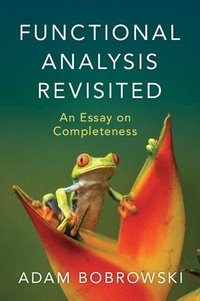
Functional Analysis Revisited
An Essay on Completeness
Published on 4. July 2024
Book
Paperback/Softback
250 pages
978-1-009-43089-0 (ISBN)
Description
'Functional Analysis Revisited' is not a first course in functional analysis - although it covers the basic notions of functional analysis, it assumes the reader is somewhat acquainted with them. It is by no means a second course either: there are too many deep subjects that are not within scope here. Instead, having the basics under his belt, the author takes the time to carefully think through their fundamental consequences. In particular, the focus is on the notion of completeness and its implications, yet without venturing too far from areas where the description 'elementary' is still valid. The author also looks at some applications, perhaps just outside the core of functional analysis, that are not completely trivial. The aim is to show how functional analysis influences and is influenced by other branches of contemporary mathematics. This is what we mean by 'Functional Analysis Revisited.'
Reviews / Votes
'This is a remarkable book whose concept is not to present a comprehensive overview of a field but, keeping the geographical metaphor, it follows one of the main rivers there, exploring its tributaries and distributaries and going even beyond the boundaries of the original territory. In this case, the author follows the river of completeness of normed spaces and presents its sources in more fundamental areas of mathematics and its impact on an array of theoretical and applied fields. The book is written in an effortless, casual, yet rigorous style and is a pleasure to read.' Jacek Banasiak, University of Pretoria 'This non-standard book can serve as a supplement to an introductory functional analysis course. Centred around the fundamental notion of completeness, it introduces a variety of basic notions and tools, and covers a solid range of material presented in a lively and vivid way. The emphasis has been placed on applications of abstract concepts, including the rudiments of operator semigroups, partial differential equations, and probability theory. The exposition is friendly and fresh, and many insightful comments facilitate digesting the material. Each chapter is accompanied by helpful summaries and carefully selected exercises. The book would be useful for beginners aiming to improve their understanding of the subject, for lecturers willing to refresh their routine courses, and it would be of value to anyone who likes elegant expositions of important mathematical theories.' Yuri Tomilov, Institute of Mathematics, Polish Academy of SciencesMore details
Language
English
Place of publication
Cambridge
United Kingdom
Product notice
Paperback (trade)
Illustrations
Worked examples or Exercises
Dimensions
Height: 229 mm
Width: 152 mm
Thickness: 14 mm
Weight
349 gr
ISBN-13
978-1-009-43089-0 (9781009430890)
Copyright in bibliographic data and cover images is held by Nielsen Book Services Limited or by the publishers or by their respective licensors: all rights reserved.
Schweitzer Classification
Other editions
Additional editions
Book
07/2024
Cambridge University Press
€120.50
Shipment within 15-20 days
Person
Adam Bobrowski is a professor in the Department of Mathematics at Lublin University of Technology, Poland. He was awarded the Hugo Steinhaus Prize for his achievements in analyzing mathematical models of biological reality and has authored more than 70 scientific papers and six books. His works include 'Functional Analysis for Probability and Stochastic Processes' (2005), 'Convergence of One-Parameter Operator Semigroups' (2016), and 'Generators of Markov Chains' (2020).
Content
Introduction; 1. Complete metric spaces; 2. Banach's principle; 3. Picard's theorem; 4. Banach spaces; 5. Renewal equation in the McKendrick-von Foerster model; 6. Riemann integral for vector-valued functions; 7. The Stone-Weierstrass theorem; 8. Norms do differ; 9. Hilbert spaces; 10. Complete orthonormal sequences; 11. Heat equation; 12. Completeness of the space of operators; 13. Working in L(X); 14. The Banach-Steinhaus theorem and strong convergence; 15. We go deeper, deeper we go (into the structure of complete spaces); 16. Semigroups of operators; Appendix. Two consequences of the Hahn-Banach theorem; References; Index.