

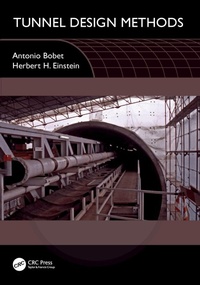
Tunnel Design Methods
1st Edition
Published on 21. May 2026
Book
Paperback/Softback
612 pages
978-1-032-35845-1 (ISBN)
Description
Tunnel Design Methods covers analytical, numerical, and empirical methods for the design of tunnels in soil and in rock. The material is intended for design engineers looking for detailed methods, for graduate students who are interested in tunnelling, and for researchers working on various aspects of ground-support interaction under static and seismic loading.
The book is divided into seven chapters, covering fundamental concepts on ground and support behavior and on ground-excavation-support interaction and provides detailed information on analytical and numerical methods used for the design of tunnels, with applications, and on the latest developments on empirical methods. The principles and formulations included are used, throughout the book, to provide insight into the response of tunnels under both simple and complex loading conditions, thus providing the reader with fundamental understanding of tunnel behavior.
Both authors have experience in tunnelling and have worked extensively in practice, designing tunnels both in the United States and abroad, and in research.
The book is divided into seven chapters, covering fundamental concepts on ground and support behavior and on ground-excavation-support interaction and provides detailed information on analytical and numerical methods used for the design of tunnels, with applications, and on the latest developments on empirical methods. The principles and formulations included are used, throughout the book, to provide insight into the response of tunnels under both simple and complex loading conditions, thus providing the reader with fundamental understanding of tunnel behavior.
Both authors have experience in tunnelling and have worked extensively in practice, designing tunnels both in the United States and abroad, and in research.
More details
Language
English
Place of publication
London
United Kingdom
Publishing group
Taylor & Francis Ltd
Target group
College/higher education
Professional and scholarly
Postgraduate and Professional
Product notice
Paperback (trade)
Illustrations
48 s/w Tabellen, 16 farbige Zeichnungen, 363 s/w Zeichnungen, 13 Farbfotos bzw. farbige Rasterbilder, 29 farbige Abbildungen, 363 s/w Abbildungen
48 Tables, black and white; 16 Line drawings, color; 363 Line drawings, black and white; 13 Halftones, color; 29 Illustrations, color; 363 Illustrations, black and white
Dimensions
Height: 254 mm
Width: 178 mm
Thickness: 32 mm
Weight
1075 gr
ISBN-13
978-1-032-35845-1 (9781032358451)
Copyright in bibliographic data and cover images is held by Nielsen Book Services Limited or by the publishers or by their respective licensors: all rights reserved.
Schweitzer Classification
Other editions
Additional editions
Antonio Bobet | Herbert H. Einstein
Tunnel Design Methods
E-Book
09/2023
1st Edition
CRC Press
€178.99
Available for download
Antonio Bobet | Herbert H. Einstein
Tunnel Design Methods
E-Book
09/2023
1st Edition
CRC Press
€178.99
Available for download
Antonio Bobet | Herbert H. Einstein
Tunnel Design Methods
Book
09/2023
1st Edition
CRC Press
€231.70
Shipment within 10-20 days
Persons
Antonio Bobet is a professor at Purdue University, USA who has previously worked in industry and is a specialist in the seismic design of tunnels and ground-tunnel interaction.
Herbert H. Einstein is a professor at MIT, USA. He has developed the widely used Schwartz-Einstein method and the Decision Aids for Tunnelling, a computer based interactive tool, and works on the use of AI and Machine Learning in tunnelling.
Herbert H. Einstein is a professor at MIT, USA. He has developed the widely used Schwartz-Einstein method and the Decision Aids for Tunnelling, a computer based interactive tool, and works on the use of AI and Machine Learning in tunnelling.
Content
1. Principles of Ground-Structure Interaction. 2. Empirical Methods and Classifications for Rock Tunnels. 3. Direct and Indirect Methods for Soil Tunnels: with Effects on the Surface. 4. Analytical Methods. 5. Numerical Methods. 6. Special Cases. 7. Analysis of Structural Components.