

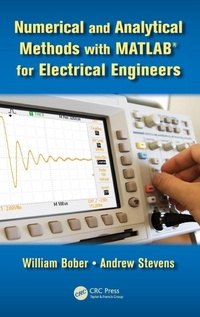
Numerical and Analytical Methods with MATLAB for Electrical Engineers
1st Edition
Published on 27. August 2012
Book
Hardback
388 pages
978-1-4398-5429-7 (ISBN)
Description
Combining academic and practical approaches to this important topic, Numerical and Analytical Methods with MATLAB (R) for Electrical Engineers is the ideal resource for electrical and computer engineering students. Based on a previous edition that was geared toward mechanical engineering students, this book expands many of the concepts presented in that book and replaces the original projects with new ones intended specifically for electrical engineering students.
This book includes:
An introduction to the MATLAB programming environment
Mathematical techniques for matrix algebra, root finding, integration, and differential equations
More advanced topics, including transform methods, signal processing, curve fitting, and optimization
An introduction to the MATLAB graphical design environment, Simulink
Exploring the numerical methods that electrical engineers use for design analysis and testing, this book comprises standalone chapters outlining a course that also introduces students to computational methods and programming skills, using MATLAB as the programming environment. Helping engineering students to develop a feel for structural programming-not just button-pushing with a software program-the illustrative examples and extensive assignments in this resource enable them to develop the necessary skills and then apply them to practical electrical engineering problems and cases.
This book includes:
An introduction to the MATLAB programming environment
Mathematical techniques for matrix algebra, root finding, integration, and differential equations
More advanced topics, including transform methods, signal processing, curve fitting, and optimization
An introduction to the MATLAB graphical design environment, Simulink
Exploring the numerical methods that electrical engineers use for design analysis and testing, this book comprises standalone chapters outlining a course that also introduces students to computational methods and programming skills, using MATLAB as the programming environment. Helping engineering students to develop a feel for structural programming-not just button-pushing with a software program-the illustrative examples and extensive assignments in this resource enable them to develop the necessary skills and then apply them to practical electrical engineering problems and cases.
Reviews / Votes
"... I like the organization of the book and especially the early focus on matrix fundamentals ... use of examples is excellent. ...The end-of chapter problems are good ... presents some excellent frameworks for computational methods- students should be able to build their programs more effectively by understanding the core components and following the directions..."-Michael R. Gustafson II, Duke University, Durham, North Carolina, USA
"... covers MATLAB (R) first while providing gradual introduction first and progressing to advanced concepts. Numerical methods, algorithms, and implementations are well explained."
- Gleb V. Tcheslavski, Lamar University, Beaumont, Texas, USA
More details
Series
Language
English
Place of publication
Bosa Roca
United States
Publishing group
Taylor & Francis Inc
Target group
College/higher education
Undergraduate Electrical Engineering students in a course that includes Numerical Methods, Engineering Analysis, Numerical & Analytical Methods, Numerical Methods with MATLAB®. Professional engineers needing to know about the application of MATLAB® to basic EE problem-solving.
Illustrations
168 s/w Abbildungen, 21 s/w Tabellen
21 Tables, black and white; 168 Illustrations, black and white
Dimensions
Height: 240 mm
Width: 161 mm
Thickness: 25 mm
Weight
749 gr
ISBN-13
978-1-4398-5429-7 (9781439854297)
Copyright in bibliographic data and cover images is held by Nielsen Book Services Limited or by the publishers or by their respective licensors: all rights reserved.
Schweitzer Classification
Other editions
Additional editions
William Bober | Andrew Stevens
Numerical and Analytical Methods with MATLAB for Electrical Engineers
E-Book
04/2016
1st Edition
CRC Press
€205.99
Available for download
Persons
Dr. William Bober received his B.S. degree in civil engineering from the City College of New York (CCNY), his M.S. degree in engineering science from Pratt Institute, and his Ph.D. degree in engineering science and aerospace engineering from Purdue University. At Purdue University, he was on a Ford Foundation Fellowship; he was assigned to teach one engineering course each semester. After receiving his Ph.D., he went to work as an associate engineering physicist in the Applied Mechanics Department at Cornell Aeronautical Laboratory in Buffalo, New York. After leaving Cornell Labs, he was employed as an associate professor in the Department of Mechanical Engineering at the Rochester Institute of Technology (RIT) for the following twelve years. After leaving RIT, he obtained employment at Florida Atlantic University (FAU) in the Department of Mechanical Engineering. More recently, he transferred to the Department of Civil Engineering at FAU.
Dr. Andrew Stevens, P.E., received his bachelor's degree from Massachusetts Institute of Technology, his master's degree from the University of Pennsylvania, and his doctorate from Columbia University, all in electrical engineering. He did his Ph.D. thesis work at IBM Research in the area of integrated circuit design for high-speed optical networks. While at Columbia, he lectured a course in the core undergraduate curriculum and won the IEEE Solid-State Circuits Fellowship. He has held R&D positions at AT&T Bell Laboratories in the development of T-carrier multiplexer systems and at Argonne National Laboratory in the design of radiation-hardened integrated circuits for colliding beam detectors. Since 2001, he has been president of Electrical Science, an engineering consulting firm specializing in electrical hardware and software.
Dr. Andrew Stevens, P.E., received his bachelor's degree from Massachusetts Institute of Technology, his master's degree from the University of Pennsylvania, and his doctorate from Columbia University, all in electrical engineering. He did his Ph.D. thesis work at IBM Research in the area of integrated circuit design for high-speed optical networks. While at Columbia, he lectured a course in the core undergraduate curriculum and won the IEEE Solid-State Circuits Fellowship. He has held R&D positions at AT&T Bell Laboratories in the development of T-carrier multiplexer systems and at Argonne National Laboratory in the design of radiation-hardened integrated circuits for colliding beam detectors. Since 2001, he has been president of Electrical Science, an engineering consulting firm specializing in electrical hardware and software.
Content
Numerical Methods for Electrical Engineers. MATLAB (R) Fundamentals. Matrices. Roots of Algebraic and Transcendental Equations. Numerical Integration. Numerical Integration of Ordinary Differential Equations. Laplace Transforms. Fourier Transforms and Signal Processing. Curve Fitting. Optimization. Simulink. Appendices. MATLAB (R) Function Index.