

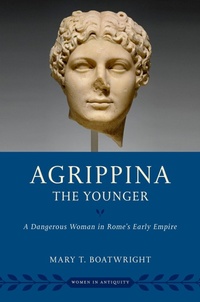
Agrippina the Younger
A Dangerous Woman in Rome's Early Empire
Will be published approx. on 6. November 2026
Book
Paperback/Softback
248 pages
978-0-19-785715-1 (ISBN)
Description
Firmly based on ancient literature and material evidence, this illustrated biography assesses the life of Agrippina the Younger (15-59 CE). Agrippina was declared "unique" by Tacitus, ancient Rome's most insightful political historian, both for her own political standing and as the daughter of a triumphing general and the sister, wife, and mother of emperors--respectively, Caligula (r. 37-41), Claudius (r. 41-54), and Nero (r. 54-68). Tacitus and other ancient historians depict her with horrified fascination as they vividly chart her growing presence through tumultuous vicissitudes, ending with her murder by her son Nero in 59.
Documentary evidence corroborates Agrippina as extraordinary. Among other "firsts," she is the first woman to be portrayed and identified on coins while alive; the first woman whose name is given to a veteran colony; and she appeared in more numerous statuary installations than known for earlier women. Agrippina's life sheds light on Rome's evolution into a monarchy dominated by her family; it also illuminates the endurance of Rome's ancestral patriarchy, showing the tight limits of power even for imperial women. Assessment of her reception up to the twentieth century highlights the importance of Tacitus for our understanding of this remarkable political creature. Neither damning nor glorifying Agrippina, this biography sensitively relies on ancient evidence to tell her story.
Documentary evidence corroborates Agrippina as extraordinary. Among other "firsts," she is the first woman to be portrayed and identified on coins while alive; the first woman whose name is given to a veteran colony; and she appeared in more numerous statuary installations than known for earlier women. Agrippina's life sheds light on Rome's evolution into a monarchy dominated by her family; it also illuminates the endurance of Rome's ancestral patriarchy, showing the tight limits of power even for imperial women. Assessment of her reception up to the twentieth century highlights the importance of Tacitus for our understanding of this remarkable political creature. Neither damning nor glorifying Agrippina, this biography sensitively relies on ancient evidence to tell her story.
More details
Series
Language
English
Place of publication
New York
United States
Product notice
Paperback (trade)
Unsewn / adhesive bound
Illustrations
26 Illustrations
Dimensions
Height: 235 mm
Width: 156 mm
ISBN-13
978-0-19-785715-1 (9780197857151)
Copyright in bibliographic data and cover images is held by Nielsen Book Services Limited or by the publishers or by their respective licensors: all rights reserved.
Schweitzer Classification
Other editions
Additional editions
Book
approx. 08/2026
Oxford University Press Inc
€84.50
Not yet published
Person
Mary T. Boatwright is Professor Emerita of Classical Studies at Duke University. Her previous books include Peoples of the Roman World, Hadrian and the Cities of the Roman Empire, Imperial Women of Rome, and (with Daniel J. Gargola, Noel Lenski, and Richard J. A. Talbert) A Brief History of the Romans.
Content
- Introduction: Agrippina's Contexts and Impacts
- 1: Agrippina's Youth (15-37 )
- 2: Life under Caligula (37-41)
- 3: Betwixt and Between (41-48)
- 4: At Last, at the Center (49-54 )
- 5: Best of Mothers-or Nero's Nemesis (54-59)
- 6: Agrippina's Afterlife and Legacy: Conclusions