

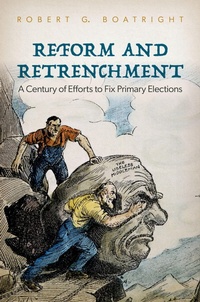
Reform and Retrenchment
A Century of Efforts to Fix Primary Elections
Published on 29. August 2024
Book
Hardback
344 pages
978-0-19-777408-3 (ISBN)
Description
The direct primary, in which voters rather than party leaders or convention delegates select party nominees for state and federal offices, was one of the most widely adopted political reforms of the early twentieth century. Yet after decades of practice and study, scholars have found little clear evidence that direct primaries changed the outcomes of party nominations. The conventional wisdom has always been that once the Progressive movement declined and voters became distracted by more pressing issues, parties slowly reasserted their control over candidate selection. This book shows that the conventional wisdom is wrong.
Exploring changes in American primary election laws from the 1920s to the 1970s, Robert G. Boatright argues in Reform and Retrenchment that the introduction of the direct primary created far more chaos in American elections than most scholars realize. As he shows, political parties, factions, and reform groups manipulated primary election laws in order to gain an advantage over their opponents, often under the guise of enhancing democracy. Today there is widespread dissatisfaction with primaries, and we are again in a period of experimentation. Boatright looks at how this history can help us understand the reform ideas before us today, ultimately suggesting that, for all of its flaws, there is likely little that can be done to improve primaries, and those who would seek to change American politics are best off exploring reforms to other areas of elections and governance.
Exploring changes in American primary election laws from the 1920s to the 1970s, Robert G. Boatright argues in Reform and Retrenchment that the introduction of the direct primary created far more chaos in American elections than most scholars realize. As he shows, political parties, factions, and reform groups manipulated primary election laws in order to gain an advantage over their opponents, often under the guise of enhancing democracy. Today there is widespread dissatisfaction with primaries, and we are again in a period of experimentation. Boatright looks at how this history can help us understand the reform ideas before us today, ultimately suggesting that, for all of its flaws, there is likely little that can be done to improve primaries, and those who would seek to change American politics are best off exploring reforms to other areas of elections and governance.
Reviews / Votes
Despite the fact that much of our political leadership today is selected through primaries rather than general elections, we have far too little knowledge about them. Thankfully we now have Rob's Boatright's superb book, which gives a highly readable history and analysis of this uniquely American institution. Not only does this work illustrate the challenges of making democracy better through primary reforms, but he uses the past to help us think clearly about contemporary efforts at reform of all kinds. * Raymond J. La Raja, Professor of Political Science, University of Massachusetts * Reform and Retrenchment is the most comprehensive and ambitious study of primary election reforms in the 20th century. The book uncovers new insights into the winding paths of primary reforms and provides an essential historical grounding for the growing conversation around primaries. * Danielle Thomsen, Associate Professor of Political Science, University of California, Irvine * Whether primary elections contribute to polarization and extremism, and if so, what changes would mitigate that, has become one of the most significant political reform issues of our era. In this masterful synthesis of political and intellectual history with empirical analysis, Robert Boatright provides crucial perspective on today's debates by chronicling the causes and consequences of prior primary reform efforts throughout the 20th century. * Richard H. Pildes, Sudler Family Professor of Constitutional Law, NYU School of Law * In a detailed and systematic analysis that takes into account differences across geography and history, Boatright tests common assumptions about primary reforms. This is a well-written and fascinating book. * Julia Azari, Professor of Political Science, Marquette University * The study is well worth pondering. * Choice *More details
Language
English
Place of publication
New York
United States
Target group
Professional and scholarly
Product notice
sewn/stitched
Cloth over boards
Illustrations
33 b/w figures; 29 tables
Dimensions
Height: 226 mm
Width: 150 mm
Thickness: 28 mm
Weight
567 gr
ISBN-13
978-0-19-777408-3 (9780197774083)
Copyright in bibliographic data and cover images is held by Nielsen Book Services Limited or by the publishers or by their respective licensors: all rights reserved.
Schweitzer Classification
Other editions
Additional editions
E-Book
04/2024
OUP eBook
€64.99
Available for download
E-Book
04/2024
OUP eBook
€64.99
Available for download
Person
Robert G. Boatright is Professor of Political Science at Clark University and the Director of Research for the National Institute for Civil Discourse at the University of Arizona. His research focuses on the effects of campaign and election laws on the behavior of politicians and interest groups, with a particular emphasis on primary elections and campaign finance laws. He is the author or editor of nine books, including The Deregulatory Moment? A Comparative Perspective on Changing Campaign Finance Laws (2016); Getting Primaried: The Causes and Consequences of Congressional Primary Challenges (2013); and Interest Groups and Campaign Finance Reform in the United States and Canada (2011). He has served on many different task forces studying political reform, campaign finance, and primary elections, including the Bipartisan Policy Center's Task Force on Campaign Finance, and the Campaign Finance Institute's advisory board.
Content
List of Tables and Figures
Acknowledgments
1. Introduction
Part I: The Middle Years: Primary Election Reforms, 1928-1970
2. Reform or Retrenchment? An Overview of Changes in Primary Election Laws, 1928-1970
3. The Direct Primary and the Decline of the Progressive Movement
4. Hostile Takeover: Nonparty Group Capture of Primaries
5. Defective Primary Laws
6. Primaries and Partisan Advantage
7. Are Southern Primaries Different?
Part II: What the History of Primary Elections can Tell us About Contemporary Reform Ideas
8. Contemporary Primary Reform Efforts
9. Why Primary Reforms Rarely Work
10. The Future of the Direct Primary
Notes
Bibliography
Index
Acknowledgments
1. Introduction
Part I: The Middle Years: Primary Election Reforms, 1928-1970
2. Reform or Retrenchment? An Overview of Changes in Primary Election Laws, 1928-1970
3. The Direct Primary and the Decline of the Progressive Movement
4. Hostile Takeover: Nonparty Group Capture of Primaries
5. Defective Primary Laws
6. Primaries and Partisan Advantage
7. Are Southern Primaries Different?
Part II: What the History of Primary Elections can Tell us About Contemporary Reform Ideas
8. Contemporary Primary Reform Efforts
9. Why Primary Reforms Rarely Work
10. The Future of the Direct Primary
Notes
Bibliography
Index