

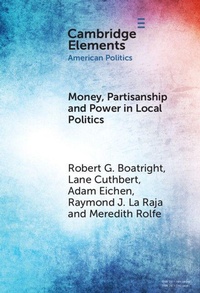
Money, Partisanship and Power in Local Politics
Will be published approx. on 4. December 2025
Book
Hardback
108 pages
978-1-009-61371-2 (ISBN)
Description
This Element presents an analysis of campaign finance in city council elections in four midsize Massachusetts cities. It shows that while money does not determine local election outcomes it plays a gatekeeping role - especially for nonincumbents. Moreover, this money comes from a very unrepresentative segment of the electorate. Although elections in these cities are nonpartisan, individual donors and interest groups are sorted into networks that function like political parties. The Element also shows that donors tend to be substantially more liberal than city residents. This can lead cities to adopt policies that are at odds with the views and needs of cities' less-wealthy inhabitants, including racial minorities. Despite low financial stakes relative to national races, campaign finance in midsize city elections reflects and reinforces broader patterns of political inequality. The result is a campaign finance system that disadvantages city residents who lack the cues that exist in other elections.
More details
Series
Language
English
Place of publication
Cambridge
United Kingdom
Illustrations
Worked examples or Exercises
Dimensions
Height: 235 mm
Width: 157 mm
Thickness: 11 mm
Weight
319 gr
ISBN-13
978-1-009-61371-2 (9781009613712)
Copyright in bibliographic data and cover images is held by Nielsen Book Services Limited or by the publishers or by their respective licensors: all rights reserved.
Schweitzer Classification
Other editions
Additional editions
Robert G. Boatright | Lane Cuthbert | Adam Eichen
Money, Partisanship and Power in Local Politics
Book
approx. 12/2025
Cambridge University Press
€27.20
Not yet published
Persons
Content
Introduction; 1. Money and elections in mid-sized cities; 2. Four mid-sized cities; 3. The candidates; 4. Donors; 5. Parties; 6. Interest groups; 7. Conclusions and implications; Acknowledgments; Bibliography.