

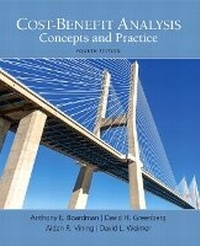
Cost-Benefit Analysis
4th Edition
Published on 9. September 2010
Book
Hardback
560 pages
978-0-13-700269-6 (ISBN)
Description
A practical introduction to cost-benefit analysis through problem solving.
This authoritative, market-leading text is known for its consistent application of a nine-step framework for conducting or interpreting a cost-benefit analysis.
This edition includes a number of chapters that have been revised and reorganized to make the material clearer and more accessible.
This authoritative, market-leading text is known for its consistent application of a nine-step framework for conducting or interpreting a cost-benefit analysis.
This edition includes a number of chapters that have been revised and reorganized to make the material clearer and more accessible.
More details
Edition
4th edition
Language
English
Place of publication
United States
Publishing group
Pearson Education (US)
Target group
College/higher education
Dimensions
Height: 232 mm
Width: 187 mm
Weight
900 gr
ISBN-13
978-0-13-700269-6 (9780137002696)
Copyright in bibliographic data and cover images is held by Nielsen Book Services Limited or by the publishers or by their respective licensors: all rights reserved.
Schweitzer Classification
Other editions
Previous edition
Anthony Boardman | David Greenberg | Aidan Vining
Cost Benefit Analysis
Concepts and Practice: United States Edition
Book
01/2006
3rd Edition
Pearson
€117.60
Article exhausted; check for reprint
Content
Part I: Overview
Chapter 1. Introduction to Cost-Benefit Analysis
Chapter 2. Conceptual Foundations of Cost-Benefit Analysis
Part II: Fundamentals of CBA
Chapter 3. Economics Foundations of Cost-Benefit Analysis
Chapter 4. Valuing Benefits and Costs in Primary Markets
Chapter 5. Valuing Benefits and Costs in Secondary Markets
Chapter 6. Discounting Benefits and Costs in Future Time Periods
Chapter 7. Dealing with Uncertainty: Expected Values, Sensitivity Analysis, and the Value of Information
Chapter 8. Option Price and Option Value
Chapter 9. Existence Value
Chapter 10. The Social Discount Rate
Part III: Valuation of Impacts
Chapter 11. Predicting and Monetizing Impacts
Chapter 12. Valuing Impacts From Observed Behavior: Experiments and Quasi-Experiments
Chapter 13. Valuing Impacts from Observed Behavior: Direct Estimation of Demand Curves
Chapter 14. Valuing Impacts from Observed Behavior: Indirect Market Methods
Chapter 15. Contingent Valuation: Using Surveys to Elicit Information About Costs and Benefits
Chapter 16. Shadow Prices from Secondary Sources
Chapter 17. Shadow Prices: Applications to Developing Countries
Part IV: Related Methods
Chapter 18. Cost-Effectiveness Analysis
Chapter 19. Distributionally Weighted Cost-Benefit Analysis
Chapter 20. How Accurate is CBA?
Chapter 1. Introduction to Cost-Benefit Analysis
Chapter 2. Conceptual Foundations of Cost-Benefit Analysis
Part II: Fundamentals of CBA
Chapter 3. Economics Foundations of Cost-Benefit Analysis
Chapter 4. Valuing Benefits and Costs in Primary Markets
Chapter 5. Valuing Benefits and Costs in Secondary Markets
Chapter 6. Discounting Benefits and Costs in Future Time Periods
Chapter 7. Dealing with Uncertainty: Expected Values, Sensitivity Analysis, and the Value of Information
Chapter 8. Option Price and Option Value
Chapter 9. Existence Value
Chapter 10. The Social Discount Rate
Part III: Valuation of Impacts
Chapter 11. Predicting and Monetizing Impacts
Chapter 12. Valuing Impacts From Observed Behavior: Experiments and Quasi-Experiments
Chapter 13. Valuing Impacts from Observed Behavior: Direct Estimation of Demand Curves
Chapter 14. Valuing Impacts from Observed Behavior: Indirect Market Methods
Chapter 15. Contingent Valuation: Using Surveys to Elicit Information About Costs and Benefits
Chapter 16. Shadow Prices from Secondary Sources
Chapter 17. Shadow Prices: Applications to Developing Countries
Part IV: Related Methods
Chapter 18. Cost-Effectiveness Analysis
Chapter 19. Distributionally Weighted Cost-Benefit Analysis
Chapter 20. How Accurate is CBA?