

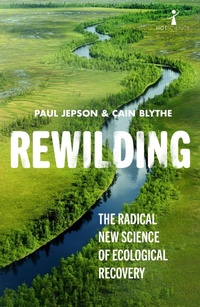
Rewilding
The Radical New Science of Ecological Recovery
Published on 23. July 2020
Book
Paperback/Softback
176 pages
978-1-78578-627-3 (ISBN)
Description
'A hugely useful and fascinating resume of rewilding - what it means, where it came from, why it's important and where it's going. Jepson and Blythe have done a masterly job, explaining the science behind rewilding in an accessible, honest and compelling way. It deserves to be widely read and become a book of great influence.' Isabella Tree, author of Wilding
'Compelling ... [a] succinct and objective account' Financial Times
Rewilding is the first popular book on the ground-breaking science behind the restoration of wild nature.
As ecologists Paul Jepson and Cain Blythe show, rewilding is a new and progressive approach to conservation, blending radical scientific insights with practical innovations to revive ecological processes, benefiting people as well as nature. Its goal is to restore lost interactions between animals, plants and natural disturbance that are the essence of thriving ecosystems.
With its sense of hope and purpose, rewilding is breathing new life into the conservation movement, and enabling a growing number of people - even urban-dwellers - to enjoy thrilling wildlife experiences previously accessible only in remote wilderness reserves. 'De-domesticated' horses galloping across a Dutch 'Serengeti'; beavers creating wetlands in the British countryside; giant tortoises restoring the wildlife of the Mauritian islands; perhaps one day even rhinos roaming the Australian outback - rewilding is full of exciting and inspirational possibilities.
'Compelling ... [a] succinct and objective account' Financial Times
Rewilding is the first popular book on the ground-breaking science behind the restoration of wild nature.
As ecologists Paul Jepson and Cain Blythe show, rewilding is a new and progressive approach to conservation, blending radical scientific insights with practical innovations to revive ecological processes, benefiting people as well as nature. Its goal is to restore lost interactions between animals, plants and natural disturbance that are the essence of thriving ecosystems.
With its sense of hope and purpose, rewilding is breathing new life into the conservation movement, and enabling a growing number of people - even urban-dwellers - to enjoy thrilling wildlife experiences previously accessible only in remote wilderness reserves. 'De-domesticated' horses galloping across a Dutch 'Serengeti'; beavers creating wetlands in the British countryside; giant tortoises restoring the wildlife of the Mauritian islands; perhaps one day even rhinos roaming the Australian outback - rewilding is full of exciting and inspirational possibilities.
Reviews / Votes
Straightforward and useful ... In offering hope rather than pessimism for humanity's care of the environment, Jepson and Blythe's well-explained primer will strike a chord with conservation-minded readers -- Publishers Weekly Compelling ... [a] succinct and objective account * Financial Times * A hugely useful and fascinating resume of rewilding - what it means, where it came from, why it's important and where it's going. Jepson and Blythe have done a masterly job, explaining the science behind rewilding in an accessible, honest and compelling way. It deserves to be widely read and become a book of great influence. * Isabella Tree, author of Wilding * Rewilding ... makes a compelling case for the need to re-evaluate how we treat the planet and its natural resources. -- Stephen MossMore details
Series
Language
English
Place of publication
Duxford
United Kingdom
Product notice
Paperback (UK-B)
Dimensions
Height: 195 mm
Width: 123 mm
Thickness: 18 mm
Weight
210 gr
ISBN-13
978-1-78578-627-3 (9781785786273)
Copyright in bibliographic data and cover images is held by Nielsen Book Services Limited or by the publishers or by their respective licensors: all rights reserved.
Schweitzer Classification
Other editions
Additional editions
E-Book
06/2020
Icon Books
€6.98
Available for download
Persons
Paul Jepson was until recently a director of Oxford University's MSc course in Biodiversity, Conservation and Management, and is a regular contributor to TV and radio.
Cain Blythe specialises in habitat restoration, nature recovery and the use of technology in conservation.
Cain Blythe specialises in habitat restoration, nature recovery and the use of technology in conservation.